
If you’re comparing on-your-lot builders and Adair Homes is your current benchmark, the strongest alternatives are Hiline Homes (Pacific Northwest budget builds), Lexar Homes (Pacific Northwest customization), True Built Homes (transparent pricing, Washington state), and Better Quality Builders (Arizona buyers who want steel-panel resilience and energy bills that can be much lower). Each serves a distinct buyer.
Here’s the quick shortlist:
- Hiline Homes — best for budget-conscious buyers in the Pacific Northwest who want a proven production-style process
- Lexar Homes — best for buyers who want more design flexibility and a semi-custom feel without full custom pricing
- True Built Homes — best for Washington-state buyers who prioritize pricing transparency and a clear build process
- Better Quality Builders — best for Arizona buyers who want a structurally superior home built with AirLight steel panels, combined land-and-build financing with 10% down, and energy costs that are significantly lower after move-in
For Arizona buyers specifically, Better Quality Builders stands apart. The AirLight steel-insulated panel system is the same technology used in hurricane and earthquake zones worldwide, and it produces a home that performs differently from anything wood-frame construction can offer in the desert heat.
Pro Tip: Before you request a single quote, decide which of these three factors matters most to you: lowest starting price, maximum design control, or long-term energy and structural performance. That one decision will cut your shortlist in half.
Table of Contents
- What is Adair Homes, and how does it compare as a baseline?
- Adair Homes vs. alternatives: side-by-side comparison
- Per-builder profiles: who each alternative actually serves
- How do construction methods affect your build?
- What does an on-your-lot build actually cost?
- How long does an on-your-lot build take?
- How do you choose between these builders?
- What do customers say about each builder?
- Where does each builder actually build?
- Key Takeaways
- Why the “best builder” question is usually the wrong question
- Better Quality Builders: the Arizona on-your-lot alternative worth knowing
- Useful sources and references
What is Adair Homes, and how does it compare as a baseline?
Adair Homes is a Pacific Northwest on-your-lot builder operating primarily in Washington, Oregon, and Idaho. The company’s model is semi-custom: buyers select from a library of pre-designed floor plans, then make finish and option selections within those plans. It is not a fully bespoke custom builder, and it is not a production tract builder. It sits in the middle, which is both its appeal and its limitation.
Standard inclusions typically associated with Adair Homes’ base packages:
- Pre-designed floor plan library with limited structural modification options
- Basic finish packages (flooring, cabinetry, countertops) with upgrade paths
- Foundation and framing (wood-frame construction)
- Standard energy code compliance
- Builder warranty (terms vary by state and package)
Common trade-offs buyers report with this model:
- Limited geographic footprint (primarily Pacific Northwest)
- Upgrade costs can push the final price well above the advertised starting figure
- Wood-frame construction performs to standard energy codes but does not offer the thermal performance of panel or SIP systems
- Design changes after contract signing often trigger change-order fees
- Third-party review sentiment is mixed, with process transparency cited as a recurring concern
Custom vs. production builder differences are worth understanding before you sign with any mid-size builder. Custom builders allow nearly unlimited choices constrained mainly by budget, while production builders gain cost advantages from volume purchasing and standardized plans. Adair Homes leans toward the production side of that spectrum, which explains both its competitive starting prices and its structural limitations.
Adair Homes vs. alternatives: side-by-side comparison
The table below covers the most decision-relevant dimensions for each builder. Read the “Best for” column first — if your buyer profile does not match, move to the next row.
| Builder | Best for | Typical pricing shape | Build timeline | Construction method | Design flexibility | Warranty | Service area | Financing |
|---|---|---|---|---|---|---|---|---|
| Adair Homes | Pacific NW buyers wanting semi-custom at mid-range price | Starts low; upgrades add significantly | 6 months typical | Wood-frame | Moderate (plan library, limited structural changes) | Limited builder warranty | WA, OR, ID | Builder-referred lenders |
| Hiline Homes | Budget-conscious Pacific NW buyers | Competitive starting price; transparent packages | 6–10 months | Wood-frame | Moderate (plan-based) | Standard builder warranty | WA, OR | Builder-referred lenders |
| Lexar Homes | Buyers wanting more semi-custom flexibility | Mid-range; customization adds cost | 8 months | Wood-frame | Higher than Adair; more plan modifications allowed | Builder warranty | Pacific NW | Builder-referred lenders |
| True Built Homes | WA buyers prioritizing pricing transparency | Transparent, itemized pricing | 7 months | Wood-frame | Moderate | Builder warranty | Washington state | Builder-referred lenders |
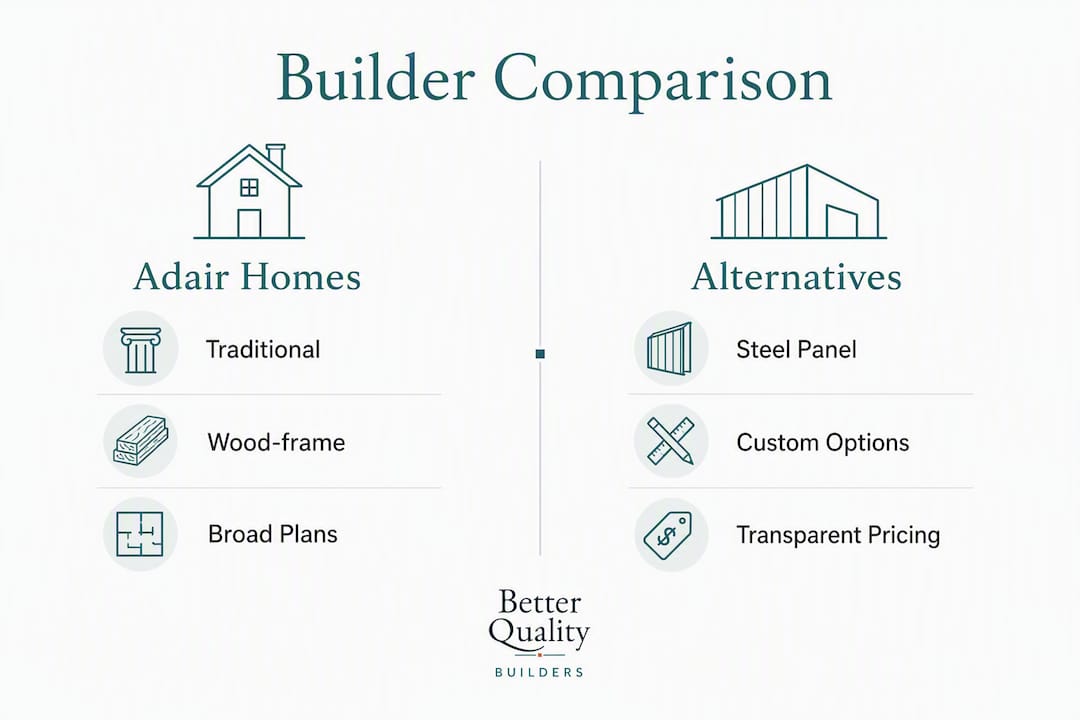
| Better Quality Builders | Arizona buyers wanting resilience, energy efficiency, and combined financing | Competitive for steel-panel construction; combined land+build with 10% down | Panelized system reduces on-site labor time | AirLight steel-insulated panels | Large floor plan library; 3D previews on your actual lot | Builder warranty; steel-panel durability advantage | Arizona (Maricopa County focus) | Combined construction and land financing, 10% down |
Pro Tip: The “typical pricing shape” column is the one most buyers misread. A low starting price with a long upgrade list often costs more at closing than a builder with a higher base price and more inclusions. Always request an itemized bid — here’s how construction bids work so you know exactly what to ask for.
AirLight steel-insulated panels offer higher resistance to moisture and pests compared with conventional wood framing, and the panelized approach often reduces on-site labor time and weather delays. That distinction matters in Arizona’s climate in ways it simply does not in the Pacific Northwest.
Per-builder profiles: who each alternative actually serves
Hiline Homes
Hiline Homes operates across Washington and Oregon with a production-leaning, on-your-lot model. The company’s strength is process consistency: buyers know what to expect at each stage, and the starting prices are among the competitive range in the Pacific Northwest market.
Strengths:
- Transparent package pricing with defined inclusions
- Established build process with predictable timelines
- Strong regional presence and subcontractor network in WA and OR
- Good fit for buyers who want a proven system over maximum customization
Weaknesses:
- Limited structural customization beyond the plan library
- Wood-frame construction offers no thermal or resilience advantage over standard code
- Not available outside the Pacific Northwest
Best for: A first-time on-your-lot buyer in Washington or Oregon with a defined budget who values process predictability over design freedom.
For warranty details and a portfolio of completed homes, check Hiline Homes’ website directly and cross-reference with third-party review platforms like Google Reviews and the Better Business Bureau.
Lexar Homes
Lexar Homes competes directly with Adair Homes in the Pacific Northwest semi-custom space. Comparative reviews highlight customization breadth, pricing transparency, and build-process clarity as primary differentiators. Lexar allows more plan modifications, appealing to buyers who find Adair’s plan library too rigid.
Strengths:
- More design flexibility than Adair Homes within the semi-custom model
- Allows structural modifications that Adair typically does not
- Competitive pricing for the level of customization offered
Weaknesses:
- Greater flexibility means more decisions, which can extend timelines
- Pricing transparency varies; itemized bids are worth requesting explicitly
- Geographic footprint is limited to the Pacific Northwest
Best for: A Pacific Northwest buyer who has outgrown Adair’s plan library but is not ready to pay full custom builder rates.
True Built Homes
True Built Homes operates in Washington state and emphasizes pricing transparency, addressing a common buyer concern among mid-size on-your-lot builders. The company provides more detailed pricing information than many competitors.
Strengths:
- Pricing transparency is a genuine differentiator in this builder category
- Clear build process documentation
- Solid regional subcontractor relationships in Washington
Weaknesses:
- Limited to Washington state
- Wood-frame construction; no structural or energy performance advantage
- Smaller plan library than Adair or Hiline
Best for: A Washington-state buyer who wants clearer pricing details before signing.
Better Quality Builders

Better Quality Builders is the Arizona-focused alternative on this list, and it operates in a different construction category entirely. The AirLight steel-insulated panel system is not a variation on wood-frame building. It is a fundamentally different structural approach, one used in regions where buildings must withstand hurricanes and earthquakes. In Arizona’s heat, that translates to energy bills that can be much lower and a home that resists the moisture, pests, and thermal cycling that degrade wood-frame homes over time.
Strengths:
- AirLight steel panels deliver measurable energy and resilience advantages over wood-frame construction
- Large library of customizable floor plans with 3D renderings previewed on your actual lot
- Real-time lot inventory for buyers who need help finding buildable land
- Combined construction and land financing with 10% down — a meaningful financing advantage
- Arizona-specific expertise, with Maricopa County as the primary service area
Weaknesses:
- Currently serves Arizona; not an option for Pacific Northwest buyers
- Steel-panel construction is a newer concept for many buyers, requiring some education upfront
Best for: An Arizona buyer who wants a home that performs better in the desert climate, with the option to bundle land procurement and construction financing into one transaction.
How do construction methods affect your build?
The method your builder uses is not just a technical detail. It shapes your energy bills, your build timeline, your change-order flexibility, and how your home holds up over decades.
| Method | Typical build speed | Energy performance | Change-order flexibility | Durability / resilience |
|---|---|---|---|---|
| Wood-frame (stick-built) | Standard (6 months) | Meets code; varies by insulation spec | High flexibility mid-build | Good; susceptible to moisture, pests, thermal cycling |
| Modular / panel (wood-based) | Faster than stick-built; factory precision | Better than stick-built; depends on panel spec | Lower; changes harder after panels are set | Good; factory quality control improves consistency |
| Steel SIP / AirLight panels | Reduced on-site labor; weather delays minimized | Significantly better; high thermal mass and airtight assembly | Moderate; design locked earlier, but 3D previews help | High; resistant to moisture, pests, fire, and climate extremes |
Wood-frame construction is the default across all four Pacific Northwest builders on this list. It works well in mild climates and offers maximum flexibility for mid-build changes. The trade-off is energy performance and long-term resilience, particularly in climates with extreme heat, humidity, or storm risk.
AirLight steel panel systems deliver substantially better thermal performance and higher resistance to climate hazards than conventional wood-frame construction. In Arizona, where summer temperatures regularly exceed 110°F, that performance gap translates directly to monthly utility savings.
Pro Tip: If your lot is in a flood zone, high-wind corridor, or extreme heat region, ask every builder you interview what their construction method’s R-value is and how it performs against moisture intrusion. A builder who cannot answer that question clearly is telling you something important.
Many buyers are better served by starting with a flexible base model and modifying it, rather than designing fully bespoke plans from scratch. This approach reduces decision fatigue and schedule risk, and it is exactly how Better Quality Builders’ floor plan library is structured.
What does an on-your-lot build actually cost?
Starting prices are marketing figures. The number that matters is the all-in cost after site work, permits, and finish selections, which can vary widely.
Standard inclusions (what most builders include in base price):
- Foundation (type varies: slab, crawl space, basement)
- Framing and exterior shell
- Roofing and windows
- Basic mechanical systems (HVAC, plumbing, electrical rough-in)
- Standard finish package (builder-grade flooring, cabinetry, countertops)
Common costs that are frequently not included:
- Site preparation and grading
- Utility hookups (water, sewer, gas, electric to the lot line)
- Permits and impact fees (vary significantly by county)
- Driveway and exterior concrete
- Landscaping and drainage (a design-build landscaping partner can integrate site work and reduce coordination delays)
- Finish upgrades above the base package
- Change orders after contract signing
- Interior door and millwork upgrades (sourcing from specialized vendors vs. big-box suppliers affects both lead time and cost)
Financing options to know:
Most Pacific Northwest builders on this list refer buyers to third-party construction lenders. Construction-to-permanent loans typically require 20% down and involve two closings (one for construction, one for the permanent mortgage). Better Quality Builders offers a combined construction and land financing product with 10% down, which reduces the upfront capital requirement and simplifies the transaction to a single process.
Common cost-related questions buyers ask:
What is a realistic all-in budget for an on-your-lot build? Site costs vary too much by location to give a universal figure, but buyers consistently underestimate site prep, utility connections, and permit fees by 10–20% of the base home price. Get itemized bids that separate site costs from home costs.
When do change orders become expensive? After framing begins, structural changes cost significantly more than the same change made at the plan stage. Lock your floor plan and structural decisions before breaking ground.
How long does an on-your-lot build take?
A realistic timeline for an on-your-lot custom build typically spans several months from contract signing to move-in, though panelized systems can shorten the construction phase.
- Pre-construction (1–3 months): Plan finalization, permit applications, and site survey. Permitting timelines vary widely by county and are the single most unpredictable phase.
- Site preparation (2–6 weeks): Clearing, grading, utility rough-ins to the lot. Undisclosed site issues (rock, poor drainage, easements) discovered here cause the most common early delays.
- Foundation (2–4 weeks): Slab, crawl space, or basement depending on plan and lot conditions.
- Shell and framing (4–8 weeks for wood-frame; shorter for panelized systems): AirLight steel panels reduce on-site labor time because components arrive pre-engineered.
- Mechanical rough-ins (3–5 weeks): HVAC, plumbing, electrical. Subcontractor scheduling is a frequent bottleneck here.
- Insulation, drywall, and interior finishes (6–10 weeks): Material lead times for cabinetry and specialty finishes are the most common cause of delay in this phase.
- Exterior finishes, landscaping, and site closeout (3–6 weeks): Final grading, driveway, and landscaping often run concurrently with interior punch-list work.
- Inspections and certificate of occupancy (1–3 weeks): Scheduling inspectors in high-demand counties can add time.
Common delay triggers: late finish selections, permit office backlogs, material lead times (especially cabinetry and windows), subcontractor availability, and weather events during the shell phase. Design visualization tools and 3D renderings shorten decision cycles by helping buyers lock design choices earlier, which reduces late-stage change orders.
Pro Tip: Make your flooring, cabinetry, and window selections before the foundation is poured. Builders who offer 3D previews of your home on your actual lot make this much easier — you can see the finished result before committing to any finish package.
How do you choose between these builders?
The decision comes down to five criteria, weighted by your situation.
- Geography first. Hiline, Lexar, True Built, and Adair Homes all operate in the Pacific Northwest. If your lot is in Arizona, Better Quality Builders is the relevant comparison.
- Construction method and long-term costs. Wood-frame meets code. Steel-panel construction exceeds it. If energy performance and structural longevity matter to you, ask every builder for their wall assembly’s R-value and moisture resistance spec.
- Pricing transparency. Request an itemized bid from every builder you interview. A builder who resists itemizing is telling you something. Use a custom home building checklist to make sure you’re comparing like-for-like.
- Financing structure. If you need to purchase land and build simultaneously, the financing product matters as much as the builder. Combined land-and-build financing with 10% down is a meaningful advantage for buyers who have not yet secured a lot.
- Warranty and post-build support. Ask for the warranty in writing before signing. Vague verbal assurances about “standing behind the work” are not a warranty.
Interview questions to ask every builder:
- What is specifically included in your base price? Can you provide an itemized list?
- What is your change-order policy, and what does a typical change order cost?
- Who manages subcontractors, and how do you handle subcontractor delays?
- Can I see a sample build schedule and a completed home in my price range?
- What does your warranty cover, for how long, and what is the claims process?
- Do you have references from buyers who built on lots similar to mine?
Red flags to watch for:
- “Starting at” pricing with no inclusions list
- No completed homes to tour or portfolio to review
- Evasive or verbal-only warranty terms
- No third-party reviews on Google, Houzz, or the BBB
- High deposit demands before a contract is signed
- No clear answer on who manages permitting and site logistics in your county
Pro Tip: Successful custom projects identify “must-have” structural requirements early. Decide before your first builder meeting whether you need a specific room count, accessibility features, or energy performance standard. Builders who know your non-negotiables upfront give you more accurate bids.
What do customers say about each builder?
Customer review sentiment varies meaningfully across these builders, and third-party platforms give you the clearest picture.
Adair Homes draws mixed reviews on Google and the BBB. Positive reviews frequently cite the plan selection process and sales team responsiveness. Negative reviews cluster around communication gaps during construction, change-order surprises, and warranty service response times.
Hiline Homes generally earns stronger review sentiment than Adair in head-to-head comparisons on Google Reviews. Buyers praise the process consistency and timeline predictability. Complaints tend to focus on finish quality at the base package level and limited upgrade flexibility.
Lexar Homes reviews reflect the semi-custom model’s inherent trade-off: buyers who engaged deeply with the design process report high satisfaction; buyers who expected a more hands-off experience report frustration with the number of decisions required.
True Built Homes earns consistent praise for pricing transparency, which is the company’s stated differentiator. Buyers who have previously worked with less transparent builders tend to rate True Built highly by comparison.
Better Quality Builders focuses on Arizona, and the AirLight steel-panel system is a differentiator that generates strong interest from buyers who have researched energy performance and structural resilience. The 3D lot preview tool and real-time lot inventory are frequently cited as features that make the early decision process clearer than with traditional builders.
For any builder, check Google Reviews, the Better Business Bureau, and Houzz for third-party sentiment. Do not rely solely on testimonials published on the builder’s own website.
Where does each builder actually build?
Geographic coverage is the first filter, and it eliminates most of this list for most buyers.
Adair Homes builds in Washington, Oregon, and Idaho. The company has operated in the Pacific Northwest for decades and has an established subcontractor network in those markets.
Hiline Homes covers Washington and Oregon. Its footprint overlaps significantly with Adair Homes, which is why the two are frequently compared directly.
Lexar Homes operates in the Pacific Northwest, primarily Washington and Oregon, with a similar geographic profile to Adair and Hiline.
True Built Homes is Washington-state focused. If your lot is in Oregon or Idaho, True Built is not the right fit.
Better Quality Builders builds in Arizona, with a primary focus on Maricopa County. The company offers real-time lot inventory for buyers who have not yet secured land, which extends its practical service area to buyers who are still in the site-selection phase. If you are considering Arizona and want to understand what buildable lots are currently available, that inventory tool is worth exploring before you commit to a lot independently.
One important note on regional availability: all five builders on this list are regional specialists, not national builders. If your lot is outside their stated service areas, the builder cannot manage local permitting, subcontractor relationships, or site logistics effectively. Always confirm that the builder has active projects in your specific county before signing.
Key Takeaways
The strongest Adair Homes alternative depends entirely on where your lot is and what you prioritize: for Pacific Northwest buyers, Hiline, Lexar, and True Built each offer a distinct trade-off between price, flexibility, and transparency; for Arizona buyers, Better Quality Builders’ AirLight steel-panel system delivers energy performance and structural resilience that wood-frame construction cannot match.
| Point | Details |
|---|---|
| Geography determines your shortlist | Pacific NW buyers compare Hiline, Lexar, and True Built; Arizona buyers should evaluate Better Quality Builders. |
| Pricing transparency is a red flag filter | Always request an itemized bid; builders who resist itemizing typically have hidden upgrade costs. |
| Construction method affects long-term costs | Steel-panel systems like AirLight offer significantly better thermal performance than standard wood-frame builds. |
| Combined financing simplifies land-and-build deals | Better Quality Builders offers construction and land financing with 10% down, reducing upfront capital requirements. |
| Better Quality Builders | Arizona’s on-your-lot alternative with AirLight steel panels, 3D lot previews, and combined land-and-build financing. |
Why the “best builder” question is usually the wrong question
The conventional framing of this comparison, which builder is best overall, misses the point. These five builders do not compete with each other in any meaningful way. Adair, Hiline, Lexar, and True Built are all Pacific Northwest wood-frame builders operating in the same regional market with similar construction methods and overlapping plan libraries. The real competition among them is on pricing transparency, plan flexibility, and process communication, not on structural or energy performance.
Better Quality Builders represents a fundamentally different category. The AirLight steel-panel system is not a premium version of what the other builders do. It is a different construction category, one that produces a home with a fundamentally different performance profile. Comparing it to a wood-frame builder on starting price alone is like comparing a diesel truck to a hybrid sedan on fuel cost without accounting for what each vehicle is built to do.
What I find underappreciated in most builder comparisons is how rarely buyers ask the 30-year question. The right question is not “which builder has the lowest starting price?” It is “which home will cost me the least to own over the next three decades?” In Arizona’s climate, that question almost always points toward a construction method with superior thermal performance. The energy savings compound. The reduced maintenance compounds. The structural resilience compounds. A home built to outlast everything is not a marketing phrase. It is a financial argument.
Better Quality Builders: the Arizona on-your-lot alternative worth knowing
If your lot is in Arizona and you want a home that performs differently from the start, Better Quality Builders builds with AirLight steel-insulated panels — the same structural system used in hurricane and earthquake zones worldwide. The result in Arizona’s climate is energy bills that can be much lower, a home that resists moisture and pests, and a structure built to last centuries rather than decades.
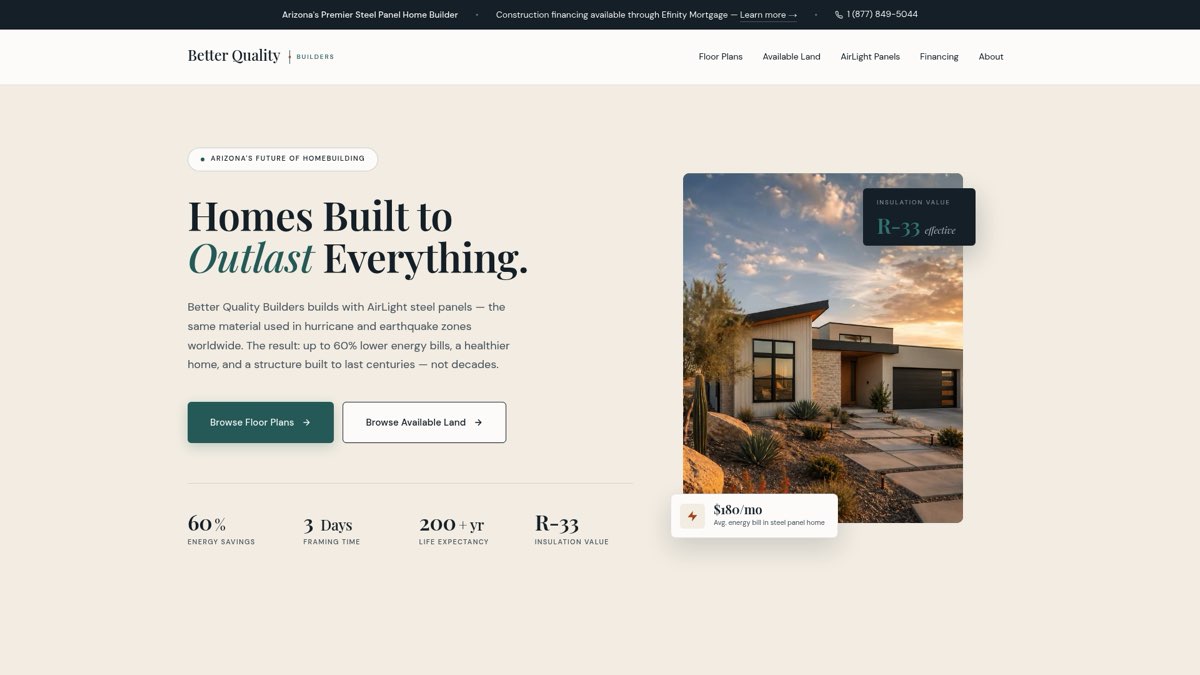
The process is designed to remove the friction that makes on-your-lot builds complicated. You get access to a large library of customizable floor plans, 3D renderings of your chosen home previewed on your actual lot, and real-time inventory of buildable lots in Maricopa County if you have not yet secured land. Financing combines construction and land into a single transaction with 10% down, which is a meaningful advantage over the two-closing construction loan process most buyers encounter elsewhere.
To get started, browse the floor plan library or contact Better Quality Builders directly to schedule a lot evaluation and consultation. Bring your lot address (or your target area if you are still searching), your target square footage, and your must-have features list. The team will walk you through what is included, what the build timeline looks like for your specific site, and how the financing works.
Useful sources and references
- Production Versus Custom Home Builders: What’s the Difference? — NewHomeSource.com — explains the spectrum from production to custom building and how it affects pricing and timeline
- Saving the Marriage: Custom Building Alternatives — Housing Design Matters — covers semi-custom, designer-ready, and spec home alternatives to full custom builds
- Steel SIP Panel Homes in Arizona — Better Quality Builders — product page describing the AirLight system’s properties and performance benefits for Arizona climates
- How Home Construction Bids Work — Better Quality Builders Blog — explains itemized bids and what to request before signing with any builder
- Custom Home Build Process Step by Step — Better Quality Builders Blog — detailed timeline and process guide for on-your-lot builds
- Landscape Design — GC Signature Outdoors — design-build landscaping partner reference for site prep and drainage planning
- Interior Door Sourcing Comparison — One Day Doors & Closets — illustrates how vendor selection affects lead times and finish costs