Turnkey home packages are worth it if your top priority is fast, low-effort occupancy and a predictable budget rather than full creative control over every finish. That trade-off is the whole story, and it holds up whether you’re buying a resale property or contracting a new build.
Before you sign anything, verify the claim using tools built for exactly this: ask your lender or appraiser about Fannie Mae condition ratings, and lean on HUD’s buyer guidance for a broader checklist. Builders like Better Quality Builders back their turnkey claims with itemized inclusion lists and documented warranties, which is the standard every turnkey seller should be held to.
Here’s the quick breakdown:
- Main benefits: faster move-in, less project management, predictable all-in budgeting
- Main trade-off: higher upfront price and less room to customize finishes after the fact
- What to check first: written inclusion list, warranty terms, and an independent home inspection
Key Takeaways
Turnkey home packages deliver faster occupancy and predictable budgeting in exchange for a price premium and less finish-level customization, and verifying the claim requires documentation, not trust.
| Point | Details |
|---|---|
| Verify before you buy | Request an independent inspection, seller disclosures, and a lender-confirmed condition rating. |
| Know the real trade-off | Turnkey costs more upfront but usually lowers first-year renovation and repair risk. |
| Get inclusions in writing | An itemized list and warranty terms should be attached directly to the purchase contract. |
| Match the buyer profile | Second-home owners, investors, and relocators typically benefit most from turnkey convenience. |
| Choose a documented builder | Better Quality Builders pairs turnkey scopes with AirLight panel construction and written warranties for verifiable move-in-ready results. |
Table of Contents
- What Does “Turnkey” Actually Mean In A Home Sale?
- What’s Typically Included In A Turnkey Home Package
- The Real Benefits Of Turnkey Home Packages
- Where Turnkey Packages Fall Short
- How To Verify A Seller’s Turnkey Claim
- What Turnkey Costs You, And How To Finance It
- Who Turnkey Home Packages Actually Fit Best
- Questions To Ask Before You Sign
- Turnkey Vs. Fixer-Upper: A Quick Comparison
- How Soon Can You Actually Move In?
- What A Reputable Turnkey Builder Should Provide
- Why Verification Beats Marketing Every Time
- Get A Turnkey Build You Can Actually Verify
- Sources
What Does “Turnkey” Actually Mean In A Home Sale?
“Turnkey” means the home is represented as ready for immediate occupancy with no repairs, upgrades, or renovation required before move-in. That’s the plain-English answer. What it is not is a legal or regulated term. No government agency certifies a property as “turnkey,” which means the word carries exactly as much weight as the seller’s credibility behind it.
This matters because “turnkey” gets used loosely in real estate marketing, sometimes interchangeably with “move-in ready” or “new construction,” when those terms mean different things. A newly built home might still need a punch list resolved before it’s genuinely turnkey. A resale home marketed as turnkey might have finishes that are ten years old but cosmetically fine. Neither is dishonest, exactly, but neither is automatically what a buyer assumes.
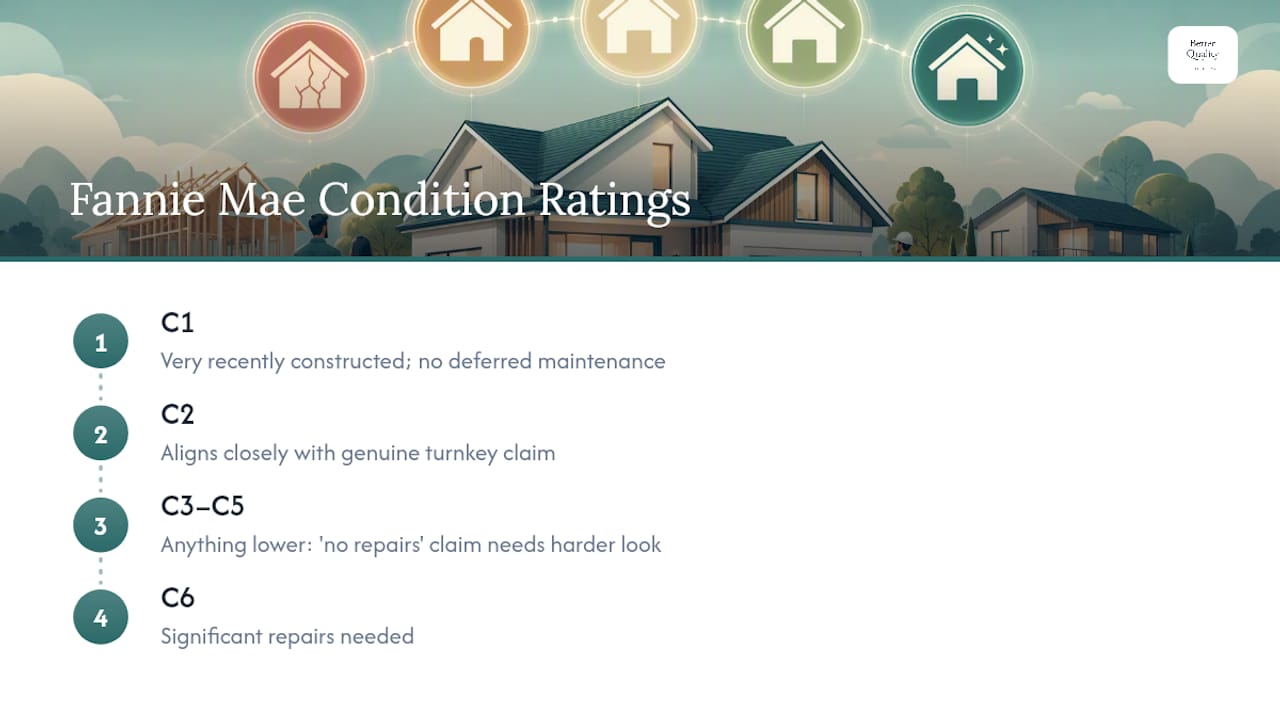
The closest thing to an objective standard comes from mortgage underwriting. Fannie Mae’s property condition ratings run from C1, meaning very recently constructed with no deferred maintenance, down to C6, meaning significant repairs are needed. A property rated C1 or C2 by an appraiser aligns closely with a genuine turnkey claim. Anything lower and the “no repairs needed” pitch deserves a harder look.
Better Quality Builders treats turnkey as a documented outcome, not a listing adjective. That means a signed scope of work, materials specified by name, and a completion standard the buyer can hold the builder to. For a deeper look at how that plays out on the construction side, see what a turnkey home build actually involves.
What’s Typically Included In A Turnkey Home Package
A turnkey package should include everything needed to live in the home the day you get the keys: finished kitchens and bathrooms, flooring throughout, interior and exterior paint, a functioning HVAC system, and standard appliances. That’s the baseline. Beyond that, inclusions vary a lot by builder and market.
Some packages go further, and this is where “turnkey” starts to mean different things to different sellers:
- Window treatments, blinds, and light fixtures already installed
- Landscaping, fencing, and driveway or walkway completion
- Furniture packages (more common in vacation and rental-focused markets)
- Smart-home basics like a video doorbell, thermostat, or garage door opener
- HOA or community amenity access already activated
House-and-land vendors note that upgrading a standard package to genuinely turnkey status usually adds cost, but it also prevents surprise expenses at handover, like discovering you still need to budget for carpets and blinds after closing.
Before you rely on a verbal description of what’s included, get it in writing. Request:
- An itemized inclusion list naming every finish, fixture, and appliance by brand and model
- A written warranty document specifying coverage length and what triggers a claim
- Copies of permits and the certificate of occupancy
- Seller or builder disclosures covering any known defects
Pro Tip: Never accept a verbal promise about inclusions. Insist the itemized list becomes an attached exhibit to the purchase contract itself, not a separate email or a sales brochure. If it’s not in the contract, it’s not enforceable.
The Real Benefits Of Turnkey Home Packages
The benefits of turnkey home packages come down to three things: speed, predictability, and reduced hands-on management. Each one solves a specific kind of buyer headache, and they don’t all matter equally to everyone.
Fast move-in and less project management
You skip the renovation timeline entirely. There’s no waiting on contractor bids, no living out of boxes for six months while flooring gets replaced. For buyers who are relocating for work, purchasing a second home from out of state, or simply don’t have the bandwidth to manage subcontractors, turnkey homes eliminate the need to interview contractors or supervise a job site. The builder or seller has already made those decisions and absorbed that coordination work.

Predictable, front-loaded budgeting
With a turnkey purchase, most of your major spending happens before closing, not after. That’s a meaningful shift in how a buyer plans finances. Instead of a mortgage payment plus an open-ended renovation budget that tends to run over, you have one number. HomeLight’s market analysis notes that buyers routinely pay a premium for this exact certainty, because avoiding renovation-phase cost overruns is worth real money to them.

Lower short-term maintenance risk
A home with fresh finishes, new appliances, and a recent HVAC install is statistically less likely to need a major repair in year one than a dated resale property. That’s not a guarantee, but it’s a reasonable expectation buyers factor into the premium they’re willing to pay.
Built for second-home owners and investors
If you’re buying a vacation property or a rental unit, turnkey status has extra appeal. You’re not on-site to manage a renovation, and every month the property sits unfinished is a month of lost rental income or unused vacation time. Industry commentary consistently frames turnkey convenience as especially valuable to relocators and buyers managing the purchase remotely.
Here’s the honest framing: turnkey isn’t usually the cheaper option on paper. It’s the option that trades a lower sticker price for lower stress, lower time investment, and a firmer handle on what you’ll actually spend.
Where Turnkey Packages Fall Short
The main trade-offs of turnkey home packages are a higher upfront price, limited ability to customize finishes, and the risk of vague marketing language standing in for real documentation. None of these are dealbreakers, but all of them deserve honest consideration before you commit.
Common downsides worth weighing:
- Higher purchase price relative to a comparable fixer-upper or a stripped-down new-construction package
- Locked-in finish choices — the flooring, countertops, and cabinetry are already selected, and changing them after close means paying for a renovation anyway
- Warranty gaps that only cover structural issues while excluding appliances, finishes, or cosmetic defects
- Furniture exclusions in listings that use “turnkey” loosely, leaving buyers to assume furnishings are included when they aren’t
- Inconsistent quality standards since “turnkey” isn’t a regulated term, meaning one seller’s turnkey is another seller’s “mostly finished”
Pro Tip: Ask the builder or seller point-blank which items are standard inclusions and which are paid upgrades. Get that distinction in writing, item by item, before you sign anything. Sales conversations tend to blur this line, and contracts don’t lie.
How To Verify A Seller’s Turnkey Claim
Verify a turnkey claim with four steps: an independent home inspection, a review of seller disclosures, a lender or appraiser condition rating, and a written inclusion and warranty list. Skip any one of these and you’re taking the listing description on faith.
Start with the inspection. The American Society of Home Inspectors recommends an independent inspection for every home purchase, including properties marketed as move-in ready, because trained inspectors routinely catch deferred maintenance that a walkthrough misses. This step alone resolves most disputes over whether a “turnkey” claim was accurate.
Then work through this checklist:
- Request all seller or builder disclosures in writing, including known defects and past repairs
- Ask your lender or appraiser to confirm the property’s Fannie Mae condition rating, targeting C1 or C2 for a genuine turnkey claim
- Confirm permits were pulled for any recent work and that a certificate of occupancy is on file
- Get the full warranty document, not a summary, and read the exclusions section closely
Watch for these red flags:
- Listing language that says “turnkey” without any supporting documentation offered
- No receipts or contractor invoices for claimed recent upgrades
- A warranty period shorter than 90 days or one that excludes major systems
- Reluctance from the seller or agent to put inclusions in writing
Our inspection guide for buyers walks through what a qualified inspector actually checks at each stage of a purchase.
What Turnkey Costs You, And How To Finance It
Turnkey homes typically carry a price premium because you’re paying for completed work and the convenience of skipping renovation, but your total first-year capital outlay is often lower since there’s no separate renovation budget to fund. That’s the real financial trade-off, and it’s worth running the numbers both ways before you decide.
A few financing considerations worth raising with your lender early:
- Talk to your lender before you shop, not after you find a property you like
- Ask the appraiser directly what condition rating they’re assigning and whether it supports the turnkey asking price
- Factor the warranty’s coverage and length into your assessment of the home’s real value, not just its listed price
- If you’re buying land and building new, ask about combined land-and-construction financing, which can simplify the process considerably
Market commentary suggests the turnkey premium varies widely by market and finish level rather than sitting at one fixed national number. Treat any specific percentage you see quoted online as a rough tendency, not a guarantee for your situation. CFPB resources on owning a home are a solid starting point for understanding how appraisals and closing costs interact with financing decisions.
Pro Tip: If a seller won’t move on price, negotiate the inclusion list instead. Adding appliances, landscaping, or window treatments to the deal is often easier to win than a price cut, and it closes the same gap in real value. For a deeper look at what drives builder pricing, see how construction bids actually work.
Who Turnkey Home Packages Actually Fit Best
Turnkey home packages are best suited to second-home buyers, investors, busy professionals, relocators, and first-time buyers who want low-maintenance ownership without a renovation learning curve. If you fall into one of those groups, the premium usually earns its keep.
Ask yourself three questions before deciding:
- Timeline: Do you need to move in within weeks, or can you tolerate a renovation timeline stretching months?
- Customization desire: Would picking your own cabinetry, flooring, and layout genuinely matter to you, or is “good enough and done” a win?
- Project management capacity: Do you have the time and appetite to manage contractors, or would you rather hand that entirely to someone else?
If you answered “renovation is fine” and “customization matters a lot,” a fixer-upper or a fully custom build might serve you better. Our guide to what a custom home build actually involves breaks down that alternative path in detail.
Questions To Ask Before You Sign
These are the must-ask questions before you commit to any turnkey purchase, whether you’re buying resale or contracting new construction.
- What exactly is included, item by item, and can that list be attached to the contract?
- Are permits pulled and closed out, and is a certificate of occupancy on file?
- What’s the warranty period, and what specifically does it cover versus exclude?
- Can you provide receipts or documentation for any recently completed upgrades?
- Is furniture included, partially included, or not included at all?
A short email works well for this. Something like: “Before we move forward, could you send an itemized list of all included finishes, appliances, and fixtures, along with the warranty terms and coverage period? We’d also like copies of any permits and the certificate of occupancy.” Keep it in writing so there’s a paper trail if something doesn’t match later.
Turnkey Vs. Fixer-Upper: A Quick Comparison
Turnkey homes win on speed and predictability; fixer-uppers win on price and customization control. That’s the tradeoff in one sentence, and almost every other difference flows from it.
- Time to move in: Turnkey is immediate or near-immediate; a fixer-upper can take months depending on scope
- Upfront cost: Turnkey typically costs more at purchase; fixer-uppers cost less upfront but require renovation capital
- Customization control: Fixer-uppers give you full control over finishes; turnkey locks in decisions already made
- Long-term risk: Turnkey carries lower short-term repair risk; fixer-uppers carry unknown condition risk until renovation is complete
Choose turnkey when your time and bandwidth are the scarce resources. Choose a fixer-upper when your budget is tighter than your patience.
How Soon Can You Actually Move In?
Turnkey shortens your move-in timeline considerably, but it doesn’t eliminate closing, inspections, or final walkthroughs. Expect real steps between contract and keys, not an instant handover.
Typical milestones:
- Contract to closing: Usually 30 to 45 days for a resale turnkey purchase, longer for new construction awaiting final inspections
- Inspection window: Generally 7 to 10 days after contract signing
- Final punchlist and certificate of occupancy: Can add several weeks for new builds if permits or final inspections are still pending
Pro Tip: Get your completion and handover date in writing, and confirm the certificate of occupancy status before you schedule movers. A verbal “should be ready by” from a builder is not the same as a documented date.
What A Reputable Turnkey Builder Should Provide
A credible turnkey builder provides an itemized scope of work, documented warranty terms, proof of pulled permits, verifiable references, and clear maintenance guidance after handover. Anything less puts the burden of verification entirely on you.
Better Quality Builders structures turnkey and turnkey-ready builds around that standard. Every project uses AirLight steel-insulated panels, which contribute to energy bills up to 60% lower than conventional framing and a structure designed to outlast typical wood-frame construction by generations, not years. That’s not a marketing flourish. It’s a materials decision that directly affects the maintenance burden a turnkey buyer inherits after move-in.
Checklist for evaluating any turnkey builder:
- A signed, itemized scope of work naming materials, brands, and finish levels
- A written warranty specifying structural, mechanical, and cosmetic coverage separately
- Documented permits and inspection sign-offs available on request
- Verifiable references from recent clients, not just testimonials on a website
- A maintenance guide covering what the homeowner is responsible for post-handover
Pro Tip: Ask any builder for the contract language covering warranty duration and defect remedies specifically, and ask for two or three recent client references you can call directly. A builder confident in their work will hand both over without hesitation.
Why Verification Beats Marketing Every Time
Turnkey is the right call when a buyer’s real priority is time and certainty, not the lowest possible price. That’s the conclusion the evidence points to consistently, and it’s worth saying plainly rather than hedging around it.
What gets underestimated is how much the word “turnkey” is doing unverified work in a typical listing. It sounds like a guarantee. It functions like an adjective. The gap between those two things is exactly where buyers get burned, not because sellers are lying, but because nobody made them prove the claim.
My honest advice: treat every turnkey listing as a claim to be verified, not a fact to be trusted. Get the independent inspection regardless of how finished the home looks. Ask your lender directly about the appraisal’s condition rating. Read the warranty’s exclusions section before you read its coverage section, because that’s where the real limits live.
None of this is paranoia. It’s the same due diligence any experienced buyer applies to a resale home, just pointed specifically at the claims a turnkey label makes.
Get A Turnkey Build You Can Actually Verify
Better Quality Builders delivers custom, turnkey-ready homes built with documented inclusion lists and AirLight steel-insulated panels, so what you’re promised on paper is what you get at handover.
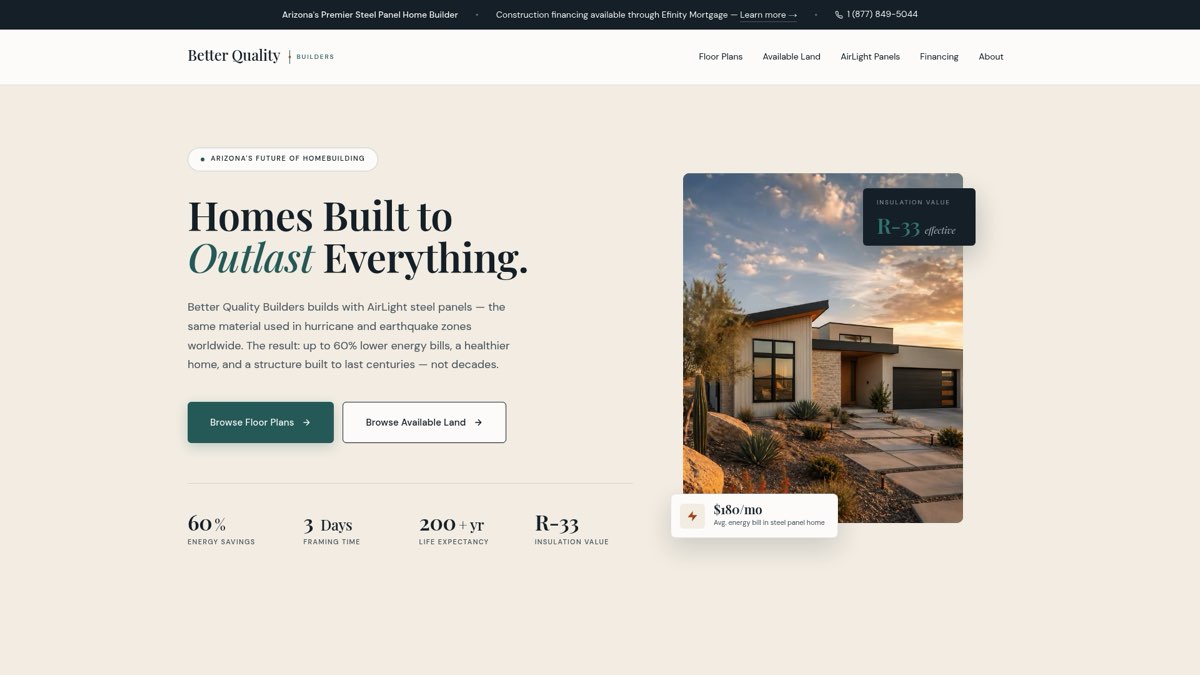
Unlike a resale listing where “turnkey” is one seller’s word against your inspector’s findings, a Better Quality Builders project gives you an itemized scope from day one, a written warranty, and a materials specification that includes documented energy performance. You’re not guessing whether the claim holds up. It’s in the contract.
Browse the custom home plans and floor plan library to see what a turnkey-ready build looks like before you commit, or reach out through the Better Quality Builders site to request a turnkey scope of work and client references for your area.
Sources
- What Is a Turnkey Home? Meaning, Pros, Cons, and What to Check Before You Buy | Home Stimulus
- Buying a Home | HUD
- Owning a Home | Consumer Financial Protection Bureau
- Homeinspector