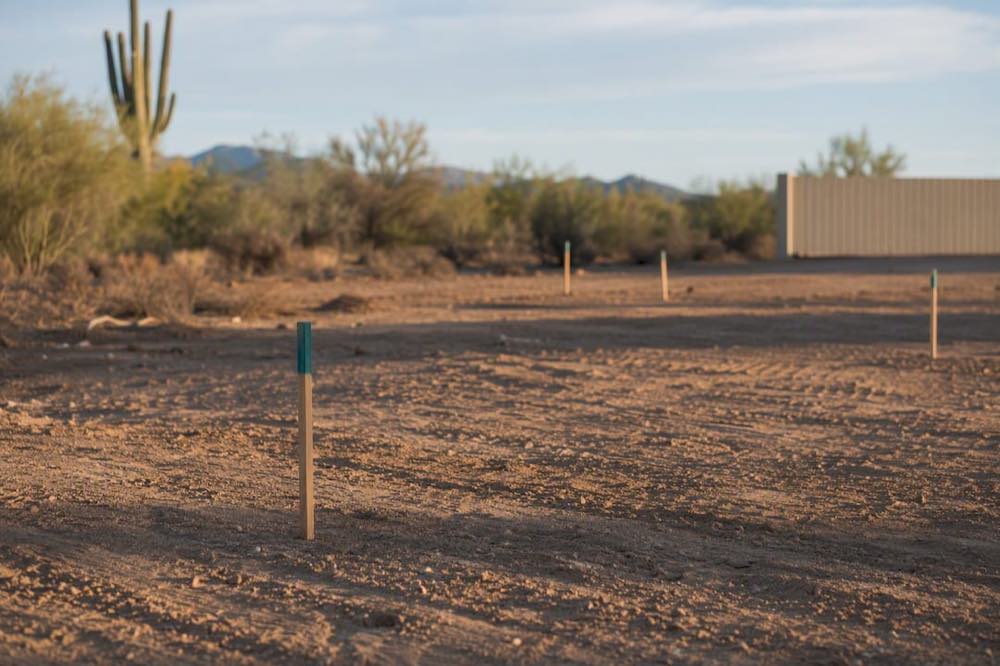
Yes, you can build on your lot in Arizona in most cases, but the “yes” comes with conditions. Before a builder can give you a real quote, you need to confirm five things: water access, power access, septic or sewer capacity, legal road access, and zoning or CCR restrictions. Skip this step and you risk a permit delay, a redesign, or a budget that blows past your estimate before the foundation is even poured.
Here’s what to check first:
- Water: municipal connection, well, or hauled water?
- Power: is there a utility line at the property, or will you need a long extension?
- Septic or sewer: has a perc test been done, or is sewer available?
- Access: is there a legal, recorded road to the parcel?
- Zoning/CCRs: does the county or an HOA restrict what you can build?
Pro Tip: Order a current title report and a site survey before you fall in love with floor plans. A $400 survey now can save you from a $40,000 surprise later.
The fastest next step is requesting a lot review from a builder who works directly with Arizona parcels, so you know exactly where you stand before you spend money on design.
Key Takeaways
Building on your own Arizona lot succeeds when you verify utilities, zoning, and access before design, then choose a builder who handles owner-lot permitting and financing as a packaged process.
| Point | Details |
|---|---|
| Confirm buildability first | Get will-serve letters, septic approval, and a current survey before committing to a floor plan. |
| Budget for site variables | Caliche soil, slope, and utility distance drive cost more than finish selections in many cases. |
| Expect an 8 month timeline | Permit issuance to certificate of occupancy typically falls in this range for Arizona lot builds. |
| Ask about combined financing | Construction-to-permanent loans simplify paying for land and building under one structure. |
| Consider AirLight panel construction | Better Quality Builders’ steel SIP system and permit-ready plans are built to help lower energy costs and speed up permitting on Arizona lots. |
Table of Contents
- How Does the Build-on-Your-Lot Process Work in Arizona?
- What Documents Prove a Lot Is Actually Buildable?
- What Does Building on Your Own Land Cost in Arizona?
- How Do You Choose the Right Builder for an On-Your-Lot Project?
- Why AirLight Steel SIP Panels Change the Math for Arizona Builds
- What Does Site Preparation Look Like on an Arizona Lot?
- Should You Hire a Local Architect for Your Arizona Build?
- What Energy-Efficient Building Practices Make Sense in Arizona?
- How Do HOA Rules Affect Building on Your Own Lot?
- What Warranty and Support Should You Expect After Move-In?
- What Landowners Get Wrong About Building on Their Own Lot
- Ready to Match Your Lot With a Plan That Fits Arizona’s Climate?
- Sources
How Does the Build-on-Your-Lot Process Work in Arizona?
Building on land you already own follows a sequence, and skipping steps is where most delays start.
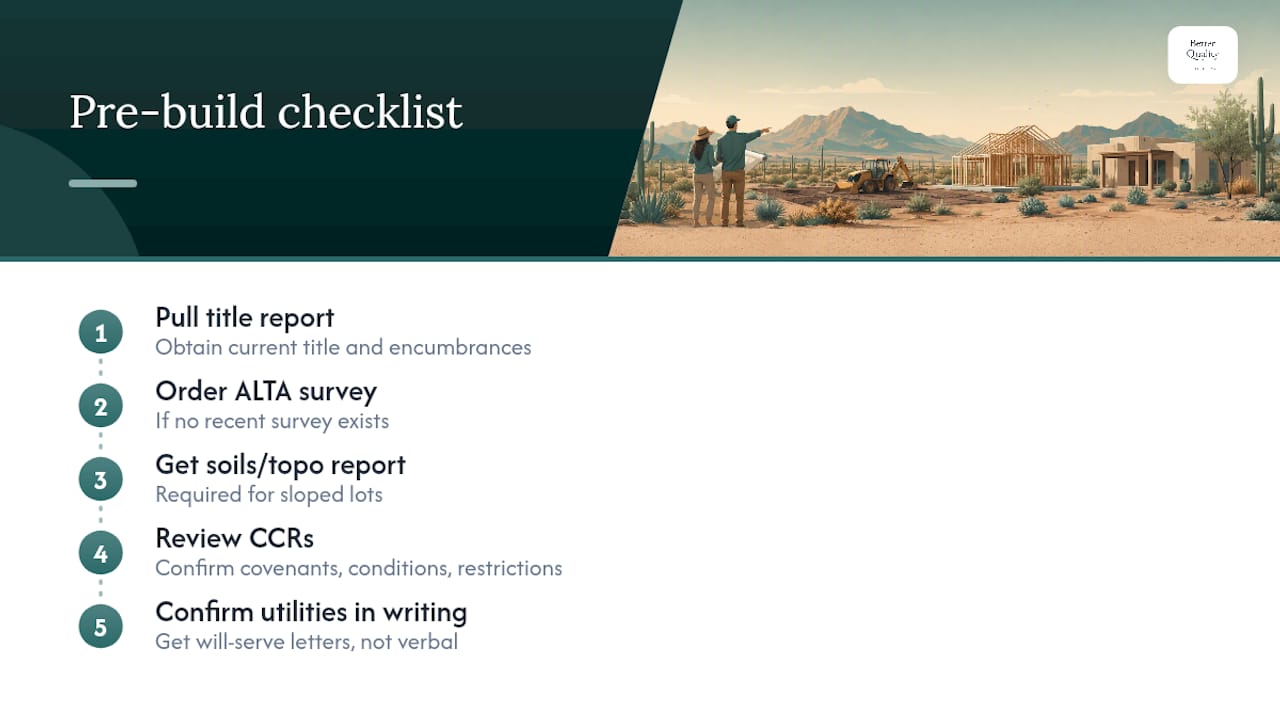
1. Pre-build checks. Pull your title report, order an ALTA survey if you don’t have a recent one, and get a soils/topo report if the lot has any slope. Confirm CCRs and utility availability in writing, not just verbally from the seller.
2. Design and budgeting. Decide between a permit-ready plan, which moves faster because the design already meets code, or a fully custom plan, which takes longer but fits unusual lots. Set allowances for finishes now, because vague allowances are the number one source of change orders later.
3. Permits and inspections. Arizona counties each have their own submittal requirements, but most ask for a stamped site plan, septic or sewer approval, and a will-serve letter from the utility provider. Maricopa County and Pinal County both require septic permits processed through their environmental services departments before a building permit is issued.
4. Site work, foundation, and construction. Grading and utility trenching come first, followed by the foundation, framing, mechanical rough-ins, and finishes. In Arizona, a typical custom on-your-lot build runs several months from permit issuance to final inspection, with remote lots without existing utilities generally taking longer.
5. Certificate of occupancy. The county’s final inspection covers structural, electrical, plumbing, and mechanical systems before you get the green light to move in.
The step-by-step build process matters more on owner lots than on tract land, because every phase depends on documentation you gather upfront, not on a developer who already handled it.
What Documents Prove a Lot Is Actually Buildable?
A lot listing that says “buildable” isn’t the same as a lot that’s ready. Ask the seller or your builder for these before you commit:
- Current ALTA or plat survey showing boundaries, easements, and access.
- Will-serve letters from the water and electric utility confirming service is available at the property line.
- Septic perc test results or sewer availability confirmation.
- Recorded easements and deed restrictions, pulled from the county recorder, not just what the seller mentions.
- Legal ingress/egress confirmation, especially for landlocked or shared-driveway parcels.
Listings that include this paperwork upfront save weeks. A 1.04-acre lot in White Hills marketed with a water line, a permitted septic system, and a permitted power box already installed is a good example of what “plug-and-play” actually looks like on paper, not just in the listing copy.
Road access needs its own scrutiny. Confirm whether the road is county-maintained or private, since private roads sometimes carry maintenance obligations that show up as recorded agreements you won’t notice until title work turns them up. If your lot sits near wildland areas, ask about fuel setbacks and your fire district’s ISO rating, since both affect insurance costs and, in some cases, construction requirements.
Pro Tip: If the lot has more than a 5% grade, order a soils report before finalizing your foundation type. Slab-on-grade works fine on flat ground, but sloped lots often need a stem wall or engineered foundation that adds cost the listing price never mentions.
What Does Building on Your Own Land Cost in Arizona?
Costs concentrate in three places: site preparation, the foundation, and finish-level upgrades. A flat, utility-ready lot keeps site prep costs low. A remote parcel needing a well, a septic system, and a long power extension can add tens of thousands before framing even starts.
Here’s where budgets typically shift:
- Site prep and utility hookups: grading, well drilling, septic installation, and power line extensions vary widely by distance from existing infrastructure.
- Foundation type: sloped lots requiring engineered foundations cost more than flat, slab-ready sites.
- Finish level: cabinetry, flooring, and fixture upgrades move the total more than almost any other line item.
For a realistic sense of total spend, review what a custom home actually costs to build in Arizona before you set a number in your head, since per-square-foot averages swing based on region and finish package.
Financing on your own lot works differently than a standard mortgage. Most lenders offer construction-to-permanent loans that convert to a regular mortgage once the certificate of occupancy is issued.
Statistic Callout: Many Arizona builders publish plan libraries and price ranges upfront specifically because buyers building on their own lot want cost clarity before they commit to a design, not after.
Always build in a contingency, ideally 10 to 15% of your construction budget, for the unexpected: a rock layer that needs blasting, a utility line that runs deeper than expected, or a change order once you see the framed walls in person.
How Do You Choose the Right Builder for an On-Your-Lot Project?
Not every builder is set up for owner-lot construction. Track builders working in a subdivision have relationships with a single utility provider and a single set of plans. A lot build demands more flexibility.
Ask these questions in your first conversation:
- How many owner-lot projects have you completed in this county?
- Who pulls the permits, you or me?
- Which subcontractors do you use for septic, well, and grading work?
- How do you handle a change order, and what’s the process for pricing it?
- What’s included in your base price versus what’s an allowance?
- Can I see a sample contract before I sign anything?
- What’s your payment draw schedule tied to?
- Do you require lien waivers from subcontractors at each draw?
- What warranty do you provide, and what’s excluded?
- How do you handle utility extensions if my lot doesn’t have service at the property line?
Your contract should spell out scope of work in detail, a clear change order process with pricing attached, a payment schedule tied to completed milestones rather than arbitrary dates, and a requirement for lien waivers at every draw.
Pro Tip: A red flag worth walking away from: a builder who won’t put an allowance dollar figure in writing. Vague allowances are where “custom home” turns into “over-budget home.”
Why AirLight Steel SIP Panels Change the Math for Arizona Builds
Better Quality Builders builds with AirLight steel-insulated panels, the same panel technology used in hurricane and earthquake-prone regions worldwide. For Arizona homeowners, the appeal isn’t storm resistance. It’s what steel panels do to your energy bill and your maintenance schedule over the next 50 years.
Homes built with AirLight steel SIP panels can run up to 60% lower energy bills than a comparable stick-built home, according to Better Quality Builders, largely because the panel system seals thermal gaps that traditional framing struggles to close.
That efficiency matters most on Arizona lots without shade cover, where cooling costs dominate a monthly bill from May through September.
Beyond the panels, Better Quality Builders gives lot owners three things that shorten the road from land to move-in:
- A library of permit-ready floor plans that skip months of custom design review.
- Real-time lot inventory for buildable Arizona land, so you can shop land and plans together.
- 3D siting previews showing how a specific plan sits on your specific lot before you commit.
This article was written by David Kobierski for Better Quality Builders.
What Does Site Preparation Look Like on an Arizona Lot?
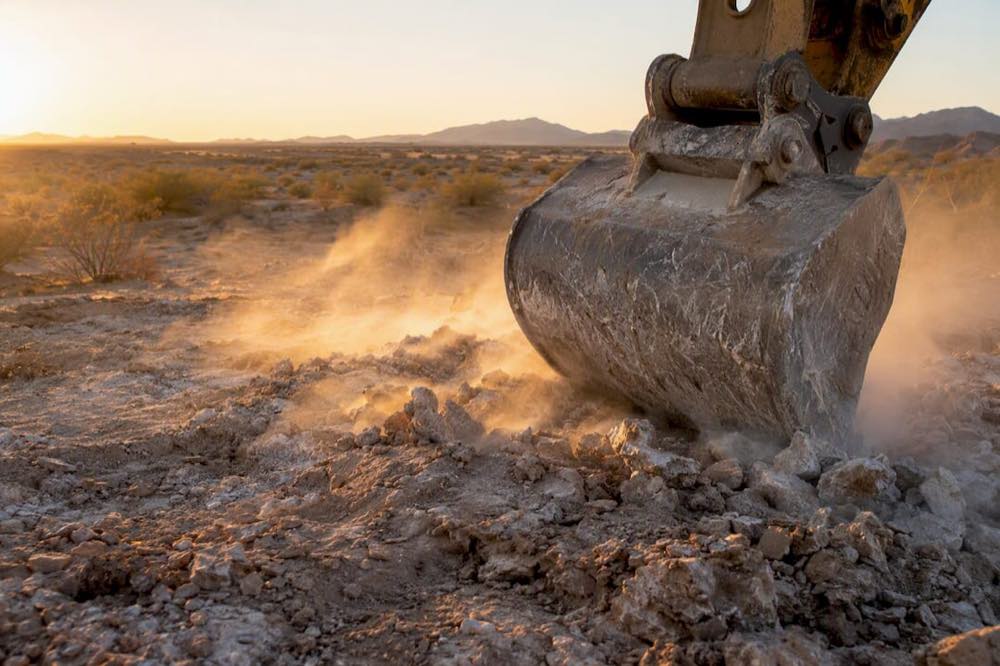
Arizona’s climate and terrain shape site work in ways that flat-state builders rarely deal with. Caliche, a hardpan layer of calcium carbonate common across the Sonoran Desert, sits just below the surface on many lots and requires heavier excavation equipment than typical soil. If your soils report flags caliche, budget extra time and cost for grading.
Drainage is the other big variable. Arizona’s monsoon season brings intense, short-duration rainfall that overwhelms poorly graded lots fast. Counties require a drainage plan showing how stormwater moves away from the structure, and Maricopa County in particular enforces retention requirements on parcels near washes or flood-prone zones. Skipping this step is one of the more common reasons a permit application gets kicked back for revision.
Vegetation clearing also carries rules. Desert-adapted plants like saguaro cacti are protected under Arizona’s native plant laws, and removing or relocating a protected species without a permit can trigger fines. If your lot has mature cacti or ironwood trees, get a native plant permit before clearing begins.
Erosion control matters too, especially on sloped or previously undisturbed land. Silt fencing and graded swales during construction keep runoff from washing onto neighboring parcels, which some counties require as a condition of your grading permit. For a deeper technical look at how professionals sequence this work, the site preparation guide from Prozone covers grading, utility trenching, and erosion control in more detail than most homeowner-facing resources.
Should You Hire a Local Architect for Your Arizona Build?
A permit-ready plan works for many lots, but if yours has an unusual slope, a mountain view worth framing, or strict architectural guidelines from an HOA, a local architect earns their fee fast.
Arizona architecture has real regional variation. Southwestern adobe-style homes common in Tucson differ structurally and aesthetically from the contemporary desert-modern designs popular in Scottsdale, and both differ from the ranch-style layouts you’ll see in rural Pinal or Yavapai County. An architect familiar with your specific region understands which rooflines, window placements, and material choices fit local expectations, and which ones will draw objections from a design review committee if you’re in a planned community.
Local knowledge also speeds up permitting. An architect who has already worked with your county’s building department knows which details reviewers flag repeatedly, whether that’s egress window sizing, wind load calculations, or setback measurements. That familiarity can shave weeks off a plan review that would otherwise bounce back for corrections.
If you’re leaning toward a fully custom design rather than a permit-ready plan, read through how to work with a custom home architect in Arizona before your first meeting. Coming in with a rough idea of your must-haves, your lot’s constraints, and your budget ceiling makes that first conversation far more productive than showing up with only inspiration photos.
Either way, confirm early whether your county or HOA requires architectural review board approval before permitting, since that adds a step most permit-ready plans are designed to avoid entirely.
What Energy-Efficient Building Practices Make Sense in Arizona?
Arizona’s climate punishes inefficient homes. Summer cooling loads dominate energy bills for most of the year, which makes envelope performance, how well your walls, roof, and windows resist heat transfer, the single biggest lever you control.
Steel-insulated panel construction, like the AirLight system Better Quality Builders uses, closes thermal gaps that traditional stick framing tends to leave open at studs and seams. That continuous insulation layer is why panel-built homes report meaningfully lower cooling costs than comparable framed construction in hot climates.
Beyond wall systems, a few practices consistently pay off in Arizona:
- Low-E windows with a low solar heat gain coefficient block radiant heat without darkening interior light.
- Radiant barrier roof sheathing reflects attic heat before it transfers into living space.
- High-efficiency HVAC sized correctly for the home, since an oversized unit cycles too frequently and wastes energy.
- Light-colored or reflective roofing reduces surface temperature compared to dark shingles that absorb heat.
Arizona’s building code also increasingly favors solar-ready construction, meaning conduit and roof space reserved for future panel installation even if you don’t install solar on day one. If you’re weighing solar now versus later, ask your builder whether your chosen plan already accommodates a roof-mounted system without structural changes down the line.
How Do HOA Rules Affect Building on Your Own Lot?
Not every Arizona lot sits inside a homeowners association, but plenty do, especially in planned rural subdivisions that market lots for exactly this kind of custom build. If yours does, the CCRs (covenants, conditions, and restrictions) can dictate more than paint colors.
Common HOA restrictions include minimum square footage, exterior material requirements, roof pitch minimums, setback distances stricter than county zoning, and design review committee approval before you break ground. Some rural Arizona zoning classifications add their own layer on top of HOA rules. A parcel zoned RU-43 in Maricopa County, for example, may require site-built homes only, with no minimum square footage but no mobile homes or long-term RV occupancy permitted, which shapes what kind of structure you can even propose.
Read the CCRs in full before you buy the lot, not after. If you already own the land, request a copy from the HOA management company or the county recorder if you don’t have one. Pay attention to submission deadlines for design review, since some HOAs require 30 to 60 days for committee approval before you can even apply for a county permit.
If a rule seems ambiguous or overly restrictive for your plan, negotiate with the HOA board directly rather than assuming rejection. Boards sometimes have more flexibility than the written CCRs suggest, particularly for design elements that don’t affect neighboring properties, like interior layout or non-visible mechanical equipment placement.
What Warranty and Support Should You Expect After Move-In?
A builder’s job doesn’t end at the certificate of occupancy. Most Arizona custom home builders offer a tiered warranty structure: a shorter workmanship warranty covering fit-and-finish issues, a longer structural warranty covering the foundation and framing, and separate manufacturer warranties on major systems like HVAC and water heaters.
Typical structures include a one-year workmanship warranty covering things like drywall cracks, paint touch-ups, and minor settling issues, alongside a longer structural warranty, often extending well beyond a decade, that covers the foundation and load-bearing elements. Ask specifically what triggers a warranty claim versus what counts as normal settling or Arizona’s expansive soil movement, since builders differentiate between the two.
Post-build support matters just as much as the paperwork. A responsive builder should offer a clear process for reporting issues, a defined response window, and a point of contact who isn’t a call center. Ask whether warranty service is handled in-house or outsourced to third-party contractors, since in-house teams typically respond faster and understand your specific build.
What Landowners Get Wrong About Building on Their Own Lot
Most advice about building on your own land treats every lot the same, and that’s the biggest gap between conventional wisdom and reality. A flat, utility-ready parcel in Maricopa County and a sloped, off-grid lot in Yavapai County face entirely different cost structures and timelines, yet generic guides quote a single per-square-foot number as if geography and terrain don’t matter.
The other overlooked issue is sequencing. Landowners often shop floor plans before confirming utilities, which is backward. A stunning plan means nothing if your lot needs a $30,000 well and a private road easement you didn’t know existed. Verify the lot first, then match a plan to what the land actually supports.
What should you prioritize? Documentation over enthusiasm. A will-serve letter and a soils report tell you more about your true budget than any rendering ever will. Builders who hand you real numbers and real lot data before you sign anything are doing you a favor most competitors skip.
— David Kobierski
Ready to Match Your Lot With a Plan That Fits Arizona’s Climate?
Better Quality Builders solves the two hardest parts of building on your own land at once: finding a lot that’s actually ready to build on, and pairing it with a plan and financing structure that doesn’t require you to juggle three separate lenders. Unlike builders who only work in existing subdivisions, Better Quality Builders maintains a live inventory of buildable Arizona parcels alongside a library of permit-ready plans, so you can shop land and design together instead of guessing whether they’ll fit.
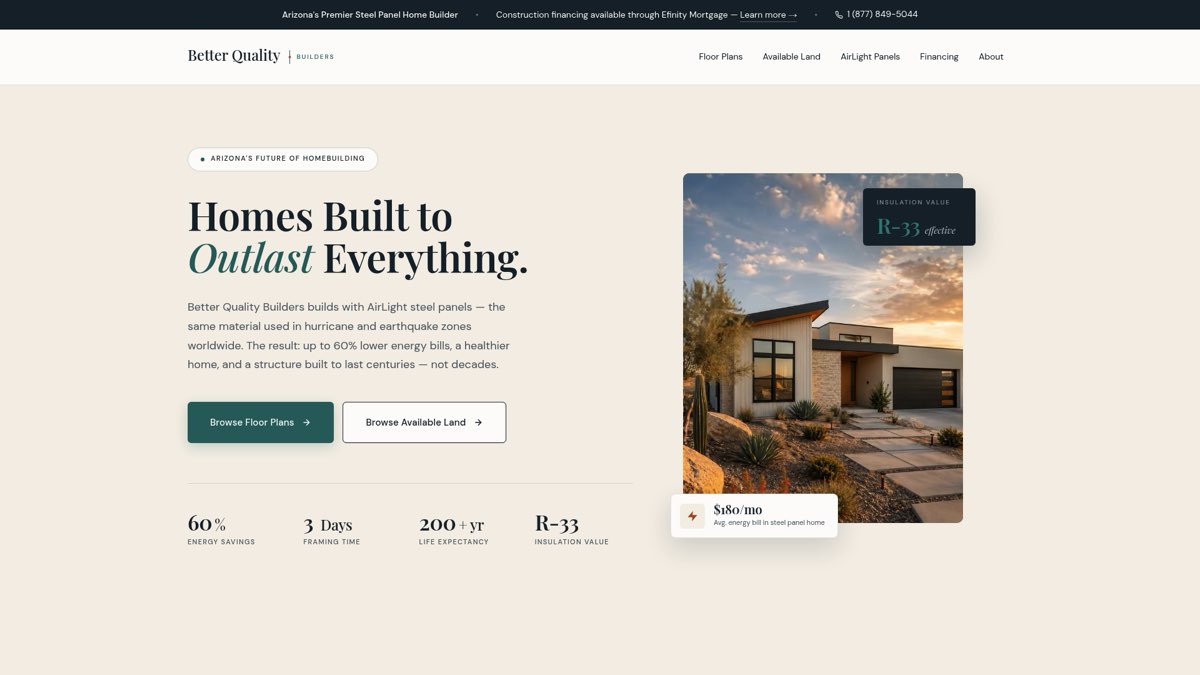
The AirLight steel panel system adds a layer most permit-ready builders don’t offer: lower long-term energy costs and a structure engineered for durability well beyond a standard framed home.
If you already own land, or you’re still hunting for the right parcel, start by browsing available Arizona lots and matching plans to see what’s buildable right now and get a straight answer on cost before you commit to anything.