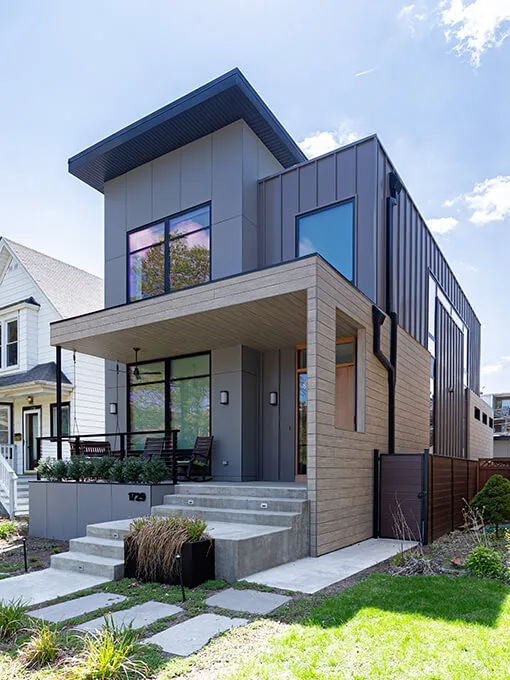
The difference comes down to who controls the design. A fully custom builder builds your plan on your lot; a semi-custom builder lets you modify a plan from their library; a production builder sells a finished model in their own community with a short list of options. Each one fits a different buyer, and picking the wrong one is the most expensive mistake you can make before the first wall goes up.
This guide explains what separates the three in Arizona, how they compare on price, timeline, lot choice, design freedom, and change orders, and how to tell which one a given builder actually is before you sign.
The short version
- Fully custom: your design, usually on a lot you own, with no fixed plan library. The most freedom, the highest cost, the longest timeline, and the most involvement required from you.
- Semi-custom: you start from the builder's existing floor plan and modify it (finishes, some layout, sometimes structure). A middle path on cost, timeline, and effort.
- Production or spec: a finished model home in the builder's own subdivision, with a short menu of options. The lowest cost and the fastest move-in, but the least say over design and lot.
- In Arizona, all three must hold an Arizona Registrar of Contractors residential license. The license class does not tell you which type a builder is, so you have to ask about lot ownership, plan library, and change orders.
- The right choice depends on three things: your budget, whether you already own a lot, and how involved you want to be. There is no universally "best" option.
What is the difference between a custom, semi-custom, and production builder in Arizona?
All three deliver a brand new home, and all three are legally "home builders." What separates them is how much of the design is already decided before you walk in the door.
A fully custom home builder starts from a blank page. You bring a lot, or buy one, and the builder designs and constructs a one-of-a-kind home around your site, your needs, and your budget. There is no catalog of plans to choose from; the plan is drawn for you, often with an architect. This is the model most associated with build-on-your-lot projects in Maricopa County, where buyers own scattered lots in areas like North Scottsdale, Cave Creek, or Paradise Valley rather than a single master-planned subdivision. If the idea of a fully custom build is new to you, our guide to what a custom home build actually involves walks through the whole process.
A semi-custom home builder starts from a library of existing floor plans and lets you make it yours. You pick a base plan, then personalize it: finishes and fixtures nearly always, layout changes often, and structural changes sometimes, within limits the builder sets. It is faster and usually costs less than fully custom because the plan is already engineered, but you are working inside a framework someone else drew. Many Arizona builders who advertise floor plans you can "customize" operate on this model.
A production or spec home builder builds at volume in their own communities. You choose from a handful of model homes, select from a defined menu of options and upgrades, and buy a home the builder is already building (or has already built) on a lot the builder controls. This is the dominant model in Arizona's large master-planned communities. It is typically the most affordable path to a new home and the fastest to move into, because the plans, the lot, and the construction are standardized.
One honest caveat: these labels blur at the edges. Some custom builders keep a few starter plans, and some semi-custom builders will go nearly fully custom for the right project. That is exactly why the label on the website matters less than the questions you ask, which we cover below.
How custom, semi-custom, and production builders compare
Here is how the three stack up on the five things buyers care about most. Because the categories overlap, treat these as the typical pattern, not a hard rule for every builder.
Design freedom
- Fully custom: highest. Any plan you and your designer can draw and your lot and budget can support.
- Semi-custom: moderate. Real choices within the builder's plan library and options; structural changes allowed within set limits.
- Production: lowest. A fixed set of models and a defined options menu.
Price
- Fully custom: generally the highest cost per square foot, because nothing is standardized and the design is unique to you.
- Semi-custom: usually in the middle; you save on the engineered base plan but pay for the changes you make.
- Production: typically the lowest cost per square foot, because volume and repetition drive efficiency.
For what a custom build actually costs in this market, see our breakdown of custom home cost in Arizona. Avoid comparing a production base price to a custom quote directly; they include different things, which is why a line-item accurate estimate matters more than a sticker number.
Timeline
- Fully custom: the longest, because design, engineering, and permitting all start from scratch. Expect many months of design before ground ever breaks.
- Semi-custom: shorter, because the base plan is already drawn and engineered.
- Production: the shortest, and sometimes immediate if the home is already built (a "spec" or inventory home).
Lot choice
- Fully custom: you choose the lot, often one you already own, anywhere a builder will travel. This is the build-on-your-lot model.
- Semi-custom: sometimes your lot, sometimes the builder's; depends on the company.
- Production: the builder's lots, inside the builder's community. You pick from available homesites, not the open market.
Change orders
- Fully custom: expected and built into the process, though each change still has a cost and schedule impact.
- Semi-custom: allowed up to a point; big layout or structural edits may push you toward custom pricing and need an architect or engineer to sign off.
- Production: the most limited. Most choices must be locked before construction, and late changes are often not possible at all.
Who is each type right for?
The best way to choose is to be honest about three things: your budget, whether you already own land, and how much you want to be involved.
A fully custom builder is right for you if:
- You already own a lot, or you want a specific lot that is not inside a production community (a view lot in the foothills, an infill lot in an established neighborhood, acreage in the county).
- Your home has requirements a stock plan cannot meet: a multigenerational layout, a specific accessibility need, a particular orientation for desert heat, or a design that responds to your exact site.
- You want full control and are willing to invest the time that control requires.
A semi-custom builder is right for you if:
- You want a home that feels personal without starting from a blank page.
- You like one of a builder's plans and mainly want to change finishes and some layout.
- You want a balance of choice, cost, and a shorter timeline.
A production builder is right for you if:
- Budget and speed matter more than a unique design.
- You are happy in a master-planned community and one of the model homes already fits your life.
- You want the simplest, most predictable path to a new home.
If you are leaning custom or semi-custom and comparing companies, our list of questions to ask a custom home builder before you sign is built for exactly this stage.
How to tell which one an Arizona builder actually is before you sign
Marketing language is slippery. Plenty of production and semi-custom builders use the word "custom." Here is how to find out what you are really dealing with.
Verify the license and standing first. Every residential builder in Arizona must be licensed by the Arizona Registrar of Contractors. Use the free license lookup to confirm the company is licensed, bonded, and in good standing, and to see any complaint history. Residential builders typically hold a general residential class (the ROC "B" family) or a dual residential and commercial class (the "KB" family); you can read the full license classifications on the ROC site. Important: the license class confirms a builder is legally allowed to build your home, but it does not tell you whether they are custom, semi-custom, or production. For that, ask directly.
Ask these five questions. The answers sort the builder into a category fast:
- "Do you build on a lot I provide, or only in your own communities?" Build-on-your-lot points to custom or semi-custom; "our communities only" points to production.
- "Do I start from your floor plans, or from a blank design?" A plan library means semi-custom (or production); a blank page means fully custom.
- "Can I change the structural layout, and what happens to the price and schedule if I do?" Freedom here separates custom from semi-custom.
- "How do change orders work once we start, and are late changes even possible?" Flexible change orders point to custom; a hard lock points to production.
- "Who draws and engineers the plan, your in-house team, an outside architect, or a stock plan you already own?"
Match the answers to the site. A builder with dozens of named model homes and a community map is almost certainly production or semi-custom. A builder who asks about your lot before anything else is almost certainly custom. Neither is wrong; what is wrong is paying custom prices for a production process, or expecting custom flexibility from a production contract.
Where Better Quality Builders fits
Better Quality Builders is a family-built, fully custom home builder rooted in Maricopa County, licensed and bonded with the Arizona Registrar of Contractors (ROC #366787). We build on your lot across the Phoenix and Scottsdale area, and we design around your site rather than fitting you into a fixed community plan.
We also build differently from a conventional stick-frame production home. Our homes use steel structural insulated panels (AirLight panels) engineered for the desert: dimensional stability in extreme heat, resistance to termites and moisture, and a tight, well-sealed envelope. That construction method is available whether your plan is highly bespoke or adapted from a starting point we discuss together.
[[OWNER-CONFIRM]] David: please confirm how BQB positions its offering for this post. Specifically (a) whether BQB is strictly fully custom or also offers a semi-custom "modify one of our floor plans" path (the site lists floor plans), and (b) any typical price-per-square-foot range or design-to-groundbreaking timeline BQB is comfortable publishing. No figures were invented here; the comparison above is framed in relative terms only.
Frequently asked questions
Is a semi-custom home cheaper than a custom home?
Usually, yes. A semi-custom home starts from a floor plan that is already drawn and engineered, so you are not paying for a design from scratch, and that typically makes it cost less per square foot than a fully custom build. The savings shrink as you add structural changes and premium finishes, and a heavily modified semi-custom plan can approach fully custom pricing. Compare line-item estimates rather than base prices, because the two are rarely built the same way.
Can you customize a semi-custom home?
Yes, within the builder's limits. Semi-custom almost always lets you choose finishes, fixtures, and some layout changes, and many builders allow certain structural edits. What you usually cannot do is redesign the plan freely; large structural changes often require an architect or engineer to approve them and can move you into fully custom territory on both price and timeline. Ask the builder in advance exactly which changes are allowed and which are off limits.
What is the difference between a custom and a production home?
A custom home is designed for you, usually on a lot you choose or own, with no fixed plan. A production home is one of a builder's standard models, built in the builder's own community, with a defined menu of options. Custom offers the most design freedom at the highest cost and longest timeline; production offers the least freedom at the lowest cost and fastest move-in.
Do custom and production builders need different licenses in Arizona?
No. Both must hold an Arizona Registrar of Contractors residential license, commonly a general residential ("B" family) or dual residential and commercial ("KB" family) classification. The license confirms the builder is legally allowed to build homes; it does not indicate whether they work as a custom, semi-custom, or production builder. Verify any license free at roc.az.gov.
Can a custom builder build on a lot I already own?
Yes. Building on a lot you own is the core of the fully custom and build-on-your-lot model, and it is common across Maricopa County. The builder designs the home to suit your specific site, then handles the design, engineering, and City of Scottsdale or Maricopa County permitting for that parcel.
Which should I choose if I am not sure?
Start with your three constraints: your budget, whether you own a lot, and how involved you want to be. If you own a distinctive lot and want full control, lean custom. If you like a builder's plan and want to personalize it affordably, lean semi-custom. If budget and speed lead and a model home already fits, lean production. Then ask every builder the five sorting questions above so the label on their website matches the process you are actually buying.
Sources
- Arizona Registrar of Contractors: residential license lookup, bonding, and complaint records (roc.az.gov)
- Arizona Registrar of Contractors: license classifications, including the residential "B" and dual "KB" building classes (azroc.gov/license-classifications)
- City of Scottsdale Planning and Development and Maricopa County Planning and Development: residential permitting for build-on-your-lot projects (scottsdaleaz.gov, maricopa.gov)
Last updated October 2026. This article is general information for Arizona home buyers, not legal or professional advice. Builder categories overlap and company practices vary; confirm a specific builder's process, license status, and contract terms directly before you sign.