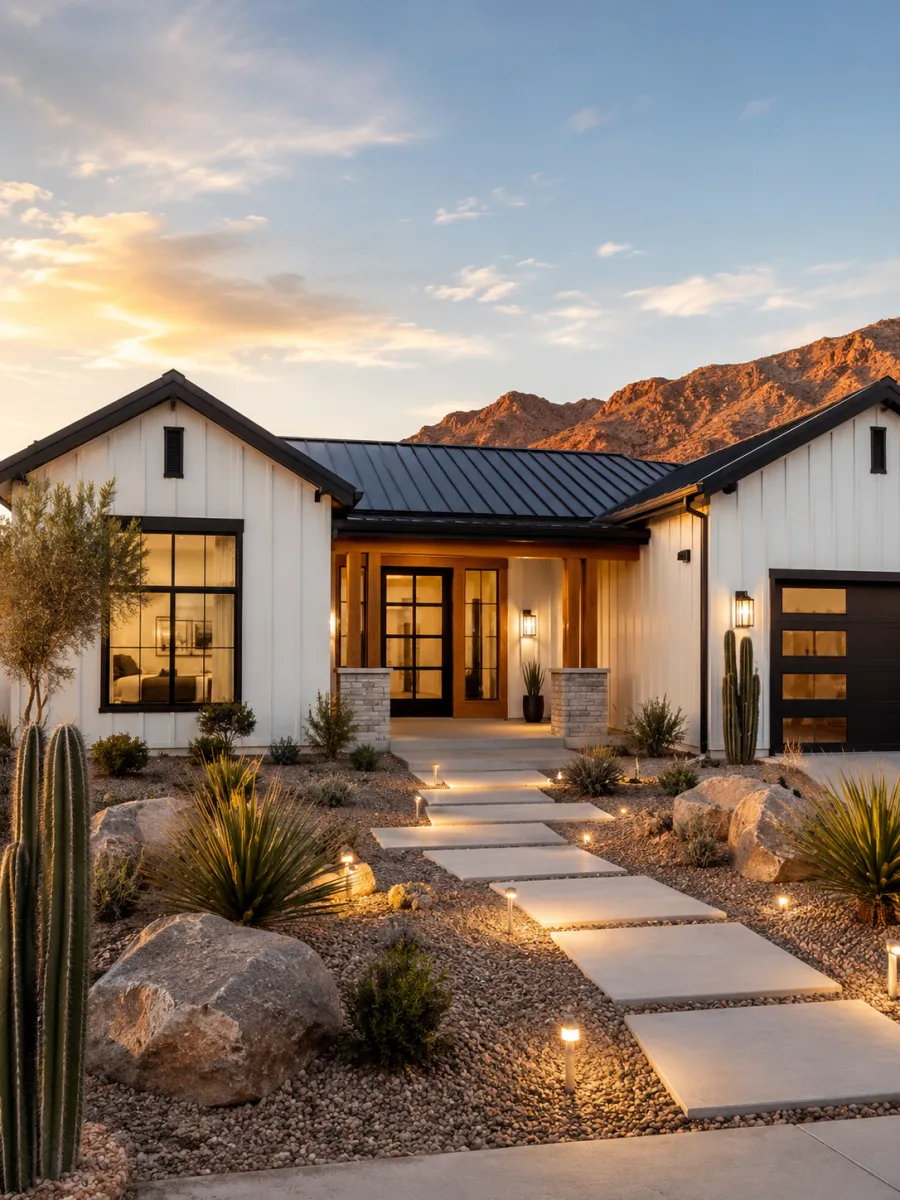
The most energy-efficient way to build a home in Phoenix heat is to stop the sun's energy at the shell of the house before your air conditioner ever has to fight it. In the desert, cooling is the bill that matters, and the wall system, roof, windows, and air sealing that make up the building envelope decide how hard your HVAC works for the next thirty years.
The short version
- In a cooling-dominated climate like Phoenix, the building envelope (walls, roof, windows, and air sealing) controls your summer bill far more than the air conditioner's efficiency rating does.
- The three biggest levers are a high-insulation, airtight wall system, a reflective, well-insulated roof and attic, and low solar-heat-gain windows on the east and west exposures.
- Steel structural insulated panels build a tighter, more thermally stable shell than conventional wood framing, which is why they are the core of how we build in Arizona.
- Summer cooling in a Phoenix-area home commonly runs several hundred dollars a month at peak; a high-performance envelope is what moves you toward the low end of that range instead of the high end.
- Build the envelope right first. It delivers the fastest payback of any energy upgrade because it reduces demand instead of just meeting it more efficiently.
Last updated: October 13, 2026.
What makes a home energy-efficient in Phoenix heat?
Energy efficiency in the desert is a different problem than it is almost anywhere else. In cold-winter states the goal is holding heat in. Here the goal is keeping heat out for the five months a year when afternoon highs sit above 100 degrees. That single difference should drive every design choice.
The U.S. Department of Energy frames it as three layers working in order. Climate sets how much heating and cooling a home will demand. The building envelope (insulation, air sealing, and window performance) decides how much of that demand actually reaches your equipment. Only then does HVAC and fuel type determine how expensive it is to meet whatever load gets through. Most Phoenix buyers skip straight to arguing about the AC unit's SEER rating, when the envelope has already set the ceiling on how low the bill can go.
That is why an "energy-efficient home builder in Phoenix" is really an envelope builder. A tight, heavily insulated shell lets you install a smaller, cheaper-to-run air conditioner and still stay comfortable through a July afternoon. A leaky, poorly insulated shell forces an oversized unit to run constantly and still lose the battle at 5 PM.
Which wall, roof, and window choices cut cooling load most?
Here is where the design dollars do the most work, in order of impact for a Phoenix build.
The wall system
Walls are the largest surface the sun hits all day, so the wall assembly's insulation value and airtightness matter most. What you want in the desert is continuous insulation with as few thermal bridges as possible. A thermal bridge is any material that conducts heat straight through the wall, and in conventional construction the wood studs themselves are the bridge: every stud is a path for outdoor heat to short-circuit the insulation in the cavity beside it.
The best wall system for Arizona heat is one that wraps the structure in continuous insulation and seals tightly, rather than one that relies only on batts stuffed between framing members. That is the central reason we build with steel structural insulated panels, covered in the comparison below.
The roof and attic
A Phoenix attic can reach 150 degrees in summer, and that heat drives straight down into the living space unless the roof assembly stops it. Two choices do the heavy lifting:
- A reflective "cool" roof that bounces solar radiation away instead of absorbing it. Our full guide to cool roofs in Arizona walks through reflective materials and coatings for the desert.
- Heavy attic or roof-deck insulation with proper air sealing. A DOE-affiliated field study of a high-performance prototype home near Phoenix used R-38 attic insulation against R-30 in the standard control house, paired with tight ducts kept inside conditioned space. Pacific Northwest National Laboratory's extreme-heat design guidance likewise calls for high attic or roof insulation, careful air sealing, and well-designed roof ventilation.
The windows
Glass is the weakest link in any desert wall, because it lets solar radiation in as direct heat. The number to know is SHGC, the solar heat gain coefficient, which measures the fraction of the sun's heat a window lets through. The Department of Energy's ENERGY STAR guidance recommends windows with an SHGC at or below 0.40 for hot, cooling-dominated climates. The same Phoenix-area prototype study used spectrally selective low-E glass at SHGC 0.37, against 0.74 for the control home's ordinary double-clear glass: less than half the solar heat for the same amount of window.
Two more window rules for the desert: keep glass area modest on the east and west faces, where low-angle morning and afternoon sun is hardest to shade, and add real shading (deep overhangs, screens, or trees) on those exposures. Our deep dive on choosing windows for Arizona heat covers glazing, coatings, and orientation in detail.
How do steel insulated panels compare with wood frame on thermal performance?
This is the question that separates a merely code-compliant Phoenix home from one built to beat the climate. The comparison comes down to three things: insulation value, thermal bridging, and airtightness.
- Continuous insulation vs. cavity insulation. A steel structural insulated panel is a single engineered sandwich: a rigid foam insulating core bonded between structural facings, manufactured as one continuous piece. A conventional wood-framed wall puts insulation only in the cavities between studs, and the studs themselves are uninsulated gaps in that blanket.
- Thermal bridging. Because the panel's insulation is continuous, there is far less of the stud-by-stud heat path that lets a wood-framed wall leak heat even when the cavities are fully insulated. In a climate where the wall faces 110-degree air for hours, cutting that bridging shows up directly on the cooling bill.
- Airtightness. Panelized assemblies go up with fewer seams and joints than a wall framed stick by stick, which means fewer places for hot outside air to leak in. A tighter shell is a measurable, lasting efficiency gain, not a trim-out detail.
There is a durability angle too, and in the desert it matters for energy: steel structural insulated panels do not shrink, warp, or check the way lumber does as it dries out in extreme heat, so the sealed envelope you pay for on day one stays sealed. Better Quality Builders reports energy bill reductions of up to 60% compared with typical stick-built construction of the same size using our AirLight steel-insulated panels. (Your actual savings depend on the floor plan, glazing, and HVAC, so we provide a per-home performance estimate rather than a blanket promise. [[OWNER-CONFIRM: can we cite a specific documented HERS Index score or third-party energy test result for a completed AirLight home, to back the "up to 60%" figure with a verified number?]])
If you want the engineering case for the panels on their own, see our AirLight steel insulated panels page and our broader guide to building a net-zero-energy custom home. Steel is one strong way to build the envelope; the point of this guide is the envelope itself.
What do new Phoenix homes actually pay to cool in summer?
Cooling is the single largest line item on a Phoenix electric bill, and it is concentrated in the May-through-October window when the air conditioner runs almost continuously.
A few grounded numbers for the Valley:
- Rates. Arizona's residential electricity rates sit slightly below the national average, around 15 cents per kilowatt-hour for a typical APS residential plan. What makes summer expensive is usage, not price: a desert home's cooling load dwarfs the rest of the year.
- Time-of-use penalty. Both APS and SRP push heavy users toward time-of-use plans where on-peak weekday hours (late afternoon, roughly 4 to 7 PM) can cost well over double the off-peak rate. That is exactly when a hot, poorly insulated house is dumping the day's accumulated heat into the living space and the AC is working hardest.
- The bill. Heavy-cooling Phoenix homes commonly see summer electric bills in the several-hundred-dollars-a-month range at the peak of the season, even though the shoulder-month bills are far lower. For an address-accurate figure, the only reliable source is your own or the prior owner's twelve months of billing history, or the published plan rates straight from APS or SRP.
Our new-home utility cost benchmarks post breaks down how home size, climate zone, and envelope quality move that monthly number, and it is the clearest illustration of the core point: two identical-sized homes in the same Phoenix ZIP code can post cooling bills hundreds of dollars apart, and the difference is the shell. Spend on the envelope and you are buying down every summer bill for the life of the home. For how those savings stack up against the build cost, see how energy savings offset build cost in custom homes.
A whole-house checklist for an energy-efficient Phoenix build
Pulled together, here is the order of priorities for a custom home designed to beat the desert:
- Envelope first. A high-insulation, airtight, low-thermal-bridge wall system is the foundation of everything below it.
- Roof and attic. Reflective roofing plus heavy, well-sealed attic insulation and good roof-deck detailing. (cool roofs in Arizona)
- Windows. Low-SHGC (0.40 or below) spectrally selective glass, modest glazing on east and west, real shading on those faces. (windows for Arizona heat)
- Air sealing and ducts. Keep the ductwork inside conditioned space and seal the whole shell; leaks quietly undo the insulation you paid for. (what causes home energy loss)
- Right-sized, efficient HVAC. Once the envelope is tight, the air conditioner can be smaller and run less. (building a net-zero-energy home)
- Optional solar. With demand already low, a modest rooftop system can offset a large share of what remains.
Do these in order. Energy research consistently finds the envelope delivers the fastest payback, because it reduces the demand instead of just meeting it more efficiently.
Building an energy-efficient home in Scottsdale and Phoenix
We are a family-owned custom home builder rooted in Maricopa County, licensed and bonded with the Arizona Registrar of Contractors (ROC #366787). We build with steel structural insulated panels precisely because the desert punishes a weak envelope, month after month, on the electric bill.
Every home we build starts with the shell: a continuous-insulation, airtight panel system engineered for dimensional stability in extreme heat, paired with cool-roof detailing and low-solar-gain glazing sized and shaded for its orientation. The result is a home designed to hold its cool through a July afternoon with a smaller air conditioner doing less work.
If you are planning a build in Phoenix, Scottsdale, or anywhere in Maricopa County, we are glad to walk you through a per-home energy estimate and show you exactly where the savings come from before you commit to a floor plan. Call us at (877) 849-5044 or browse our floor plans to start.
Frequently asked questions
What is the most energy-efficient way to build a home in Phoenix heat?
Build the envelope to stop the sun before it reaches your air conditioner. In a cooling-dominated climate, a high-insulation, airtight wall system, a reflective and well-insulated roof, and low solar-heat-gain windows matter more than the AC unit's efficiency rating. Get the shell right and you can cool the home with a smaller, cheaper-to-run system.
What is the best wall system for Arizona heat?
The best wall system for the desert is one that wraps the home in continuous insulation with minimal thermal bridging and seals tightly, rather than one that relies only on batts between wood studs. Steel structural insulated panels provide a continuous insulated core and fewer seams, which keeps more of the outdoor heat out of the living space.
How much can an energy-efficient envelope save on cooling in Phoenix?
It varies by floor plan, glazing, and HVAC, but the gap between a code-minimum shell and a high-performance one shows up every summer month, not just at closing. Two identical-sized Phoenix homes can post cooling bills hundreds of dollars apart based on the envelope alone. Better Quality Builders reports up to 60% lower energy bills with AirLight steel-insulated panels versus typical stick-built construction of the same size.
Do steel insulated panels really cool better than wood framing?
On thermal performance, the panel's advantages are continuous insulation (no stud-by-stud heat path), fewer seams for air leakage, and dimensional stability in extreme heat so the sealed shell stays sealed. In a climate where walls face 110-degree air for hours, cutting that thermal bridging and air leakage shows up directly on the cooling bill.
What SHGC should windows have for the Phoenix desert?
The Department of Energy's ENERGY STAR guidance recommends a solar heat gain coefficient (SHGC) of 0.40 or lower for hot, cooling-dominated climates. Lower is better in Phoenix. Spectrally selective low-E glass around SHGC 0.37 lets in less than half the solar heat of ordinary double-clear glass. Keep glass area modest and well shaded on east and west exposures.
Is it worth paying more for an energy-efficient custom home in Arizona?
In the desert the envelope upgrades tend to pay back faster than almost any other spend, because every summer the home is cheaper to cool for its entire life. Energy research consistently ranks envelope improvements ahead of equipment upgrades for payback, since they cut demand rather than just meeting it more efficiently.
Sources
- U.S. Department of Energy / ENERGY STAR: window guidance for cooling-dominated climates, SHGC 0.40 or lower (energy.gov, energystar.gov)
- U.S. DOE Building America / NREL: hot-dry-climate prototype home field study (R-38 vs R-30 attic; SHGC 0.37 vs 0.74 glazing; ducts in conditioned space)
- Pacific Northwest National Laboratory, Building America Solution Center: designing for extreme heat (attic insulation, air sealing, roof ventilation, east/west shading) (basc.pnnl.gov)
- Arizona Public Service (APS) and Salt River Project (SRP): residential rate plans and time-of-use pricing (aps.com, srpnet.com)
This article is general information for Arizona homeowners and buyers. Energy performance depends on your specific design, equipment, and usage; ask any builder for a per-home estimate and verify utility rates directly with APS or SRP.