Yes, qualified Arizona residents can use an FHA construction-to-permanent loan to build or substantially renovate a primary residence with a single closing. This is not a niche workaround; it is a federally backed program designed for buyers who want to build new rather than buy existing. Here is what you need to confirm right now:
- Credit score: 580 or above qualifies for 3.5% down; 500–579 requires 10% down
- Down payment: Minimum low down payment required on the total project cost (land + construction)
- Loan limit: Your county’s FHA ceiling applies; Arizona’s common floor is $541,287 for a single-family home
- Builder: Must be a licensed general contractor acceptable to your FHA-approved lender
Your immediate next step: contact an FHA-approved lender to confirm your county loan limit and pre-approval range, or reach out to Better Quality Builders for an Arizona-specific consult before you finalize any lot or floor plan.
Key Takeaways
| Point | Details |
|---|---|
| Minimum down payment | 3.5% for 580+ credit score; 10% for scores between 500 and 579 |
| Arizona county loan floor | 2026 FHA loan limits start at $541,287 for single-family homes in standard-cost counties |
| Down payment assistance | Arizona is Home program can pair with FHA to cover the 3.5% down for eligible Maricopa and Pima county buyers |
| Build timeline | Site-built homes typically take several months; lock plans before closing to avoid change-order delays |
| Better Quality Builders | Combines AirLight panel construction with customizable floor plans and financing support for Arizona buyers |
Table of Contents
- What every Arizona buyer should know about FHA construction loans
- How FHA construction-to-permanent loans work, and how they compare to 203(k) and conventional options
- Who qualifies for an FHA construction loan in Arizona
- Step-by-step: from pre-approval to your permanent mortgage
- Arizona-specific rules: county loan limits, down payment assistance, and permitting
- What an FHA construction loan in Arizona will actually cost you
- How to find FHA-approved lenders and builders in Arizona
- Risks and red flags specific to FHA construction financing in Arizona
- Alternatives to FHA construction loans and when they make more sense
- Why Better Quality Builders often recommends FHA construction-to-permanent for Arizona buyers
- Better Quality Builders can help you build with FHA financing in Arizona
- Sources
What every Arizona buyer should know about FHA construction loans
An FHA construction-to-permanent loan is a one-time close: you sign once, funds are disbursed in draws during construction, and the loan automatically converts to a standard FHA mortgage once the home passes final inspection or receives a certificate of occupancy. HUD insures these loans so lenders can offer lower down payments than conventional programs typically allow.
Who benefits most from this program:
- Buyers with solid income but limited savings (3.5% down is achievable for most working households)
- Arizona residents building on a purchased lot who want rate certainty from day one
- Buyers placing a modular or manufactured home on a permanent foundation
Key numbers to memorize: minimum low down payment required (for qualifying credit), DTI generally at or below 43%, and a typical build timeline of several months for site-built homes. Modular and manufactured placements on permanent foundations can move faster.
The 2026 FHA loan limits in Arizona start at $541,287 for a single-family home in standard-cost counties. High-cost counties carry higher ceilings. Check LendingTree’s Arizona county table or HUD’s official limit page before you set a budget.
How FHA construction-to-permanent loans work, and how they compare to 203(k) and conventional options
The core mechanics
The loan opens as a construction facility. Your lender releases funds in stages called draws, tied to verified milestones. During construction, you pay interest only on the amount drawn, not the full loan balance. Once the final inspection clears and the certificate of occupancy is issued, the loan converts automatically to a fully amortizing FHA mortgage. No second closing, no second set of closing costs.
HUD’s Single Family Housing Handbook 4000.1 governs the appraisal, property standards, and conversion timing. The appraiser evaluates the home “as completed” using your plans and specifications before construction begins, which means your floor plan and finishes must be finalized before underwriting closes.
A typical draw schedule
- Foundation complete — lender releases first draw after inspector confirms footings and foundation
- Framing complete — structural shell verified; second draw released
- Rough-in complete — plumbing, electrical, and HVAC rough-in inspected; third draw
- Drywall and insulation — interior systems enclosed; fourth draw
- Substantial completion — cabinets, fixtures, exterior finish; fifth draw
- Final inspection / CO — punch list cleared, certificate of occupancy issued; final draw and loan conversion
Each draw requires a lender-ordered inspection. Lien waivers from your contractor and subcontractors are typically required before funds are released. Recent HUD program memos have clarified inspection timing and underwriting expectations for construction-to-permanent files, so confirm your lender is current on those updates.
How FHA construction-to-perm compares to your other options
| Feature | FHA one-time-close | FHA 203(k) | Conventional construction loan |
|---|---|---|---|
| Down payment | 3.5% (580+ credit) | 3.5% (580+ credit) | Typically 5%–20% |
| Number of closings | One | One | Often two |
| Owner-builder allowed | Rarely; lender overlays common | No | Sometimes |
| Mortgage insurance | Upfront MIP + monthly MIP | Upfront MIP + monthly MIP | PMI only if under 20% down; drops off |
| Government backing | FHA/HUD | FHA/HUD | None (Fannie/Freddie) |
| Best for | New construction, primary residence | Renovation of existing home | Borrowers with larger down payment |
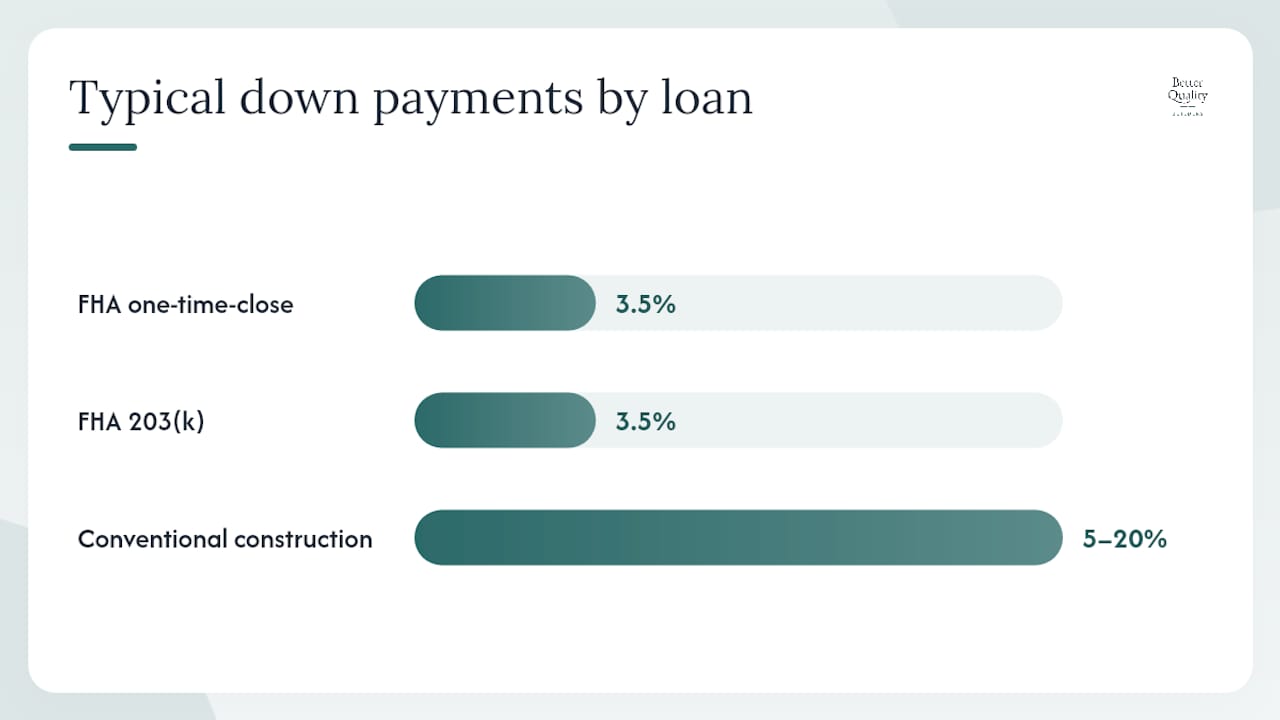
The 203(k) program covers renovation of an existing FHA-insurable home, not ground-up construction. If you are tearing down and rebuilding, or building on a vacant lot, the construction-to-permanent loan is the right FHA vehicle.
Who qualifies for an FHA construction loan in Arizona
Borrower requirements
Your credit score sets your down payment tier. Most lenders apply overlays above the FHA floor, so a score of 620 or higher is a practical target for the widest lender selection.
Income documentation follows standard FHA rules: W-2 employees need two years of employment history and recent pay stubs; self-employed borrowers need two years of tax returns and a year-to-date profit-and-loss statement. Self-employment income is averaged over two years, so a strong recent year paired with a weaker prior year can reduce your qualifying income more than you expect.
Property requirements
The home must be your primary residence. FHA’s Minimum Property Standards (MPS) apply, meaning the completed home must be safe, sound, and sanitary as defined in Handbook 4000.1. Site-built, modular, and manufactured homes placed on permanent foundations are all eligible. The total loan amount, including land and construction costs, must fall within your county’s FHA limit.
Builder requirements
Your general contractor must be licensed in Arizona and acceptable to your lender. FHA does not maintain a separate “approved builder” list, but lenders set their own standards. Most require:
- Active Arizona contractor’s license
- General liability insurance and workers’ compensation coverage
- A signed construction contract with a fixed price or clearly defined cost-plus terms
- A draw schedule aligned with the lender’s inspection process
- Lien waiver documentation at each draw
Owner-builder scenarios (where you act as your own general contractor) are technically permitted under FHA guidelines but are rarely approved in practice. Most lenders overlay a strict prohibition on owner-builder arrangements. If this matters to you, ask specifically before choosing a lender.
Documentation checklist for pre-approval
- Two years of W-2s or tax returns (plus year-to-date P&L if self-employed)
- 30 days of recent pay stubs
- Two to three months of bank statements
- Signed construction contract with itemized cost breakdown
- Architectural plans and specifications
- Builder’s license number, insurance certificates, and resume of comparable projects
- Lot purchase agreement or deed (if you already own the land)
Pro Tip: If you are self-employed, run your numbers with a mortgage professional before you file your next tax return. Aggressive deductions reduce taxable income, which is great for taxes but can shrink your qualifying income below the threshold you need. Timing matters.
Step-by-step: from pre-approval to your permanent mortgage
The process has more moving parts than a standard purchase loan, but each step is predictable when you know what is coming. Here is the full sequence:
-
Pre-approval. Submit financial documents to an FHA-approved lender. Get a pre-approval letter that specifies your maximum loan amount and confirms the program (construction-to-permanent, not a standard FHA purchase).
-
Finalize plans and contract. Work with your builder and, if needed, an architect to produce complete plans and specifications. Your lender needs these to order the appraisal. Incomplete plans are the most common cause of underwriting delays. A custom home architect familiar with FHA property standards can save weeks at this stage.
-
Appraisal and underwriting. The FHA-approved appraiser reviews your plans and issues an “as-completed” value. Underwriting then verifies all borrower, property, and builder documentation. Expect two to four weeks for this stage under normal conditions.
-
Closing. You sign the full loan package, including the permanent mortgage terms. The lender establishes the construction escrow. No funds go to the builder yet.
-
Construction draws with inspections. Your builder requests draws as milestones are reached. The lender orders an inspection for each draw. Funds are released after the inspector confirms completion and lien waivers are received. Interest accrues only on the drawn balance.
-
Final inspection and certificate of occupancy. The local building department issues the CO. The lender orders a final inspection. Once both clear, the construction phase closes.
-
Loan conversion. The loan converts automatically to a standard FHA mortgage. Your first regular principal-and-interest payment is due the following month. Review your amortization schedule and confirm the permanent rate matches your closing documents.
For a detailed milestone-by-milestone checklist, the custom home build process guide covers Arizona-specific timing and what to expect at each stage.
Common delays and how to reduce them:
- Permit timing: Maricopa County and City of Phoenix permit offices can run four to eight weeks for residential permits. Submit plans early and confirm your builder has a permit expediter relationship.
- Change orders: Every change order after underwriting closes can trigger a re-appraisal or lender review. Lock your plans before closing.
- Appraisal shortfalls: If the as-completed value comes in below the project cost, you must cover the gap in cash or reduce scope. Finalize your finishes before the appraisal, not after.
Arizona-specific rules: county loan limits, down payment assistance, and permitting
2026 FHA loan limits in Arizona
Stat callout: LendingTree reports that 2026 FHA loan limits in Arizona start at a baseline amount for single-family homes, with higher ceilings in high-cost counties.
Most Arizona counties sit at or near that floor. Maricopa County, home to Phoenix and Scottsdale, may carry a higher ceiling depending on area median home prices. Confirm your specific county’s limit directly with your lender or on HUD’s official limit lookup before finalizing your project budget.
Down payment assistance: Arizona is Home
The Arizona is Home program, administered by the Arizona Department of Housing, offers down payment assistance that can be paired with FHA financing for qualified buyers in Maricopa and Pima counties. Income limits and purchase price caps apply, so check current eligibility thresholds directly with the program before counting on it in your budget.
Industry professionals consistently recommend pairing state DPA programs like Arizona is Home with FHA financing as a practical way to reduce upfront costs for buyers who qualify. If you are building in Maricopa County, this combination deserves a serious look.
Permitting and zoning realities in Arizona
- Permit lead times: City of Phoenix and Maricopa County typically have permit processing times ranging from about a month to two months; Tucson and Pima County are similar. Plan for this in your construction timeline.
- HOA considerations: Many Arizona communities, particularly in Scottsdale, Chandler, and Gilbert, have HOA architectural review requirements. HOA approval must precede permit submission in most cases. For HOA-governed properties, exterior compliance and finish standards can affect your timeline if not addressed early.
- County inspection rules: Each county and municipality has its own inspection schedule and inspector availability. Your builder should have an established relationship with the local building department.
- Zoning: Confirm the lot is zoned for your intended use (single-family residential) before closing on land. Agricultural or commercial zoning requires rezoning, which can take months and is not guaranteed.
What an FHA construction loan in Arizona will actually cost you
Budget line items
- Down payment: Low minimum down payment required for better credit scores; higher down payment required for lower credit scores
- FHA upfront mortgage insurance premium (UFMIP): a percentage of the base loan amount, typically rolled into the loan
- Annual MIP: an annual percentage rate for most 30-year loans with less than 10% down, paid monthly
- Interim interest during construction: Interest-only on drawn funds; not the full loan balance
- Closing costs: a typical range percentage of the loan amount; includes origination, title, appraisal, and escrow fees
- Builder contingency: budget a percentage of construction cost for change orders and unexpected conditions
How interest works during construction
Interest accrues only on the amount your lender has disbursed to the builder, not the full loan balance. Early in the build, when only the foundation draw has been released, your monthly interest payment is small. It grows with each draw. This is a real cash-flow advantage compared to paying full mortgage payments while your home is still being framed.
Sample calculation
- UFMIP: $434,250 × 1.75% = $7,599 (rolled into loan, bringing total loan to approximately $441,849)
- Monthly MIP: $441,849 × 0.55% ÷ 12 = approximately $202/month
- Interim interest at 50% draw: $217,125 drawn × 7.0% ÷ 12 = approximately $1,267/month during mid-construction
- Permanent payment (30-year, 7.0%): Approximately $2,940/month principal and interest, plus $202 MIP, plus taxes and insurance
Use a construction loan calculator to model your specific scenario with Arizona county taxes and your actual draw schedule.
Model that refinance scenario before you close so you know the break-even point.*
How to find FHA-approved lenders and builders in Arizona
Finding the right lender
Start with HUD’s lender search tool to identify FHA-approved originators in Arizona. Then verify any lender’s license and complaint history through NMLS Consumer Access, the authoritative public registry for mortgage companies and individual loan officers.
Not every FHA-approved lender actively originates construction-to-permanent loans. Many approve standard FHA purchase loans but have no operational experience with draw management or construction underwriting. Ask directly:
- How many FHA one-time-close construction loans did you close in the past 12 months?
- What is your policy on owner-builder arrangements?
- What builder documentation do you require before underwriting?
- What is your typical timeline from application to closing?
- Do you use in-house or third-party draw inspectors?
Vetting your builder
Your builder’s draw management experience matters as much as their construction quality. Ask:
- Have you completed FHA construction-to-permanent projects before?
- How do you handle lien waivers at each draw stage?
- Can you provide your license number, insurance certificates, and references from recent FHA projects?
- What is your change-order policy, and how do you document scope changes?
For finish-stage work, confirm that subcontractors carry their own liability insurance. Uninsured subcontractors create lien risk and can delay draw releases. Reputable local trade partners, like those handling exterior painting in Tucson, carry the documentation your lender will want to see.
Red flags to walk away from:
- Builder cannot produce a detailed draw schedule tied to construction milestones
- Lender has never processed a construction-to-permanent file
- No written change-order policy
- Builder resists providing lien waivers or insurance certificates
- Lender cannot explain how the loan converts to permanent status
Risks and red flags specific to FHA construction financing in Arizona
FHA construction loans have more moving parts than a standard mortgage, and the failure points are predictable. Here is what to watch for:
- No contingency fund: A 5%–10% contingency is standard. Builders who resist including it in the contract are signaling that they do not plan for the unexpected, and unexpected costs are universal in construction.
- Appraisal shortfalls: If the as-completed appraisal comes in below your project cost, you must cover the gap in cash. Finalize all finishes and specifications before the appraisal is ordered.
- FHA Minimum Property Standards conflicts: Plans that include non-standard features (flat roofs in flood-prone areas, certain well/septic configurations, inadequate egress) can trigger MPR violations. Review your plans against HUD’s property standards before submitting for appraisal.
- Permitting delays: Arizona municipalities vary widely in permit processing speed. A delayed permit pushes every subsequent milestone and can cause your rate lock to expire.
- Lien risk: If your general contractor does not pay subcontractors and suppliers, those parties can file mechanic’s liens against your property. Require lien waivers at every draw, without exception.
- Change orders after closing: Any material change to plans after underwriting can require lender approval and potentially a new appraisal. Lock your scope before you close.
Pro Tip: Hire an independent inspector at the foundation, framing, and rough-in stages, separate from the lender’s draw inspector. The lender’s inspector confirms milestone completion for draw purposes; your inspector protects your long-term interests. The cost is minimal compared to discovering a structural issue at final inspection.
Alternatives to FHA construction loans and when they make more sense
The FHA construction-to-permanent loan is a strong option, but it is not always the best fit. Here is how the main alternatives stack up:
- FHA 203(k): Covers renovation of an existing home, not ground-up construction. The Limited 203(k) handles cosmetic repairs up to $75,000; the Standard 203(k) covers structural work. If you are buying a fixer-upper rather than building new, this is the right FHA vehicle.
- Conventional one-time-close: Requires a larger down payment (typically 5%–20%) but mortgage insurance drops off once you reach 20% equity. Better for buyers with strong credit and more cash who want to eliminate MIP faster.
- VA construction loan: Zero down for eligible veterans and active-duty service members. If you qualify, this is almost always the most cost-effective option. VA funding fee applies but there is no monthly MIP.
- USDA construction loan: Zero down for eligible rural properties. Arizona has qualifying rural areas; check USDA’s eligibility map for your lot address. Income limits apply.
- Two-close construction loan: A short-term construction loan that converts to a separate permanent mortgage at completion. Two closings mean two sets of closing costs, but you can shop the permanent rate at conversion. Useful when rates are expected to drop significantly during your build.
| Feature | FHA one-time-close | Conventional OTC | VA | USDA |
|---|---|---|---|---|
| Down payment | 3.5% | 5%–20% | 0% | 0% |
| Mortgage insurance | Upfront + monthly MIP | PMI until 20% equity | Funding fee only | Guarantee fee |
| Number of closings | One | One | One | One |
| Owner-builder | Rarely | Sometimes | Rarely | Rarely |
| Best for | Lower down payment, primary residence | Higher credit/cash buyers | Eligible veterans | Rural lot buyers |
The long-term MIP savings often outweigh the higher upfront cash requirement. If you are a veteran, start with VA before looking at anything else.
Why Better Quality Builders often recommends FHA construction-to-permanent for Arizona buyers
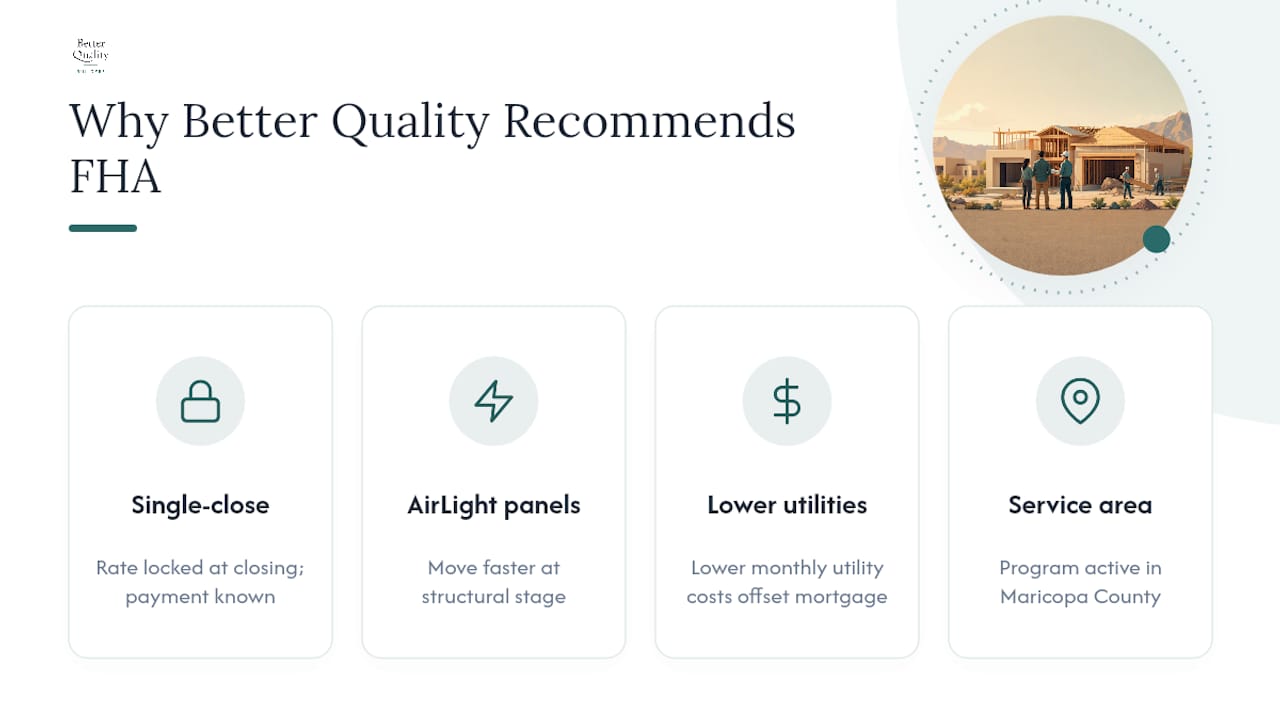
The single-close structure is what makes FHA construction financing particularly well-suited to how Better Quality Builders operates. When a client locks their rate at closing, they know their permanent payment before the first panel goes up. That predictability matters when you are managing a build timeline that runs nine months or longer.
AirLight steel-insulated panel construction tends to move faster than traditional stick-frame builds at the structural stage, which compresses the draw period and reduces the total interim interest a borrower pays. Lower monthly utility costs offset a portion of the mortgage payment in real household budget terms.
Better Quality Builders works with buyers in Maricopa County specifically, where that program is active.
What to bring to a pre-consultation with Better Quality Builders: your pre-approval letter or a summary of your financial picture, any lot information you have identified, a rough sense of your target square footage and floor plan preferences, and your timeline. The more specific you are, the more useful the conversation.
Better Quality Builders can help you build with FHA financing in Arizona
Building a custom home with FHA financing is achievable, and having the right builder makes the process significantly smoother. Better Quality Builders combines AirLight steel-insulated panel construction with a library of customizable floor plans, real-time lot inventory, 3D previews of your home on your chosen lot, and support for combined land and construction financing with as little as 10% down.
For a consultation, bring your financial documents, any lot information, and your floor plan preferences. Better Quality Builders will walk you through the build package, financing structure, and timeline so you can move from planning to pre-approval with a clear picture of costs and next steps. Visit Better Quality Builders to request your consultation and see what is possible for your Arizona build.
Sources
Use these official resources to confirm specifics before you commit to a lender or builder:
- Arizona is Home program — Arizona Department of Housing
- 2026 FHA Loan Limits in Arizona - LendingTree
- HUD: Helping Americans — Loans overview
- NMLS Consumer Access
This article is general information, not a substitute for advice from a qualified financial advisor. Consult a qualified financial professional about your own circumstances before acting on anything here.