Green building certification types for homes are defined as verified third-party programs that confirm a home meets specific standards for energy efficiency, sustainability, and occupant health. The leading residential certification systems include LEED, ENERGY STAR, the National Green Building Standard (NGBS), PHIUS Passive House, WELL, and the Living Building Challenge. Each program targets a different set of priorities, from thermal performance to indoor air quality, and choosing the right one shapes your project’s cost, timeline, and long-term value. Third-party certification adds credibility with buyers and lenders by verifying what a home actually delivers, not just what it claims.
1. Green building certification types homes: what each program covers
The six major residential certification systems each address a distinct set of performance goals. Understanding what each one measures helps you match the right program to your project.
-
LEED (Leadership in Energy and Environmental Design): LEED uses a point-based scoring system across categories including energy, water, materials, and indoor environmental quality. LEED certification tiers run from Certified (40–49 points) through Silver (50–59), Gold (60–79), and Platinum (80 or more). The program is thorough, but its documentation demands are among the highest of any residential certification.
-
ENERGY STAR: ENERGY STAR focuses specifically on energy performance. ENERGY STAR homes must perform at least 10% more efficiently than the IECC baseline, verified by a third-party assessor. That threshold means real, measurable savings on utility bills, not just design intent.
-
NGBS (National Green Building Standard): The NGBS is an ANSI-approved standard with five certification tiers: Certified, Bronze, Silver, Gold, and Emerald. Over 700,000 homes have earned NGBS certification nationwide. Builders favor it because its documentation process is more flexible than LEED’s, making it practical for production and custom home projects alike.
-
PHIUS (Passive House Institute US): PHIUS sets some of the strictest performance standards in residential construction. PHIUS 2021 standards limit envelope air leakage to a maximum of 0.06 CFM50 per square foot and require rigorous insulation levels. Homes built to this standard use a fraction of the energy of a code-built house.
-
WELL Building Standard: WELL shifts the focus from the building’s environmental footprint to the health of the people inside it. WELL certification addresses indoor air quality, water quality, lighting, thermal comfort, and occupant well-being. It works well as a complement to LEED or ENERGY STAR rather than a standalone replacement.
-
Living Building Challenge: The Living Building Challenge is the most demanding standard on this list. It requires net-positive energy and water performance, meaning the home must produce more than it consumes. Projects must also meet strict materials requirements that prohibit a list of harmful chemicals. Few residential projects achieve it, but those that do represent the highest tier of verified sustainable building.
2. How certification requirements and documentation demands compare
Choosing a certification is not just about performance goals. The paperwork, testing, and verification each program requires can significantly affect your project’s budget and schedule.
| Certification | Verification method | Documentation load | Airtightness test required |
|---|---|---|---|
| LEED | Third-party LEED assessor | High | Optional by credit |
| ENERGY STAR | HERS rater inspection | Moderate | Yes (blower door) |
| NGBS | Third-party verifier | Moderate, flexible | Yes |
| PHIUS | PHIUS-certified rater | High, technical | Yes (strict threshold) |
| WELL | WELL assessor | High | No |
| Living Building Challenge | LBC auditor | Very high | Yes |
LEED’s documentation overhead can increase project costs compared to NGBS, which offers a more flexible, builder-friendly process. That difference matters most on smaller custom projects where administrative time directly affects the bottom line.
PHIUS requires the most technical discipline of any program on this list. Even minor penetrations during rough-in can cause test failures and expensive remediation. Builders pursuing PHIUS need trained trades and should schedule early blower-door testing before walls are closed.
Pro Tip: Lock in your certification target before schematic design begins. Early certification planning reduces costly retrofit risks and keeps your entire team aligned from day one.
3. How to choose the right certification for your home project
The right certification depends on four factors: your performance goals, your budget for certification costs, your builder’s experience, and how you plan to use the home long-term.
-
Match rigor to your goals. If your primary goal is lower energy bills, ENERGY STAR or PHIUS delivers the clearest return. If you want a comprehensive sustainability score that covers materials and site, LEED is the stronger fit. If occupant health is the priority, add WELL to your plan.
-
Factor in certification costs. LEED and PHIUS carry higher soft costs because of their documentation and testing requirements. NGBS offers a lower administrative burden, which makes it a practical starting point for builders new to green certification.
-
Know who drives the decision. Builders often prefer NGBS for its practical application, while architects tend to drive adoption of technical certifications like PHIUS for complex, high-performance homes. Aligning your builder and architect on the certification target early prevents conflicts later.
-
Think about resale value. Green certifications add resale premiums and support faster sales by giving buyers and lenders verified performance data. If resale is a priority, choose a certification that buyers in your market recognize.
-
Plan for combined certifications. LEED and WELL can be pursued together for comprehensive benefits. Homeowners often assume sustainability and health certifications are mutually exclusive, but combining them captures both environmental and wellness value in a single project.
-
Build certification into the design phase. Retrofitting a home to meet certification requirements after construction begins is expensive and often impossible. The role of your architect in embedding certification specs into the initial design is one of the most cost-effective decisions you can make.
Pro Tip: Ask your builder for a list of certifications they have completed, not just ones they are familiar with. Completed projects mean trained trades, established documentation workflows, and fewer surprises during testing.
4. Emerging trends shaping residential green certifications in 2026
Green home certifications are expanding beyond energy efficiency to cover the full picture of how a home affects its occupants and the environment.
-
Wellness integration is accelerating. WELL certification adoption in residential projects has grown steadily as homeowners connect indoor air quality and lighting to long-term health outcomes. Builders who offer custom home air quality improvements as a standard feature are better positioned to pursue WELL alongside energy certifications.
-
ESG and financing are driving demand. Green certifications are becoming essential for validating ESG commitments and enhancing resale value through trusted third-party verification. Lenders and appraisers increasingly treat certified homes as lower-risk assets.
-
Combined certification strategies are growing. Builders and homeowners are pairing ENERGY STAR with WELL, or NGBS with PHIUS-level airtightness targets, to capture multiple performance benefits without committing to the full administrative load of a single high-end program.
-
Net-zero alignment is becoming a baseline expectation. The Living Building Challenge and PHIUS are setting the performance bar that other programs are moving toward. Homeowners building net-zero energy homes today are ahead of where code requirements are heading in the next decade.
-
Custom home builders are gaining a competitive edge. Production builders have been slower to adopt rigorous certifications because of volume constraints. Custom builders who master PHIUS or LEED Platinum are differentiating themselves in a market where verified performance is becoming a purchase criterion, not just a marketing claim.
Key takeaways
The most effective approach to green home certification is selecting the right program during the design phase, aligning your builder and architect on its requirements, and verifying performance through third-party testing before construction closes.
| Point | Details |
|---|---|
| Match certification to your goals | Energy savings favor ENERGY STAR or PHIUS; comprehensive sustainability favors LEED; health focus favors WELL. |
| Start in the design phase | Selecting your certification before schematic design prevents costly retrofits and keeps the team aligned. |
| NGBS suits most builders | With over 700,000 certified homes and a flexible process, NGBS is the most practical entry point for custom builders. |
| PHIUS demands trade discipline | Airtightness failures during rough-in are expensive; early blower-door testing and trained trades are non-negotiable. |
| Combine certifications strategically | LEED and WELL can be pursued together to capture both environmental and occupant health benefits in one project. |
What I’ve learned about green certifications after years in custom home building
A field perspective on green certifications from David Kobierski
The biggest mistake I see homeowners make is choosing a certification based on its name recognition rather than its fit for their project. LEED Platinum sounds impressive, but if your builder has never completed one and your budget does not account for the documentation overhead, you are setting yourself up for a frustrating experience.
The certifications that deliver the most value are the ones your team can actually execute. I have seen NGBS projects come in clean, on time, and under budget because the builder knew the process cold. I have also seen LEED projects stall because no one owned the documentation workflow. The certification on the wall matters less than the performance inside the walls.
PHIUS is the one certification I would never attempt without a builder who has completed at least two prior projects under that standard. The airtightness requirements are unforgiving. One missed penetration around a plumbing rough-in can fail a blower-door test and cost weeks of remediation. The homes that come out of a successful PHIUS build are extraordinary, but the path there requires a level of trade coordination that most teams underestimate.
My honest advice: pick the certification that your builder has completed before, then push them to the next tier up. That combination of proven experience and incremental ambition produces better homes than chasing a prestigious label with an unprepared team.
— David Kobierski
Building certified green homes with Better Quality Builders
Better Quality Builders brings hands-on certification experience to every custom home project in Arizona. Whether you are targeting ENERGY STAR verification, Passive House airtightness standards, or a combined LEED and WELL approach, the team at Better Quality Builders integrates certification requirements from the first design conversation, not as an afterthought.
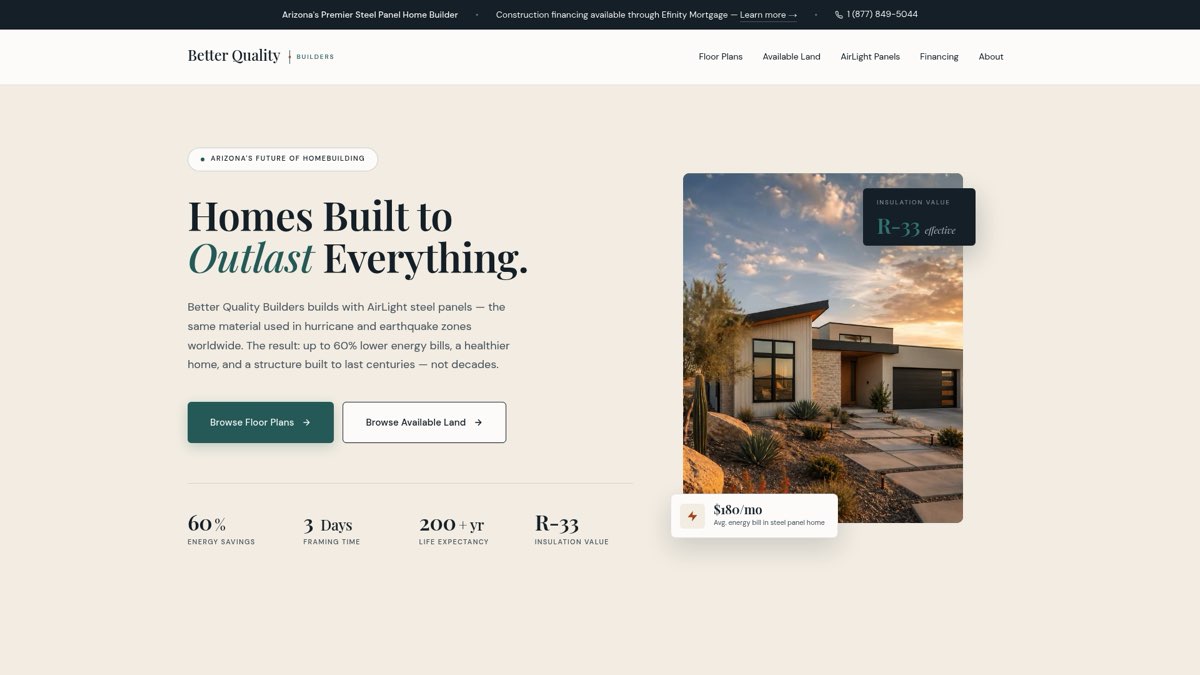
Better Quality Builders constructs with AirLight steel panels, a building system engineered for the airtightness and thermal performance that high-performance certifications demand. The result is a home that meets verified green standards and delivers up to 60% lower energy bills. If you are ready to build with a team that has completed the process before, explore custom home plans designed with certification criteria built in from day one.
FAQ
What is the most common green building certification for homes?
ENERGY STAR is the most widely adopted residential green certification in the United States, requiring homes to perform at least 10% more efficiently than the IECC baseline, verified by a third-party assessor.
How much does green home certification cost?
Certification costs vary by program. LEED and PHIUS carry higher soft costs due to documentation and testing requirements, while NGBS offers a more flexible, lower-overhead process suited to most custom home budgets.
Can a home hold more than one green certification?
Yes. LEED and WELL are commonly combined because they address different priorities. LEED covers environmental performance while WELL focuses on occupant health, and pursuing both captures comprehensive benefits in a single project.
What is the difference between PHIUS and ENERGY STAR?
ENERGY STAR sets a minimum energy efficiency threshold above code, while PHIUS sets strict airtightness and thermal performance limits that go significantly further. PHIUS requires envelope leakage no greater than 0.06 CFM50 per square foot, a standard that demands precision construction throughout.
Does green certification increase home resale value?
Green certifications add resale premiums and support faster sales by giving buyers and lenders verified, third-party-confirmed performance data rather than unverified marketing claims.