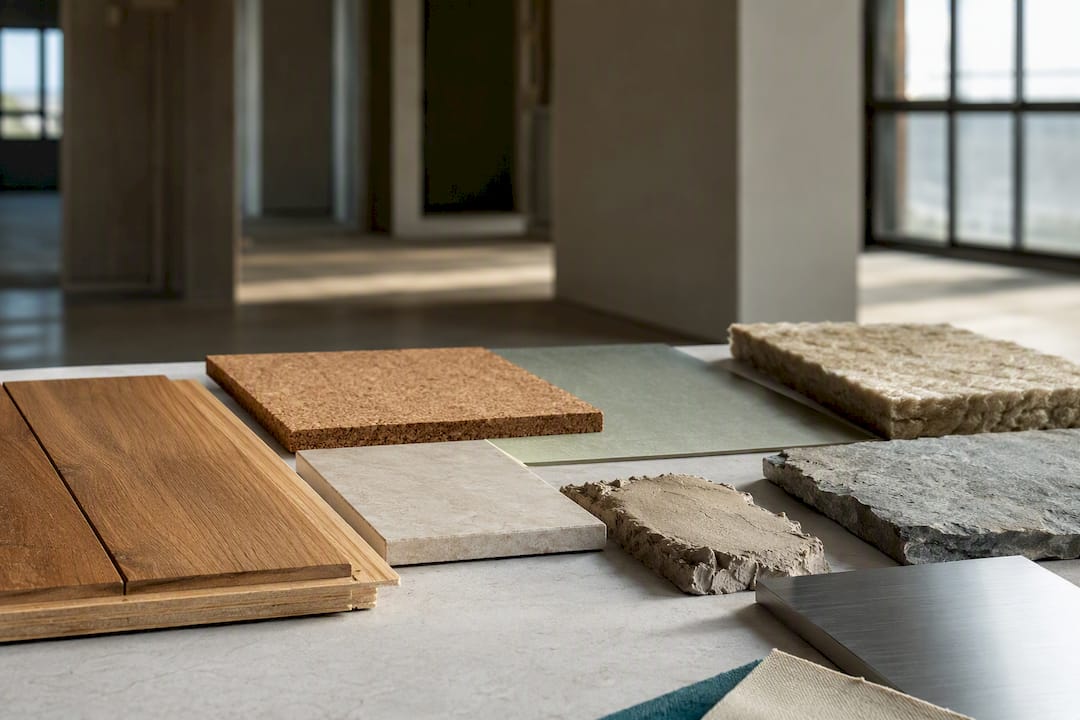
The healthiest home materials share four traits: solid wood, natural stone, mineral wool, cork, clay, or lime plaster over engineered wood, vinyl, and spray polyurethane foam. The single highest-impact move you can make is verifying third-party emissions certification before you buy anything, then pairing those materials with balanced mechanical ventilation. Ask every supplier for a Health Product Declaration, a Declare label, or GREENGUARD Gold documentation before it goes on your order.
TL;DR:
- Choosing materials with third-party emissions certification and pairing them with proper ventilation significantly reduces indoor pollutant levels.
- Sustainable options like solid wood, natural stone, mineral wool insulation, and clay plaster outperform conventional, chemical-heavy materials across categories.
- Prioritize flooring, cabinetry, and paint, as these areas contribute most to indoor air quality and have affordable, low-VOC alternatives.
- Vigilantly verify product safety through documentation such as HPDs, Declare labels, or GREENGUARD Gold, and request test data if unavailable.
- Integrate building systems from the start with a focus on envelope, insulation, and ventilation to achieve long-term healthier indoor environments.
Table of Contents
- Choosing Healthy Home Materials by Category
- What Chemicals Should You Avoid in Building Materials?
- Which Certifications Actually Prove a Material Is Safe?
- Why Ventilation Matters as Much as Materials
- How Do You Prevent Mold With the Right Materials?
- How Do You Verify a Material Is Actually Healthy?
- A Builder’s View on Material Choices That Actually Hold Up
- How Better Quality Builders Builds Healthier Homes From the Ground Up
- Sources
- FAQ
Choosing Healthy Home Materials by Category
Every room in your house has a low-tox option that performs as well as its conventional counterpart, and in most categories, it costs about the same. The trick is knowing which category actually moves the needle on indoor air quality, since flooring and cabinetry tend to matter more than trim or hardware.
Flooring: Solid wood, cork, natural linoleum, and porcelain tile top the list of healthier building products recommended by material researchers. Skip PVC-based vinyl and vinyl-plank products where you can. Multiple design publications flag vinyl flooring as one of the more common offenders in a healthy build, largely because of what it releases over its lifecycle.
Walls: Clay plaster, lime plaster, and magnesium oxide (MgO) board outperform standard drywall on moisture tolerance and chemical load. Paperless gypsum board is a solid middle ground if a full plaster wall isn’t in the budget.
Insulation: Mineral wool, cellulose, and wool batts avoid the blowing agents and isocyanates found in some spray foams. They cost a little more upfront in some markets, but they don’t require the same off-gassing window before occupancy.
Cabinetry and composite wood: Look for products labeled NAUF (no added urea formaldehyde) or documented as compliant with TSCA Title VI or CARB Phase II. These federal formaldehyde-emission standards apply to particleboard, medium-density fiberboard, and hardwood plywood, so any cabinet maker should be able to hand you the paperwork.
Countertops and finishes: Natural stone, quartz with disclosed resin content, and stainless steel outperform laminate on emissions. For paint and sealants, choose low or zero-VOC formulations and apply them with the space fully ventilated.
What Chemicals Should You Avoid in Building Materials?
Volatile organic compounds (VOCs) and formaldehyde are the two chemical families that show up most often in building materials, and both are worth screening for by name. VOCs off-gas from paints, sealants, adhesives, and manufactured wood, and indoor concentrations run measurably higher than outdoor air. Formaldehyde, a specific VOC found heavily in composite wood, is linked to eye and throat irritation at low exposure and more serious long-term risks at higher levels.
Beyond those two, watch for:
- Phthalates, common in vinyl flooring, shower curtains, and some caulks
- PFAS, used in stain-resistant carpets and some sealants
- Halogenated flame retardants, found in foam insulation and upholstered furniture
Children, older adults, and anyone with asthma or chemical sensitivity face higher risk from these exposures. The clearest procurement red flag is vagueness. If a manufacturer can’t produce an HPD, a Declare label, or a third-party certification when you ask, treat that as a “no” rather than benefit of the doubt.
Which Certifications Actually Prove a Material Is Safe?
No single label tells the whole story, so you’re looking for two things at once: proof of low emissions and proof of what’s actually inside the product. Combining an emissions certification with an ingredient disclosure is the only way to avoid greenwashing.
- GREENGUARD Gold certifies low chemical emissions and is one of the strictest thresholds on the market.
- FloorScore applies specifically to flooring and flooring adhesives for VOC emissions.
- Declare / Red List Free discloses every ingredient in a product and flags anything on the Living Building Challenge’s restricted list.
- Cradle to Cradle rates a product across material health, recyclability, and manufacturing.
- FSC (Forest Stewardship Council) certifies that wood came from responsibly managed forests.
- EPA Indoor AirPlus sets low-emission requirements for composite wood, paint, and carpet, and it recommends GREENGUARD Gold or SCS Indoor Advantage Gold as qualifying certifications, alongside CRI Green Label Plus for carpet.
Pro Tip: If a product has no certification at all, ask directly for its Safety Data Sheet and any emissions test data the manufacturer has on file. A legitimate supplier will have both on hand within a day.
Why Ventilation Matters as Much as Materials
Materials set your pollutant ceiling. Ventilation determines whether pollutants that do exist ever leave the building. A balanced mechanical system, an energy recovery ventilator or heat recovery ventilator, keeps fresh air cycling through the house continuously instead of relying on cracked windows or leaky construction.
Filtration matters just as much as air exchange:
- MERV 13 is the practical minimum for a whole-house HVAC filter
- HEPA filtration adds meaningful protection for households with asthma or allergies
- Target indoor relative humidity between 30% and 50% year-round
A tight, low-organic envelope paired with proper ERV/HRV ventilation and filtration achieves the lowest long-term indoor pollutant exposure of any combination tested by healthy-building standards. An HVAC contractor experienced in indoor air quality upgrades can help you size the system correctly for your square footage and climate zone. Skipping ventilation while upgrading materials is like buying premium ingredients and never opening a window while you cook.
How Do You Prevent Mold With the Right Materials?
Mold needs three things: moisture, a food source, and time. Building assemblies that manage all three at once are the ones that hold up. Healthy building standards generally point to four layers of moisture control: drainage, a water-resistive barrier, air sealing, and a functioning vapor strategy that lets any trapped moisture escape.
- Use water-resistant hard-surface flooring, tile or stone, in bathrooms, laundry rooms, and entryways.
- Choose paperless gypsum or MgO board in any area prone to splashing or humidity.
- Never enclose wet or damp framing lumber. Verify moisture content with a meter before drywall goes up.
- Store lumber and insulation off the ground and covered until installation.
- In high-moisture climates, inorganic sheathing and mineral-wool-based wall assemblies resist mold growth far better than organic materials like OSB or standard fiberglass batts.
Construction-phase moisture control, actually checking that your framing is dry before you close the walls, cuts mold risk substantially even when every material in the house is otherwise healthy. If you’re renovating an older home in a humid or monsoon-prone region, our guide to mold-resistant steel panel construction walks through assembly choices in more detail.
How Do You Verify a Material Is Actually Healthy?
Verification is a paperwork problem before it’s a chemistry problem. Here’s the order to work through it in:
- Request documentation first. Ask every supplier for an HPD, a Declare label, or GREENGUARD Gold certification before you commit to a product.
- Confirm formaldehyde compliance separately for wood products. TSCA Title VI and CARB Phase II compliance letters should be available on request for cabinetry, plywood, and MDF trim.
- Write it into your contract or spec sheet. A simple line, “all composite wood to meet CARB Phase II; interior paints and adhesives to be low-VOC or zero-VOC”, holds your contractor accountable without a lot of legal language.
- Ventilate during and after installation. Run exhaust fans or open windows while paint, sealants, and adhesives cure, and respect the manufacturer’s stated cure time before full occupancy.
- Schedule air-quality testing if anyone in the household has asthma, chemical sensitivity, or is pregnant.
If your budget can’t stretch to every category at once, prioritize flooring, cabinetry, and paint first. Those three categories carry the most surface area and the most frequent off-gassing exposure, and low-VOC paint in particular costs roughly the same as conventional paint, so it’s the easiest upgrade to make with zero added cost. Our builder’s guide to healthier construction practices covers spec language in more depth if you’re working with a general contractor directly.
Pro Tip: Keep every certification document and Safety Data Sheet in a single project folder as you buy materials. If a health question ever comes up down the road, you’ll want that paper trail in one place, not scattered across a dozen email threads.

A Builder’s View on Material Choices That Actually Hold Up
Materials alone don’t make a healthy home. That’s the part most guides skip. Better Quality Builders builds with AirLight steel-insulated panels precisely because the envelope and the material choices have to work together, not in isolation. A low-VOC paint job inside a leaky, poorly ventilated envelope still traps whatever off-gassing does occur, while a tight, well-insulated steel panel structure paired with proper ventilation controls both temperature swings and air quality at the same time. Treat material selection as one piece of a larger system, not the whole solution, and you’ll get a result that outperforms a house where someone just swapped the paint and called it done.
— David Kobierski
How Better Quality Builders Builds Healthier Homes From the Ground Up
If you’re planning a custom build rather than a room-by-room renovation, the smartest move is choosing a builder who bakes healthy materials into the plan from day one instead of retrofitting them later.
Because controlling the envelope, the insulation, and the ventilation planning as one integrated system helps skip the guesswork of trying to coordinate material certifications, moisture detailing, and HVAC sizing across separate contractors. Browse the AirLight steel panel system to see how the construction method works, or explore available floor plans and get in touch to start pricing your custom home in Arizona.
Sources
FAQ
What Are the Least Toxic Building Materials?
Solid wood, natural stone, porcelain tile, cork, mineral wool insulation, and clay or lime plaster rank among the lowest-emission material choices available for most home categories.
What Are Some Non-Toxic Household Items Beyond Building Materials?
Natural fiber rugs, solid wood furniture, and untreated cotton or wool bedding reduce chemical exposure in living spaces; for bedrooms specifically, choosing a low-chemical mattress and sleeping environment matters as much as flooring or paint.
What Are Common Building Materials to Avoid?
PVC vinyl flooring, spray polyurethane foam insulation, urea-formaldehyde particleboard, and conventional oil-based paints and sealants are the most frequently flagged materials for VOC and formaldehyde emissions.
What Are Some Eco-Friendly Building Materials for a Renovation?
Cork flooring, cellulose insulation, reclaimed wood, natural linoleum, and clay or lime plaster all offer strong sustainability profiles alongside lower chemical emissions.
Is Low-VOC the Same as Zero-VOC?
No. Low-VOC products contain a small, regulated amount of volatile organic compounds, while zero-VOC products are formulated with none added, though trace amounts can sometimes still appear during manufacturing.