
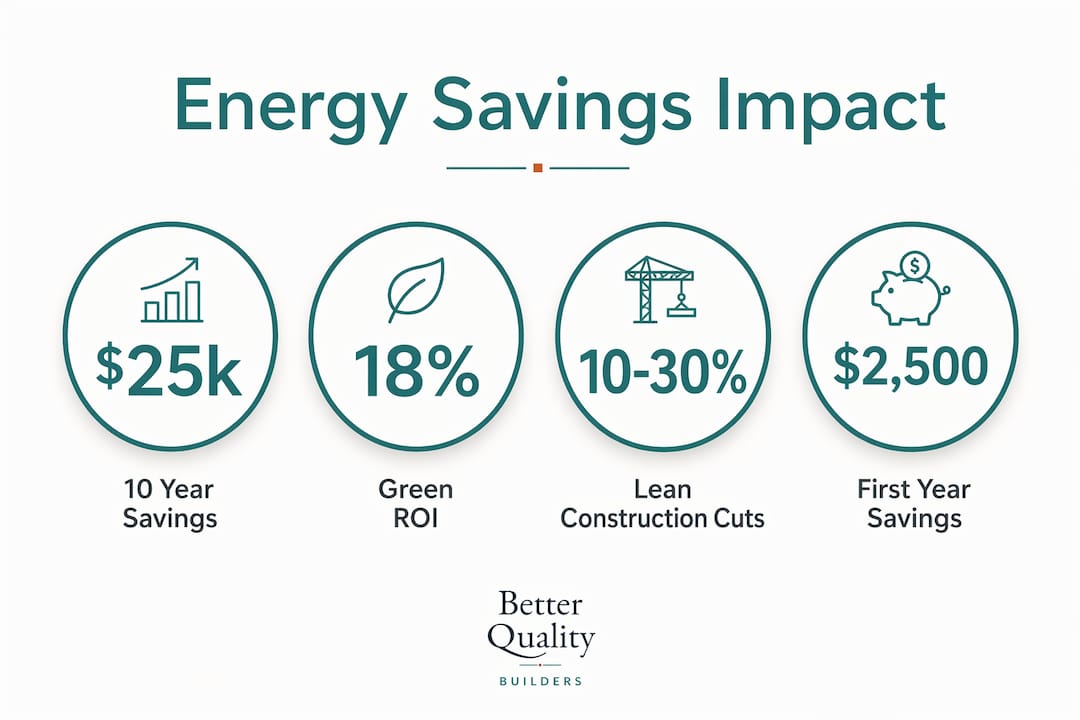
Energy savings offset build cost by reducing the total amount you spend on a home over time, not just at closing. Buyers of new construction homes save an average of $25,335 on utilities and major system replacements over 10 years compared to 20-year-old homes, despite paying a $60,000 median price premium upfront. That gap closes faster than most homeowners expect. The real measure of affordability is total cost of ownership, and energy-efficient custom homes consistently win that comparison. Understanding how energy savings offset build cost is the first step toward making a financially confident decision on your new home.
How energy savings offset build cost: the core financial case
The principle is straightforward. You spend more upfront on efficient materials and systems, then spend less every month on utilities, repairs, and replacements. Over a 10-year window, those monthly savings compound into a figure that can close or eliminate the gap between a new build and a resale home.
The $25,335 in projected savings comes from two sources: lower utility bills and fewer major system replacements. New homes built to current energy codes run tighter envelopes, more efficient HVAC systems, and better insulation than homes built even a decade ago. Each of those features cuts monthly operating costs in ways that add up quietly but consistently.
Total cost of ownership is the industry term for this full financial picture. It accounts for purchase price, financing, utilities, maintenance, and eventual system replacement. Homeowners who evaluate only the purchase price miss the most important part of the equation.
What components of energy savings contribute to offsetting building costs?
Energy savings in a custom home come from several distinct sources, and each one contributes to reducing your long-term expenses.
- Heating and cooling. HVAC accounts for the largest share of residential energy use. A well-insulated home with a properly sized system spends far less on heating and cooling than a code-minimum build. The savings are largest in climates with extreme temperature swings.
- Lighting and appliances. LED lighting and Energy Star-rated appliances cut electricity consumption without changing how you live. These savings are modest individually but consistent year after year.
- Reduced system replacements. New construction homes come with new mechanical systems. Older homes require furnace replacements, water heater swaps, and roof repairs that cost thousands each. Avoiding those expenses is a direct financial benefit of building new.
- Lower maintenance costs. Durable materials and tight construction reduce the frequency and cost of repairs. A home built with high-performance panels, for example, requires less patching, repainting, and weatherproofing over time.
- Building code compliance. Homes built to the International Energy Conservation Code (IECC) meet minimum efficiency thresholds that older homes often miss. Exceeding those thresholds through intentional design choices multiplies the savings.
Pro Tip: Ask your builder to run a Manual J load calculation before finalizing your HVAC system. Right-sizing your system based on actual load data, rather than square footage rules of thumb, lowers costs and improves efficiency without sacrificing comfort.
How do upfront energy efficiency investments translate into long-term financial gains?
The financial return on energy-efficient construction is measurable and well-documented. Developers who embed sustainability from the design stage earn an 18% return on investment, because the sales premium they charge often exceeds the upfront cost of green features. That dynamic benefits builders and buyers alike.
For homeowners, the gain shows up in two ways: lower monthly costs and higher resale value. Energy-efficient homes command a price premium in most markets. Appraisers and buyers increasingly recognize that a home with lower operating costs is worth more than an identical home with higher ones. Understanding how home appraisals work for new builds helps you capture that value when you sell.
The breakeven timeline depends on the size of the premium and the scale of the savings. A home that costs $60,000 more than a comparable resale but saves $2,500 per year in utilities and maintenance reaches breakeven in roughly 24 years on savings alone. Factor in avoided system replacements and the resale premium, and that timeline shortens considerably.
“Green home features can earn developers 18% more, then save homeowners money in the long term. The financial case for building green is no longer theoretical. It is measurable, repeatable, and growing stronger as energy costs rise.”
The table below shows how the savings stack up over time against a typical construction premium.
| Year | Cumulative savings | Remaining premium gap |
|---|---|---|
| Year 1 | $2,500 | $57,500 |
| Year 5 | $12,500 | $47,500 |
| Year 10 | $25,000 | $35,000 |
| Year 15 | $37,500 | $22,500 |
| Year 20 | $50,000 | $10,000 |
Note: Figures use the Realtor.com 10-year average of $25,335 in savings, projected linearly. Actual savings vary by climate, system type, and energy prices.
What practical strategies can homeowners and builders use to maximize energy savings offset?
Getting the most from your energy investment requires decisions made early, before design is locked in. Late-stage changes cost more and deliver less. Here are the strategies that move the needle most.
-
Start value engineering at the design phase. Early-stage value engineering finds better-performing, lower-cost alternatives before the design is finalized. Once construction begins, substitutions become expensive and disruptive. Engage your builder and architect together from day one.
-
Apply lean construction principles. Lean construction reduces waste, improves scheduling, and cuts construction budgets by 10–30%. The savings come from eliminating rework, reducing material waste, and tightening subcontractor coordination. Those savings can fund energy upgrades without increasing your total budget.
-
Right-size every mechanical system. Oversized HVAC systems cost more to install and run less efficiently than correctly sized ones. Use Manual J calculations for HVAC and equivalent load analysis for electrical and plumbing. Value engineering on MEP systems alone can save 5–15% on those line items.
-
Use prefabrication where it fits. Prefabrication and standardization reduce on-site labor by 20–40%, cutting overall build cost and improving schedule reliability. Structural insulated panels, factory-built wall assemblies, and modular mechanical systems all benefit from this approach.
-
Eliminate unnecessary systems from the design. Avoiding gas-pipe installation in all-electric green designs reduces construction costs and removes a recurring expense for buyers. Every system you do not install is a system you never have to maintain or replace.
-
Choose materials for lifecycle cost, not just purchase price. High-performance insulation, triple-pane windows, and durable cladding cost more upfront but reduce heating, cooling, and maintenance expenses for decades. Run the 20-year math, not just the day-one price comparison.
Pro Tip: Use your custom home building checklist to flag energy decisions at each phase of construction. Decisions made in framing affect insulation options. Decisions made in rough-in affect HVAC efficiency. Catching conflicts early prevents expensive corrections later.
How do regional and climate factors influence the extent energy savings offset build cost?
Energy savings are not uniform across the country. Where you build determines how much you save and how quickly those savings offset your construction premium.
- Cold climates save more on heating. States in the northern U.S. see the largest energy savings from tight building envelopes and high-efficiency heating systems. Heating loads are high, and the gap between a well-insulated home and a code-minimum home is wide. New construction energy savings are regionally variable and highest in cooler climates.
- Hot climates save more on cooling. In Arizona, Texas, and Florida, air conditioning dominates energy bills. High-performance insulation, reflective roofing, and proper window orientation cut cooling loads significantly. The savings are real, but the mechanisms differ from northern states.
- Building codes vary by state and municipality. States that have adopted the most recent IECC editions require higher efficiency baselines. Builders in those states start from a stronger position. States with older code versions leave more room for voluntary upgrades that deliver savings above the baseline.
- HVAC sizing changes by climate zone. A system sized for Phoenix performs very differently from one sized for Minneapolis. Climate-specific load calculations prevent both oversizing and undersizing, which both waste money in different ways.
- Local energy prices affect payback timelines. States with high electricity rates see faster payback on efficiency investments. States with low rates see slower payback, but the savings still accumulate over a 10- to 20-year horizon.
The regional lesson is practical: work with a builder who knows your climate zone and local codes. Generic efficiency advice does not translate directly across regions. The right strategy for your location may differ significantly from national averages.
Key takeaways
Energy-efficient custom homes reduce total ownership cost by cutting utility bills, maintenance, and system replacement expenses over time, making the upfront premium financially justified within a 10- to 20-year window.
| Point | Details |
|---|---|
| Total cost of ownership matters most | Evaluate purchase price plus 10-year utilities and maintenance, not just the sticker price. |
| Savings average $25,335 over 10 years | New construction buyers recover a significant portion of the price premium through lower operating costs. |
| Green features earn an 18% ROI | Developers who price in sustainability from the design stage recoup more than they spend on upgrades. |
| Early decisions drive the biggest savings | Value engineering and lean construction at the design phase can cut budgets by 10–30%. |
| Climate zone shapes your payback timeline | Cold and hot climates both benefit, but the dominant savings source differs by region. |
What I have learned from watching homeowners get this decision wrong
Most homeowners I talk to focus on the wrong number. They negotiate hard on the purchase price and then accept whatever mechanical and insulation package the builder offers as standard. That trade-off costs them far more over 10 years than the few thousand dollars they saved at closing.
The total cost of ownership perspective is not just a financial concept. It is a mindset shift. When you start thinking about your home as a 20-year financial instrument, not just a place to live, the math on energy upgrades becomes obvious. Spending $15,000 more on insulation, windows, and a properly sized HVAC system is not a luxury. It is a return on investment with a measurable payback period.
The other mistake I see regularly is waiting too long to make efficiency decisions. Early-stage value engineering is where the real savings live. Once framing is done, your insulation options narrow. Once rough-in is complete, your HVAC choices are constrained. The builders who deliver the best long-term value are the ones who treat energy performance as a design priority from the first meeting, not an afterthought at the end of the budget conversation.
My honest advice: find a builder who can show you a 10-year cost of ownership projection before you sign anything. If they cannot produce that number, they are not thinking about your home the right way.
— David Kobierski
How Better Quality Builders deliver energy savings that offset your build cost
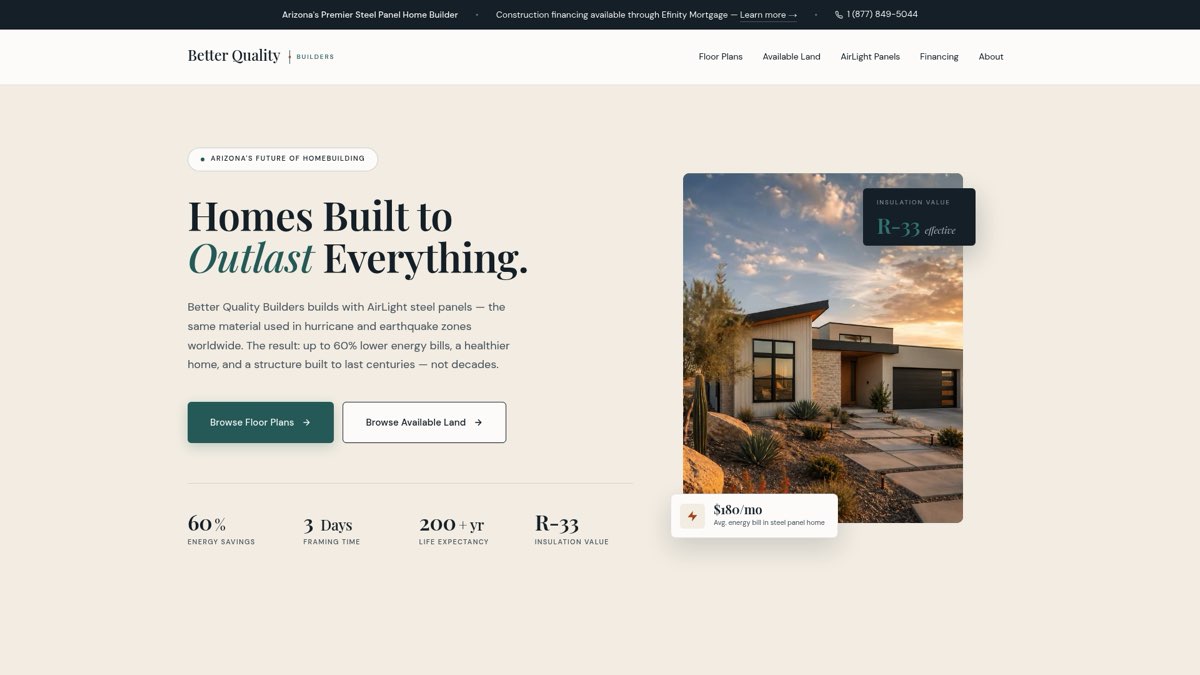
Better Quality Builders constructs custom homes with AirLight steel panels, the same material used in hurricane and earthquake zones worldwide. The result is a building envelope that delivers up to 60% lower energy bills compared to standard construction. That level of performance does not require a larger budget. It requires the right materials and a builder who designs for efficiency from the start.
Every custom home plan Better Quality Builders offers is designed with long-term cost of ownership in mind. From right-sized mechanical systems to high-performance insulation, each decision is made to reduce what you spend after move-in. If you are ready to build a home that pays you back over time, Better Quality Builders is the place to start.
FAQ
How much can energy savings offset the cost of a new build?
Buyers of new construction homes save an average of $25,335 on utilities and system replacements over 10 years. That figure offsets a meaningful portion of the typical $60,000 price premium over older resale homes.
What is the return on investment for green building features?
Developers who embed green features from the design stage earn an 18% return on investment, because the sales premium typically exceeds the cost of the upgrades.
How does lean construction reduce build cost?
Lean construction cuts construction budgets by 10–30% through waste reduction, better scheduling, and tighter subcontractor coordination. Those savings can fund energy upgrades without increasing your total project budget.
Does climate affect how much energy savings offset build cost?
Yes. Energy savings are highest in climates with extreme heating or cooling loads. Regional variability means your payback timeline depends on where you build and your local energy prices.
When is the best time to make energy efficiency decisions in a custom build?
The best time is at the design phase, before construction begins. Late-stage substitutions risk project delays, higher costs, and reduced performance benefits compared to decisions made early in the process.