
A construction bid is a formal, legally binding proposal a contractor submits to compete for your home building project. It details the proposed cost, timeline, scope of work, and qualifications. Unlike a rough estimate, a bid is a binding proposal that includes overhead, profit margins, risk assumptions, and a defined schedule. Understanding how home construction bids work puts you in control of one of the biggest financial decisions you will ever make.
Before you sign anything, here is what every bid should include:
- Project scope: A clear description of all work to be performed, including demolition and disposal
- Cost breakdown: Itemized labor, materials, equipment, and subcontractor fees
- Payment schedule: Milestone-based or draw-based payment terms
- Timeline: Start date, key milestones, and projected completion
- Contractor qualifications: Licenses, insurance certificates, and references
- Bid type: Fixed price (lump sum), cost-plus, or unit pricing
- Allowances and exclusions: Placeholders for undecided items and work outside the contractor’s scope
Whether you are a homeowner evaluating proposals or a builder preparing one, knowing these fundamentals shapes every decision that follows.
Table of Contents
- How the construction bidding process works, step by step
- What a construction bid package actually contains
- How contractors estimate labor and material costs
- Strategies that improve your chances of winning a construction bid
- What happens after a bid is accepted
- Tendering methods and bid leveling for custom home projects
- Legal considerations and compliance in construction bids
- How subcontractors and suppliers shape the bidding process
- How project size and complexity affect bidding strategies
- Better Quality Builders: built for homeowners who want more than a low bid
- Key Takeaways
How the construction bidding process works, step by step
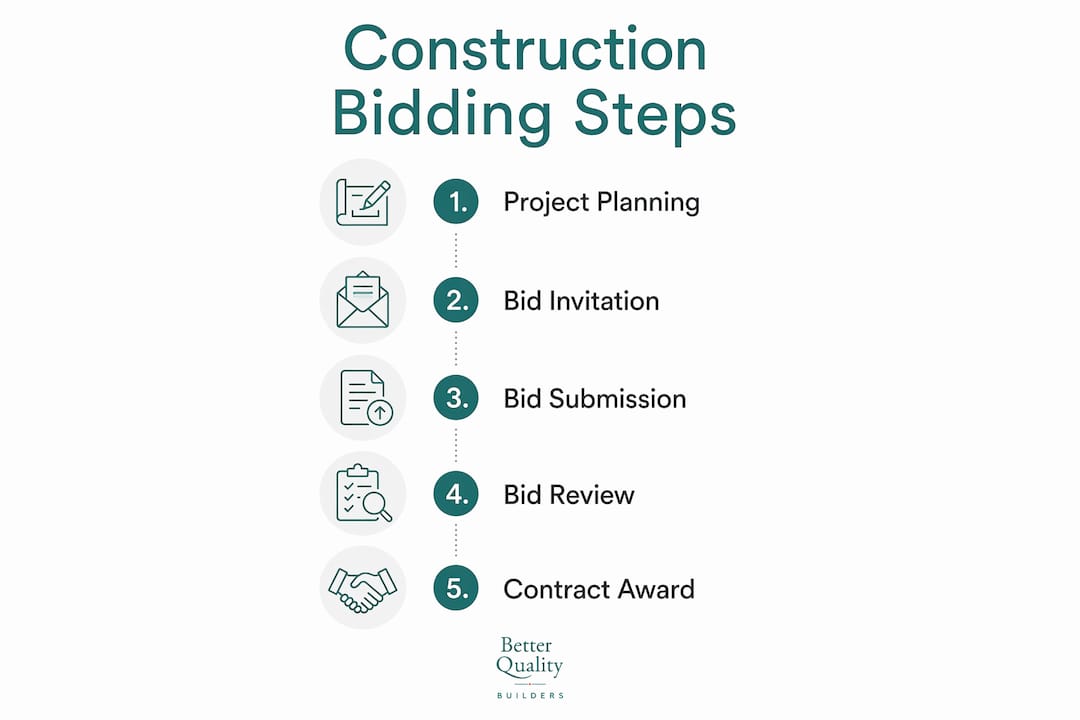
The construction bidding process follows a defined sequence from project announcement through contract award. Each phase builds on the last, and skipping steps creates costly gaps.
- Bid solicitation. The owner issues an Invitation for Bid (IFB), a Request for Proposal (RFP), or a Request for Quote (RFQ). For custom residential projects, this often means reaching out directly to a short list of builders rather than posting publicly.
- Bid document distribution. Detailed plans, specifications, and contract terms are shared with interested contractors. The more complete these documents are, the more accurate the bids you receive will be.
- Pre-bid meetings and site visits. Contractors visit the property to take measurements, review existing conditions, and ask clarifying questions. This step is especially valuable for renovation projects where hidden conditions can affect pricing.
- Bid preparation. Each contractor reviews the documents, estimates labor and material costs, accounts for overhead, and calculates their profit margin before assembling a formal proposal.
- Bid submission. Contractors submit their proposals by the stated deadline. In competitive bidding, these are often sealed bids opened simultaneously to ensure fairness.
- Bid evaluation. The owner reviews all submissions. For private residential projects, price is not always the sole factor. Reputation, past performance, and communication style all carry weight.
- Contract award. The owner selects a winning bid, negotiates final terms if needed, and both parties sign a formal contract before any work begins.
For a deeper look at how this sequence plays out on a custom project, the custom home build process guide from Better Quality Builders walks through each phase in detail.
What a construction bid package actually contains
A bid package is the full set of documents a contractor submits to support their proposal. Formats vary widely. One builder might send a detailed packet with sketches and line-item lists; another might use a streamlined template. Regardless of format, the core components remain consistent.
| Component | Purpose |
|---|---|
| Contact information | Identifies both the contractor and the homeowner for legal and communication purposes |
| Project details and scope | Defines all work to be performed, including demo, disposal, and site prep |
| Current site conditions | Documents the existing state of the property, critical for renovation bids |
| Cost and payment terms | Breaks down all costs and establishes the payment schedule |
| Project schedule | Sets start date, milestones, and completion target |
| Licenses and insurance | Verifies the contractor’s legal standing and liability coverage |
| Allowances | Cost placeholders for items not yet finalized, such as fixtures or finishes |
| Exclusions | Lists work the contractor will not perform, preventing scope disputes later |
| Specifications | Hard details like square footage, material quantities, and fixture counts |
A few terms show up in nearly every residential bid and are worth knowing cold. Millwork covers wood products made in a mill, from cabinets to crown molding. Always ask for an itemized breakdown when you see it listed. Allowances are cost placeholders for items still being decided. F&I (furnish and install) means the homeowner supplies the material and the contractor installs it. Exclusions spell out what the contractor will not do, which is just as important as what they will.
Owner-furnished items require careful coordination. If you supply tile or fixtures, delays or damage to those items become your responsibility and can push the entire schedule back.
Pro Tip: Ask every bidder to use the same allowance amounts for undecided items. This is the only way to compare bids on equal footing when finishes are not yet chosen.
How contractors estimate labor and material costs
Accurate cost estimation is what separates a competitive bid from a money-losing one. Contractors build their numbers from the ground up, starting with direct costs and layering in indirect expenses before adding profit.
The major cost components in any residential bid include:
- Labor: Wages for the contractor’s own crew, calculated by trade and hours required
- Materials: Lumber, concrete, roofing, insulation, fixtures, and all other physical inputs
- Equipment: Rentals or depreciation on owned machinery like excavators and lifts
- Subcontractor fees: Quotes from electrical, plumbing, HVAC, and specialty trades
- Overhead: Office rent, insurance, vehicles, and salaries not tied to a single job
- Profit margin: The builder’s return on the project, typically ranging from 10% to 40% for residential work, with around 20% considered average
The distinction between an estimate and a bid matters here. An estimate is a projection of quantities and costs. A bid is the formal, binding proposal that incorporates those estimates along with risk, overhead, and profit. Once a contractor submits a bid and you accept it, they are contractually committed to that price and scope.
Allowances in construction bids are one of the most common sources of budget overruns. If a bid includes a $3,000 allowance for kitchen fixtures and you choose fixtures that cost $6,000, that $3,000 gap comes out of your pocket. Experienced builders set realistic allowance figures and update the budget as selections are finalized.

Pro Tip: Before signing, ask your contractor to walk through every allowance line by line. Confirm the dollar amount reflects what you actually plan to buy, not a generic placeholder that will inflate your final cost.
Strategies that improve your chances of winning a construction bid
For contractors, winning residential bids consistently comes down to a combination of accuracy, presentation, and relationship. Price matters, but it rarely tells the whole story on a custom home project.
Practical strategies that work:
- Submit on time and completely. A late or incomplete bid is often disqualified outright, regardless of price.
- Present in person when possible. Walking a homeowner through your bid face to face lets you explain your pricing logic, answer questions, and build trust in a way an emailed PDF cannot.
- Lead with qualifications. Include photos of comparable completed projects, client references, and any relevant certifications. On private residential projects, detailed bids demonstrating qualifications often outrank lower-priced submissions.
- Be specific about scope. Vague bids create doubt. Itemized line items signal professionalism and reduce the chance of disputes later.
- Use estimating software. Tools that pull current local material and labor costs reduce the risk of underbidding or pricing yourself out of the market.
- Follow up. A brief, professional follow-up after submission shows genuine interest and keeps your bid top of mind during evaluation.
For homeowners, getting at least three bids on any significant project gives you a meaningful comparison. Reviewing contractor vetting criteria before you invite bids helps you screen for quality before price becomes the conversation. The custom home building checklist from Better Quality Builders is a practical tool for identifying gaps in proposals before you commit.
Understanding how to vet demolition and construction contractors beyond their quoted price is a skill that pays for itself on any major project.
What happens after a bid is accepted
Winning a bid is the beginning, not the finish line. The steps between bid acceptance and breaking ground are where projects either get set up for success or quietly set up for conflict.
Here is what typically happens after a bid is selected:
- Contract negotiation. Both parties review and finalize terms. The homeowner may negotiate payment milestones, change order procedures, or specific material specifications.
- Contract signing. Once both parties agree, they sign a formal construction contract. This document is the legal foundation for everything that follows.
- Permit applications. The contractor typically pulls the required building permits before any work begins. Skipping this step creates liability for both parties.
- Subcontractor confirmation. The general contractor locks in subcontractor schedules for electrical, plumbing, HVAC, and other specialty work.
- Pre-construction meeting. Owner, contractor, and key subs align on schedule, site access, communication protocols, and material delivery logistics.
- Mobilization. Equipment arrives, temporary facilities are set up, and construction begins.
A bid bond guarantees that the winning contractor will honor the contract. If they back out after winning, the project owner can file a claim against the bond, for which both the contractor and their surety are jointly liable. Bid bonds are typically a small percentage of the total bid value, serving as a financial guarantee behind the contractor’s commitment.
Performance bonds and payment bonds provide additional protection once construction is underway. Performance bonds ensure the work meets contract requirements. Payment bonds protect the owner against liens from unpaid subcontractors or suppliers.
Tendering methods and bid leveling for custom home projects
Not all bids are collected the same way. The method an owner uses to solicit proposals shapes the quality of bids received, the level of competition, and the overall risk profile of the project.
The three main tendering methods in construction are:
- Open tendering: Any qualified contractor can submit a bid after the owner publicly posts the project. This maximizes competition and tends to produce lower prices, but it also means less control over who bids. Government projects commonly use this method.
- Selective tendering: The owner invites a short list of pre-qualified contractors to bid. This is the most common approach for private custom home projects because it prioritizes quality and reliability over lowest cost.
- Negotiated tendering: The owner works directly with a single preferred contractor to agree on scope and price. This method suits complex custom projects where early builder involvement during the design phase can improve outcomes and reduce costly redesigns.
Once bids are collected, bid leveling is the process of standardizing them so you can make a fair comparison. Without it, you might unknowingly select a bid that excluded a major scope item, only to face a change order for that work weeks into construction. Bid leveling involves going line by line through each proposal, identifying what is included, what is excluded, and what assumptions each contractor made. An architect or owner’s representative often handles this process on larger custom projects.
For custom home building specifically, negotiated tendering lets you bring your builder into the design conversation early. That collaboration can surface cost-saving alternatives before plans are finalized, rather than after the bid is already submitted.
Legal considerations and compliance in construction bids
Every construction bid carries legal weight, and understanding the compliance requirements protects both the homeowner and the contractor.
A submitted bid, once accepted, creates a binding contractual obligation. Contractors who win a bid and then walk away face financial penalties, particularly when a bid bond is in place. Homeowners who accept a bid and then change the scope without a formal change order process can face disputes over cost and timeline.
Licensing and insurance requirements vary by state, but every legitimate contractor should carry general liability insurance and workers’ compensation coverage. Always verify these before signing. Some states also require contractors to be bonded, which provides an additional layer of financial protection if the work is not completed as agreed.
Lien rights are another legal reality in construction. Subcontractors and suppliers who are not paid by the general contractor can file a mechanic’s lien against your property, even if you paid the general contractor in full. A payment bond, or a lien waiver requirement written into your contract, protects against this scenario. The role of inspections in home builds is also tied to compliance. Permits and inspections are not optional. They confirm that work meets local building codes and protect your investment at resale.
Change orders deserve special attention. Any deviation from the original bid scope should be documented in writing, with a revised cost and timeline, before the work proceeds. Verbal agreements about changes are a leading cause of construction disputes.
How subcontractors and suppliers shape the bidding process
A general contractor’s bid is rarely built from their own numbers alone. Most residential bids are assembled from quotes collected from subcontractors and suppliers who handle specialized work.
Electrical, plumbing, HVAC, roofing, and framing are typically subcontracted. The general contractor solicits quotes from these trades, evaluates them, and incorporates the costs into the overall bid. The accuracy of the final bid depends heavily on the accuracy of those sub-quotes. A general contractor who accepts subcontractor pricing without verifying it against current market rates takes on real risk.
Communication between the general contractor and their subs is where many bids either sharpen or fall apart. Subcontractors who understand the full project scope provide more accurate quotes. Those who receive incomplete information tend to pad their numbers to cover unknowns, which inflates the bid unnecessarily.

Suppliers influence bids through material pricing, lead times, and availability. Lumber, steel, and specialty materials fluctuate with market conditions. A contractor who locks in supplier pricing before submitting a bid protects both their margin and the homeowner’s budget. One who bids on assumed pricing and then faces a material cost spike will either absorb the loss or issue a change order.
When reviewing a bid, ask the general contractor how they sourced their subcontractor quotes and whether material prices are locked or estimated. Those two questions reveal a lot about how the bid was built.
How project size and complexity affect bidding strategies
A bathroom renovation and a custom home build are both construction projects, but the bidding strategies that work for one rarely translate to the other.
Smaller, well-defined projects are well suited to competitive bidding. The scope is clear, the timeline is short, and multiple contractors can price the work accurately without investing significant time. Getting three bids on a kitchen remodel is practical and gives you a genuine comparison.
Custom home construction is a different situation. The scope is larger, the design is more complex, and the number of variables is higher. Contractors must invest real time to prepare an accurate bid, which is why many experienced custom home builders are selective about which projects they bid on. Homeowners who ask for bids without providing complete plans and specifications often receive wide price ranges that are not truly comparable.
Project complexity also affects which contract type makes sense. A lump sum contract works well when the design is fully complete and the scope is locked. A cost-plus contract is better suited to projects where design decisions are still evolving, because it allows the builder to begin work and provide pricing input before every detail is finalized. The tradeoff is less cost certainty for the homeowner upfront.
Cost-plus contracts for custom residential building allow the builder to participate in the design phase, which can surface ways to save money or improve quality before construction begins. That early collaboration is one of the strongest arguments for negotiated tendering on complex custom projects.
Site conditions add another layer of complexity. Sloped lots, expansive soils, and existing structures all require additional investigation before a contractor can price accurately. A pre-bid site visit is not optional on complex projects. It is the only way to produce a bid that reflects reality.
Better Quality Builders: built for homeowners who want more than a low bid
Choosing a builder is not just about finding the lowest number on a bid sheet. It is about finding a team that will still be accountable when the project gets complicated.
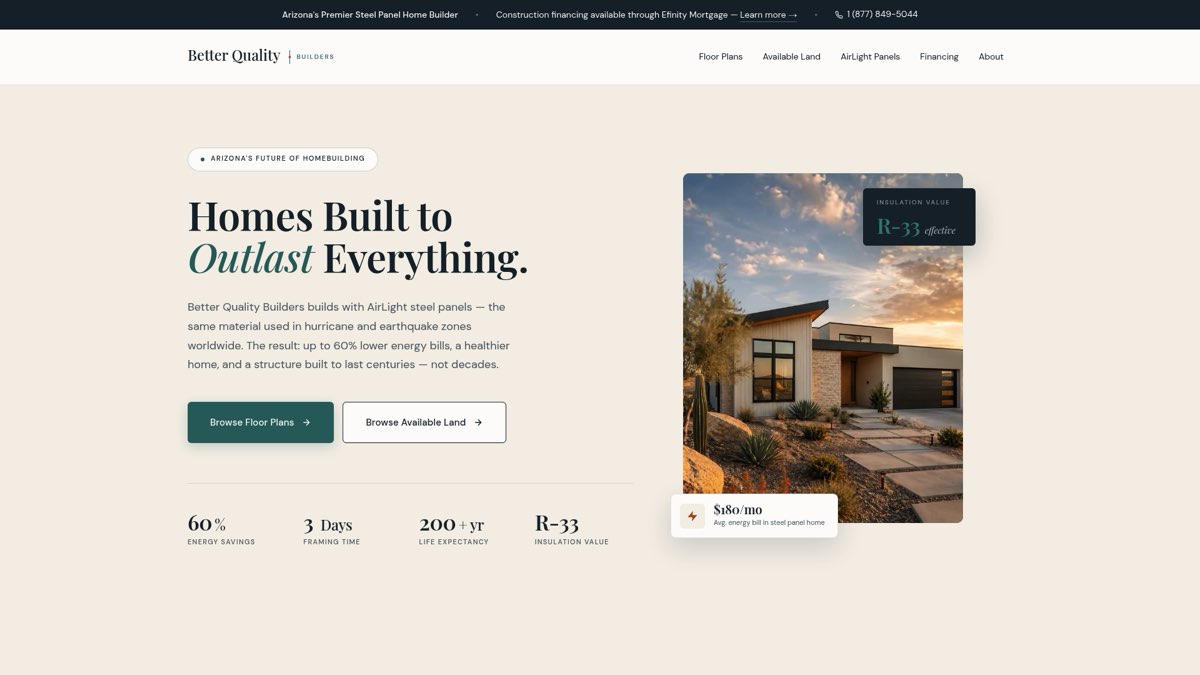
Better Quality Builders builds custom homes in Phoenix and Scottsdale using AirLight steel panels, the same structural material trusted in hurricane and earthquake zones worldwide. The result is a home that delivers significantly lower energy bills, healthier indoor air quality, and a structure designed to last centuries rather than decades. That kind of performance does not show up in a standard bid comparison. It shows up in your utility bills and your home’s long-term value.
When you work with Better Quality Builders, you get a builder who brings pricing transparency and material expertise to the bid process from day one. No vague allowances, no scope gaps, no surprises buried in the fine print. If you are ready to see what a well-built bid looks like for a home that is genuinely built to last, explore AirLight steel panel homes or reach out to the team at Better Quality Builders to start the conversation.
Key Takeaways
A construction bid is a legally binding proposal, and understanding every component before you sign protects your budget, your timeline, and your investment.
| Point | Details |
|---|---|
| Bids vs. estimates | A bid is legally binding and includes overhead, profit, and risk; an estimate is only a projection. |
| Bid package contents | Every bid should include scope, cost breakdown, schedule, allowances, exclusions, and proof of insurance. |
| Allowance risk | Mismanaged allowances are a leading cause of cost overruns; confirm every allowance reflects your actual selections. |
| Tendering method matters | Selective tendering is the preferred approach for custom home projects, prioritizing quality over lowest price. |
| Better Quality Builders | Offers transparent, detailed bids for AirLight steel panel homes in Phoenix and Scottsdale, with substantially lower energy bills. |