
For most owner-occupant custom builds, a construction-to-permanent loan (also called a one-time close) is the strongest starting point. It combines land purchase, construction, and your permanent mortgage into a single approval, a single closing, and one set of closing costs. You lock your long-term rate before the first shovel hits the ground, and when the build is complete, the loan converts automatically. No requalifying. No second closing.
That said, a two-close structure (a stand-alone construction loan followed by a separate end loan) makes sense when you want to shop for the best permanent rate after your home is built, or when your financial picture is likely to improve significantly during construction. The trade-off is qualifying twice and paying two rounds of closing costs.
Three things to do right now:
- Get pre-approved with a lender who specializes in construction financing before you finalize any plans or sign a builder contract.
- Draft your project budget with a 10–15% contingency built in. Lenders expect this reserve, and you will need it.
- Vet your builder and lender together. The lender will review your contractor’s license, insurance, and credentials. Starting that conversation early prevents delays.
Table of Contents
- How do you build a realistic, lender-ready project budget?
- How do construction loans actually work?
- Which loan type fits your situation?
- How do you choose a construction lender?
- What does a draw schedule look like in practice?
- How does the construction loan convert to a permanent mortgage?
- What are the alternatives when a construction loan isn’t the right fit?
- Assemble your build team early and get your documents ready
- How Better Quality Builders supports your financing
- Key Takeaways
- Why financing coordination is the part most builders get wrong
- Better Quality Builders: financing support built into the process
- Authoritative sources and tools for further reading
How do you build a realistic, lender-ready project budget?
Lenders don’t just want a number. They want a line-item budget that separates hard costs from soft costs and shows a credible contingency reserve. Getting this right before your first lender meeting puts you ahead of most applicants.

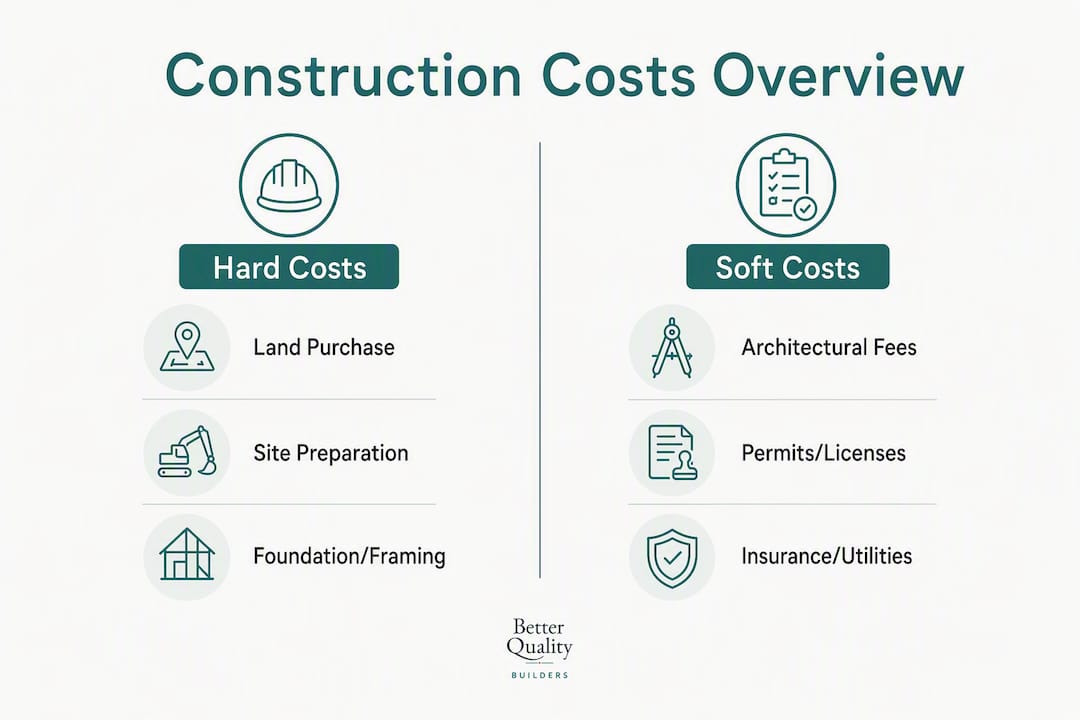
Hard costs cover everything physical: land purchase, site clearing and grading, foundation, framing, roofing, mechanical systems (HVAC, plumbing, electrical), insulation, drywall, flooring, cabinetry, and exterior finishes. These are the largest line items and the ones most exposed to material price swings.
Soft costs are everything that doesn’t go into the structure itself: architectural drawings and engineering, permit fees, soil reports, survey, title insurance, lender origination fees, appraisal, and inspections during construction. Soft costs typically run a significant portion of hard costs, and many first-time builders underestimate them badly.
Sample cost breakdown for a custom build
| Cost category | Typical range | Notes |
|---|---|---|
| Lot purchase | Varies widely | Often financed separately or bundled |
| Site work (clearing, grading, utilities) | — | Utility hookups alone can run $10,000–$30,000 |
| Construction (hard costs) | $150 per sq. ft. | Depends on materials, finishes, and region |
| Soft costs (permits, design, fees) | 15–25% of hard costs | Often underestimated |
| Contingency reserve | 10–15% of the total budget | Required by most lenders |
Contingency sizing: Experts recommend building a 10–15% contingency into your total project budget to absorb cost overruns from material price swings, permit delays, or unexpected site conditions. Lenders expect to see this reserve in your budget before they approve.
Pro Tip: The line items most buyers forget: temporary power and water hookups during construction, builder’s risk insurance (required by most lenders), dumpster and debris removal, and landscaping. Add those before you submit your budget to a lender, or you will be revising it under pressure.
For a deeper look at where costs accumulate and where you can trim without sacrificing quality, the custom home building checklist from Better Quality Builders walks through every stage of the process.
How do construction loans actually work?
Construction loans are fundamentally different from a standard purchase mortgage. The funds don’t arrive in a lump sum. Instead, the lender releases money in stages called draws, each tied to a verified milestone in the build.
Draws, milestones, and inspections
Construction loans disburse funds in draws tied to verified milestones. Before each draw is released, the lender typically sends an inspector to confirm that the work described in the draw request is actually complete. Common milestones include:
- Foundation complete: Footings poured, foundation walls up, slab or basement finished.
- Framing complete: Walls, floors, and roof structure in place.
- Rough mechanicals: HVAC, plumbing, and electrical roughed in and ready for inspection.
- Drywall and insulation: Interior walls closed, insulation installed.
- Final finishes: Flooring, cabinetry, fixtures, and exterior complete.
- Certificate of occupancy: Final inspection passed, home ready for occupancy.
Interest-only payments during construction
You pay interest only on the funds actually drawn, not on the full loan amount. If your loan is approved for $400,000 but only $100,000 has been drawn, your interest payment is calculated on $100,000. As draws increase, so do your monthly payments. This keeps early-stage costs manageable, but plan for payments to climb steadily through the build.
What lenders verify before approving
Lenders underwriting a construction loan look at more than your credit score. They review your full set of plans and specifications, a line-item budget, the builder’s contract, and the contractor’s license and insurance. On the borrower side, expect scrutiny of:
- Credit score: Most conventional construction lenders want a minimum score of 680–720, though FHA programs allow lower.
- Debt-to-income ratio (DTI): Typically 43–45% maximum, including the projected mortgage payment.
- Down payment: Conventional construction loans commonly require 20–25% down.
- Cash reserves: Lenders want to see funds beyond the down payment.
Common lender fees include an origination fee (typically 1% of the loan amount), draw inspection fees charged per visit, and a contingency holdback, where the lender retains a percentage of each draw until the milestone is fully verified.
Which loan type fits your situation?

Not every borrower fits the same product. Here is how to match your profile to the right financing structure.
One-time close vs. two-close construction loans
A one-time close loan combines construction financing and the permanent mortgage into a single transaction. You qualify once, close once, and lock your rate at the start. When construction finishes, the loan converts automatically. The rate-lock advantage is real: you are protected if rates rise during the build. The trade-off is that if rates fall during construction, you can’t benefit without refinancing later.
A two-close structure uses a stand-alone construction loan first, then a separate permanent mortgage at completion. You qualify twice and pay two sets of closing costs, but you get to shop for the best permanent rate after the build is done. This suits borrowers whose income or credit is expected to improve significantly during the construction period, or those who want maximum flexibility on the end loan.
Government-backed one-time close programs
- FHA one-time close: Down payments as low as 3.5% for borrowers who meet FHA credit requirements. Mortgage insurance is required. Best for buyers with strong income but limited cash for a large down payment.
- VA one-time close: No down payment required for eligible veterans and active-duty service members. One of the most powerful financing tools available for those who qualify.
- USDA one-time close: Available for rural properties in eligible areas with no down payment required. Income limits apply. Worth checking if your build site is outside a metro area.
Construction loans usually require 20–25% down for conventional products, so government-backed programs can change the math substantially for qualifying buyers.
When a HELOC or home equity loan makes more sense
If you already own land or have significant home equity, a HELOC or home equity loan can be a flexible alternative to a dedicated construction loan. A HELOC functions like a revolving credit line that you draw against as needed, which aligns naturally with a phased build schedule. It typically involves less paperwork than a full construction loan and can be faster to close. The downside: your existing property secures the debt, and variable-rate HELOCs carry rate risk.
Special cases
- Cash buyers: Paying cash eliminates lender requirements entirely but ties up capital. A hybrid approach (cash for land, construction loan for the build) often preserves liquidity.
- Owner-builders: Self-build loans require documented construction experience or a general contractor’s license, and lenders set higher down payment and reserve requirements. Most buyers working with a licensed general contractor will have a smoother path.
- Veteran buyers: VA one-time close is the strongest option available. Start with a VA-approved lender who has handled construction loans specifically.
- Rural builds: Check USDA eligibility for the property address before assuming a conventional loan is the only route.
Pro Tip: Use a builder loan calculator to model your monthly interest-only payments at different draw stages before you commit to a loan amount. Seeing the payment ramp-up in real numbers helps you plan cash flow through the build.
How do you choose a construction lender?
Not all lenders offer construction products, and among those that do, the terms vary more than most buyers expect. Lenders who specialize in construction financing will ask for blueprints, line-item budgets, and contractor credentials early. That front-loaded process actually speeds underwriting and reduces the chance of a draw being held up mid-build.
Questions to ask every lender before you commit
- Do you offer one-time close (construction-to-permanent) loans, or only stand-alone construction loans?
- What is your draw schedule, and how many draws are allowed?
- Who performs the draw inspections, and what is the fee per inspection?
- What is your holdback policy, and what percentage is withheld per draw?
- Can you lock the permanent rate at closing, and what is the lock period?
- What are your minimum credit score and DTI requirements for construction loans?
- How long does your underwriting process typically take for a construction loan?
- Do you require the builder to be on an approved list, or will you vet any licensed contractor?
Red flags to watch for
- No written draw schedule provided before closing.
- Vague or verbal-only inspection policies.
- Unwillingness to review your builder’s credentials before approval.
- Pressure to close quickly without reviewing the full loan estimate.
- No clear answer on rate-lock terms or conversion timing.
Document checklist for lender submission
Lenders evaluate construction projects by reviewing a detailed timeline, blueprints, cost estimates, and the contractor’s credentials. Have these ready before your first underwriting meeting:
- Final architectural plans and specifications
- Itemized, line-item construction budget
- Signed builder contract with payment schedule
- Builder’s general contractor license and certificate of insurance
- Soil report and survey (if required by the lender or municipality)
- Permit approvals or permit application confirmation
- Personal financial documents: two years of tax returns, W-2s or 1099s, recent pay stubs, bank statements, and a list of assets and liabilities
What does a draw schedule look like in practice?
Understanding the draw timeline helps you plan monthly cash flow and avoid surprises when a payment climbs after a major milestone.
Typical draw milestones and budget allocation
| Milestone | Approximate % of total budget | Typical timeline |
|---|---|---|
| Mobilization / site prep | 5–10% | Month 1 |
| Foundation complete | 10–15% | Months 1–2 |
| Framing complete | 20–25% | Months 2–4 |
| Rough mechanicals (HVAC, plumbing, electrical) | 15–20% | Months 3–5 |
| Insulation and drywall | 10–15% | Months 4–6 |
| Interior finishes and exterior complete | 15–20% | Months 5–8 |
| Final completion / certificate of occupancy | 5–10% | Month 10–12 |
Most custom home builds run several months from groundbreaking to certificate of occupancy, though complex designs or permitting delays can extend that. Adding a time buffer to your timeline estimate is a practical way to protect your rate-lock period and your cash flow plan.
Sample interest-only payment calculation
On a $300,000 construction loan at a 7.5% annual interest rate, with $150,000 drawn at the midpoint of the build:
Monthly interest = ($150,000 × 7.5%) ÷ 12 = $937.50
At full draw ($300,000 drawn), the monthly interest payment would be $1,875. These are interest-only payments. Principal repayment begins after conversion to the permanent mortgage.
When draws are delayed or denied
Change orders are the most common cause of draw delays. If you modify the scope after the lender has approved the budget, the lender may require a revised budget review before releasing the next draw. To avoid this, document every change order in writing, get your builder’s sign-off, and notify the lender before the work begins. A denied draw usually means the inspection found incomplete or non-conforming work. The fix is straightforward: complete the work, request a re-inspection, and resubmit the draw request.
For a detailed look at how build stages connect to financing milestones, the custom home build process guide from Better Quality Builders maps each phase clearly.
How does the construction loan convert to a permanent mortgage?
This is where the two loan structures diverge most sharply, and where your closing cost exposure is determined.
One-time close conversion
With a one-time close loan, conversion is largely automatic. When the certificate of occupancy is issued and the final inspection is complete, the lender modifies the loan to begin amortizing as a standard mortgage. You don’t requalify, and there is no second closing. Expect a brief administrative period (typically 30–60 days) for the lender to process the modification.
Two-close conversion steps
- Pay off or refinance the stand-alone construction loan at completion.
- Apply for a permanent mortgage (conventional, FHA, VA, or USDA) as if purchasing a completed home.
- Provide an updated appraisal based on the finished home’s value.
- Pay a second full set of closing costs (typically 2–5% of the loan amount).
- Close on the permanent loan and begin standard monthly payments.
The advantage of going through this process is the ability to shop rates at completion. If rates have dropped since you started construction, a two-close structure lets you capture that. Understanding how appraisals work for new builds is worth reviewing before conversion, since the appraised value at completion determines your permanent loan limit.
What monthly payments look like after conversion
On a permanent mortgage at a typical fixed rate over 30 years, principal and interest payments can vary. To qualify, lenders apply front-end DTI guidelines, meaning gross monthly income requirements depend on the payment amount. These are estimates; your actual qualifying income depends on your full debt picture, lender limits, and current rates.
Closing costs at conversion for a two-close loan typically run a percentage of the permanent loan amount. One-time close borrowers avoid this second round entirely.
What are the alternatives when a construction loan isn’t the right fit?
A traditional construction loan is the most common route, but it isn’t the only one. Several alternatives reduce complexity, lower upfront cash requirements, or fit situations where a full construction loan isn’t available.
Options and their trade-offs
- Builder financing: — Some builders offer in-house financing or have preferred lender relationships. Convenient, but compare the rate and terms carefully against independent lenders before committing.
Phased builds and shell-first strategies
If full financing isn’t available or you want to reduce initial loan size, a phased build can help. Building the shell (foundation, framing, roof, and exterior) first and finishing the interior in a later phase reduces the immediate financing requirement. This approach works best when you have a clear plan for phase two financing and when local codes permit occupancy of a partially finished structure.
Mixing cash and loans
Combining a cash contribution with a smaller construction loan reduces the loan-to-value ratio, which can lower your interest rate and eliminate the need for mortgage insurance. Even a modest cash injection for the lot purchase, combined with a construction loan for the build, can meaningfully improve your lender terms.
Assemble your build team early and get your documents ready
The lender isn’t just evaluating you. They are evaluating your entire team. A licensed, insured, experienced general contractor is as important to underwriting approval as your credit score.
Key team roles and why lenders care
- General contractor: The lender will verify the license, insurance, and track record. An unlicensed or uninsured contractor is a deal-stopper.
- Architect: Provides the stamped plans and specifications the lender requires. Early design work speeds the underwriting timeline considerably.
- Surveyor: Provides the lot survey and legal description the lender needs to confirm the property and its boundaries.
- Lender inspector: The lender’s representative who visits the site before each draw. Not your inspector. Their job is to protect the lender’s collateral.
Lender-ready document checklist
- Final stamped architectural plans and specifications
- Itemized line-item construction budget (tied to the draw schedule)
- Signed general contractor agreement with payment milestones
- General contractor’s license number and certificate of insurance
- Soil report and geotechnical study (if required)
- Recorded survey and legal property description
- Permit approvals or confirmation of permit application
- Two years of personal tax returns and W-2s or 1099s
- Recent pay stubs (last 30 days) and two months of bank statements
- Documentation of assets (retirement accounts, investment accounts)
Pro Tip: Ask your architect to deliver plans in both PDF and CAD format. Many lenders and their inspectors prefer digital files for draw reviews, and having both formats ready prevents a week-long delay at a critical milestone.
The role of an architect in your custom build covers exactly what deliverables your design team should hand off to the lender and when.
How Better Quality Builders supports your financing
Better Quality Builders is built around one practical reality: the financing process is where most custom builds stall. The builder’s approach addresses that directly.
Combined land-and-construction financing with 10% down
Better Quality Builders offers combined land and construction financing with a 10% down payment option. For buyers in Arizona who haven’t yet purchased a lot, this changes the math significantly. Instead of sourcing separate land financing and then a construction loan, you work through a single financing structure that covers both. That means one approval process, one coordinated timeline, and less cash required upfront than a conventional 20–25% down construction loan.
Energy savings that affect long-term affordability
Better Quality Builders builds with AirLight steel-insulated panels, the same structural material used in hurricane and earthquake zones. The result is up to 60% lower energy bills compared to a conventionally built home. That reduction in monthly operating costs improves long-term affordability in a way that a standard appraisal may not fully capture, but that you will feel every month after you move in. For a detailed breakdown of how those savings compound over time, the energy savings analysis from Better Quality Builders shows the numbers across a 10- and 20-year horizon.
Lender-ready documentation and appraisal coordination
- Lender-ready plans, specifications, and itemized budgets prepared as part of the build process.
- Builder license, insurance, and credential documentation provided upfront.
- Site preparation and soil report coordination handled by the builder’s team.
- 3D preview renderings of your home on your selected lot, which support the appraisal and help lenders visualize the completed project.
- Draw schedule aligned with the lender’s inspection requirements to minimize holdbacks and delays.
Key Takeaways
A construction-to-permanent (one-time close) loan is the most practical financing route for most custom home buyers, provided you have a lender-ready budget with a 10–15% contingency and a licensed, credentialed builder on your team.
| Point | Details |
|---|---|
| One-time close is usually best | Combines land, construction, and permanent mortgage into one closing, saving time and closing costs. |
| Budget with 10–15% contingency | Lenders require this reserve; material swings and permit delays make it necessary in practice. |
| Vet your lender and builder together | The lender reviews your contractor’s credentials; a weak builder file delays or kills approval. |
| Government programs lower the bar | FHA allows 3.5% down and VA allows zero down for eligible veterans on one-time close loans. |
| Better Quality Builders simplifies the process | Combined land-and-construction financing with 10% down and lender-ready documentation reduces friction from day one. |
Next steps checklist:
- Get pre-approved with a construction-loan specialist before finalizing plans.
- Build your line-item budget and add the 10–15% contingency before submitting to any lender.
- Confirm your builder’s license, insurance, and draw schedule compatibility with your lender.
- Review government-backed options (FHA, VA, USDA) if your down payment is limited.
- Contact Better Quality Builders to explore combined land-and-construction financing in Arizona.
Why financing coordination is the part most builders get wrong
The conventional advice on financing a new home focuses almost entirely on the borrower: improve your credit, save your down payment, pick a loan type. That framing misses half the picture.
From a builder’s perspective, the financing failures that actually derail projects happen at the intersection of the lender and the build team, not in the borrower’s credit file. A draw request that arrives without proper documentation, a contractor whose insurance lapsed, or a change order that wasn’t cleared with the lender first can freeze a project for weeks. The borrower did everything right. The coordination failed.
The honest tradeoff in construction financing is this: faster builds reduce your rate-lock risk and your interest-only payment period, but speed requires a builder who has done this before and a lender who knows how to process draws efficiently. Choosing the cheapest contractor or the most convenient lender often costs more in delays than it saves in fees.
Contingency buffers are the other underestimated variable. Most buyers treat the 10–15% contingency as a worst-case reserve they hope not to touch. Experienced builders treat it as a planning assumption. Material prices shift. Inspections find things. Weather delays happen. The contingency isn’t pessimism; it’s the number that keeps your project moving when reality diverges from the plan.
Better Quality Builders: financing support built into the process
Building a custom home in Arizona doesn’t have to mean navigating construction financing on your own. Better Quality Builders offers combined land and construction financing with a 10% down payment option, so you can move from lot selection to groundbreaking without juggling separate loan processes.
Every build includes lender-ready documentation, 3D renderings of your home on your selected lot, and AirLight steel panel construction that delivers up to 60% lower energy bills. The builder’s team coordinates directly with your lender on draw schedules, inspections, and appraisal workflows so your project stays on track from approval through certificate of occupancy.
If you are ready to see what your home looks like on a real lot before you commit, visit the AirLight panel homes page to explore floor plans, energy performance, and financing options. To get started with a financing conversation, the custom home financing page walks through the combined land-and-construction program and how to take the next step.
Authoritative sources and tools for further reading
These resources are worth bookmarking as you move through the financing process:
- Fannie Mae — Construction Products: The primary source for conventional one-time close loan guidelines. Use this to understand what conforming construction loans require at the agency level.
- Bankrate — Construction Loans Explained: A clear breakdown of construction loan mechanics, lender requirements, and how to compare lenders.
- Rocket Mortgage — Construction Loans: Covers one-time close vs. two-close structures and what to expect from the application process.
- U.S. Bank — Construction Loans: Practical detail on draw schedules, inspection requirements, and interest-only payment mechanics.
- HUD.gov: For FHA one-time close program eligibility, lender requirements, and fair housing protections.
- Bob Vila — How to Finance Building a House: A practical step-by-step checklist from pre-approval through project completion.
- Builder Loan Calculator: Run your own draw-based interest calculations to model monthly payments at each construction milestone.
- Construction Loan Interest Rates Guide: Context on how current rate ranges affect construction loan math and what to expect when comparing lender offers.
- Better Quality Builders — Financing Page: Details on combined land-and-construction financing and the 10% down program available in Arizona.
This article provides general information about construction financing in the United States and is not professional financial or legal advice. Loan programs, rates, and eligibility requirements change frequently. Confirm current terms with your lender and consult a qualified financial professional before making financing decisions.