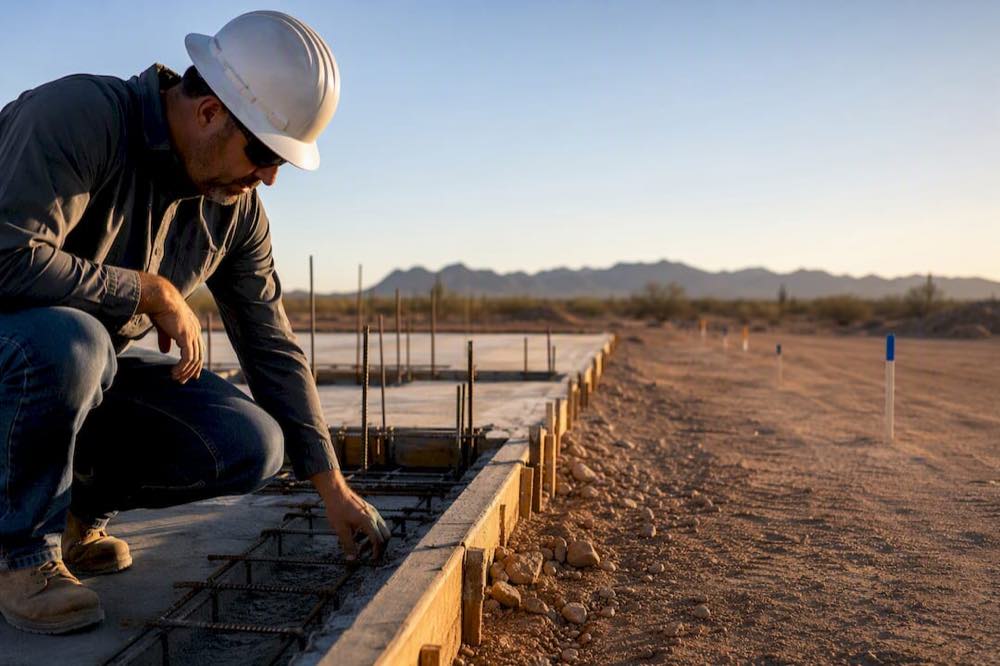
Yes, Arizona buyers can finance land and construction together. The most common routes are a standalone lot loan followed by a separate construction loan, or a one-time-close construction-to-permanent mortgage that bundles land, building, and your final mortgage into one transaction with a single closing. Before you call a lender, get your house plans, a realistic budget, and a qualified builder lined up. That groundwork determines which loan structure you’ll qualify for.
TL;DR:
- Arizona lenders often require both stamped plans and detailed construction budgets to approve land and construction loans quickly and efficiently.
- Improved lots with utilities typically qualify for better loan terms, especially when paired with a one-time-close mortgage that consolidates land, build, and permanent financing.
- Construction loans usually involve interest-only payments during build, with full principal and interest payments starting after conversion to a permanent mortgage, often surprising first-time borrowers.
- A realistic construction schedule of 8 to 12 months is critical to prevent delays, cost overruns, and higher rates, especially in Arizona’s hot and soil-challenged climate.
- Locking a construction loan rate should occur after finalizing builder contracts and plans; pre-locking too early risks renegotiation and financing delays.
Table of Contents
- What Types of Land and Construction Loans Are Available in Arizona?
- What Do Lenders Require to Approve Land and Construction Financing?
- Typical Costs, Down Payments, and Monthly Payments in Arizona
- The Construction Loan Timeline: From Application to Permanent Mortgage
- How to Choose the Right Land and Construction Financing
- How Better Quality Builders Supports Financing and the Build Process
- How Arizona’s Climate and Soil Shape Land Selection and Financing
- State and Local Incentives for Land Purchase and Construction in Arizona
- A Builder-First Approach to Financing Your Arizona Build
- How Better Quality Builders Can Help You Get Started
- Sources
- FAQ
What Types of Land and Construction Loans Are Available in Arizona?
Not all land is financed the same way, and not all construction loans work the same way either. Arizona lenders generally separate raw or unimproved land (no utilities, no road access) from an improved lot (utilities and access already in place), and the second category almost always gets better terms because it carries less risk for the bank.
From there, you’re choosing a construction financing structure. Here’s how the main options break down:
- Two-close construction loan: You get a short-term construction loan, then refinance into a permanent mortgage once the home is finished. Two closings mean two sets of closing costs, but it gives you flexibility to shop lenders again after the build.
- One-time-close (construction-to-permanent): Land, construction, and your long-term mortgage close in a single transaction. You lock your mortgage rate before construction even starts and skip the second round of closing costs entirely.
- Government-backed variants: FHA, VA, and in some rural Arizona counties, USDA one-time-close programs exist and can lower down payment requirements, though approval still depends on borrower and property eligibility.
If you’re buying land now and building later, a standalone lot loan makes more sense since you’re not ready to lock construction terms yet. If you’ve already got a builder and plans in hand, a one-time-close loan usually saves money and paperwork. Local credit unions in Arizona walk borrowers through both structures and can tell you which one fits your timeline.
What Do Lenders Require to Approve Land and Construction Financing?
Lenders underwriting a land-and-build project want more paperwork than a standard home purchase, because they’re financing something that doesn’t exist yet. Expect to provide:
- Stamped architectural plans and an itemized construction budget covering every trade, from foundation to finishes.
- A signed contract with a licensed, insured builder, along with that builder’s track record and references. Lenders commonly want proof the builder has completed comparable projects on time and on budget.
- Permits and zoning verification confirming the lot is buildable for your intended use, plus documentation that water, septic or sewer, and road access are available or budgeted for.
- Two appraisals in many cases: one on the raw land value, and a second “as-completed” appraisal based on your plans, since the lender is really underwriting the finished home’s value.
A tight, organized builder packet, plans, budget, license, and insurance all in one file, speeds up underwriting considerably. Missing utility documentation or vague permit status is the single biggest cause of delayed approvals on Arizona land deals, according to regional lender guidance.
Typical Costs, Down Payments, and Monthly Payments in Arizona
Land loans and construction loans carry different risk profiles than a resale home mortgage, and your down payment reflects that. Lot loans commonly require larger down payments than traditional mortgages, often a substantial portion for raw or unimproved land, while improved lots with utilities in place can sometimes qualify for less.
By the numbers: A one-time-close construction loan that bundles land and building into a single closing eliminates the second set of closing costs entirely, since you never refinance into a separate permanent mortgage.
Plan for these costs beyond the down payment:
- Appraisal fees, often billed separately for the land and the as-completed home
- Inspection fees at each construction draw, which regional lenders list as a real line item borrowers should budget for upfront
- Title insurance and closing costs, doubled if you go the two-close route
- Builder overhead and contingency reserves, typically a percentage of your total budget
During construction, most loans charge interest only on the funds actually drawn, not the full loan amount. That keeps early payments low. Picture a $300,000 construction loan: if you’ve only drawn $75,000 for the foundation and framing, you’re paying interest on $75,000, not $300,000. Once the home is complete and the loan converts to a permanent mortgage, payments shift to standard principal-and-interest amortization based on the full balance, your rate, and your term. That jump surprises a lot of first-time builders who budgeted only for the smaller interest-only payment.
The Construction Loan Timeline: From Application to Permanent Mortgage
Getting from application to a finished home follows a fairly predictable sequence, even though every project has its own hiccups.
- Pre-approval and underwriting. Lenders verify income, credit, the builder’s qualifications, and your plans and budget before issuing a commitment.
- Closing and initial draw. Funds release in stages, starting with site prep and foundation.
- Draw schedule and inspections. Each phase, framing, roofing, mechanicals, finishes, triggers an inspection and a lien waiver from your builder before the next draw releases.
- Conversion to permanent financing. On a one-time-close loan, this happens automatically at completion. On a two-close loan, you refinance separately.
Arizona lenders generally want realistic timelines of 8 to 12 months from groundbreaking to completion. Longer builds raise the risk of cost overruns and rate exposure, which is exactly what one-time-close structures are designed to protect against.
Pro Tip: Build a two-month buffer into your construction timeline before you even apply. Lenders and builders both know delays happen, permitting, weather, material lead times, and a loan structured around an unrealistic 6-month build creates unnecessary refinancing pressure later.
How to Choose the Right Land and Construction Financing
Picking the right structure comes down to matching the loan to your project’s readiness, not just chasing the lowest rate.
Before you shop lenders, confirm you can check these boxes:
- Buildability confirmed: zoning, utilities, and road access verified in writing
- A licensed builder under contract with a detailed, itemized budget
- A realistic timeline with contingency built in
- A permitting plan you understand, including expected approval windows
| Question to ask a lender | Why it matters |
|---|---|
| One-time-close or two-close? | Determines whether you pay closing costs once or twice |
| What’s the minimum down payment? | Land loans often run higher than home mortgages |
| Are draw and inspection fees itemized? | Avoids surprise costs mid-build |
| What are the conversion terms? | Vague answers here are a red flag |
| Will you work with my chosen builder? | Some lenders restrict which builders qualify |
Lock your rate once your builder contract and plans are finalized, not before. Locking too early on a project with soft plans just invites renegotiation later. If your builder isn’t chosen yet, hold off on formal loan applications and use a land purchase action plan to line up your budget and permitting expectations first.
How Better Quality Builders Supports Financing and the Build Process
A builder who understands Arizona lending doesn’t just build the house, it shortens the distance between your loan application and your first draw. Better Quality Builders constructs with AirLight steel panels, the same insulated panel technology used in hurricane and earthquake zones, which supports the long-term durability lenders like to see backing a construction loan.
Working with an established local builder typically means:
- A lender-ready plan and budget package that avoids underwriting delays
- Coordinated draw inspections timed to your loan’s schedule
- A builder qualification file already organized for your lender’s review
For readers weighing government-backed options, Better Quality Builders’ blog covers the second-closing question in detail, along with FHA and USDA construction loan mechanics specific to Arizona builds.
How Arizona’s Climate and Soil Shape Land Selection and Financing
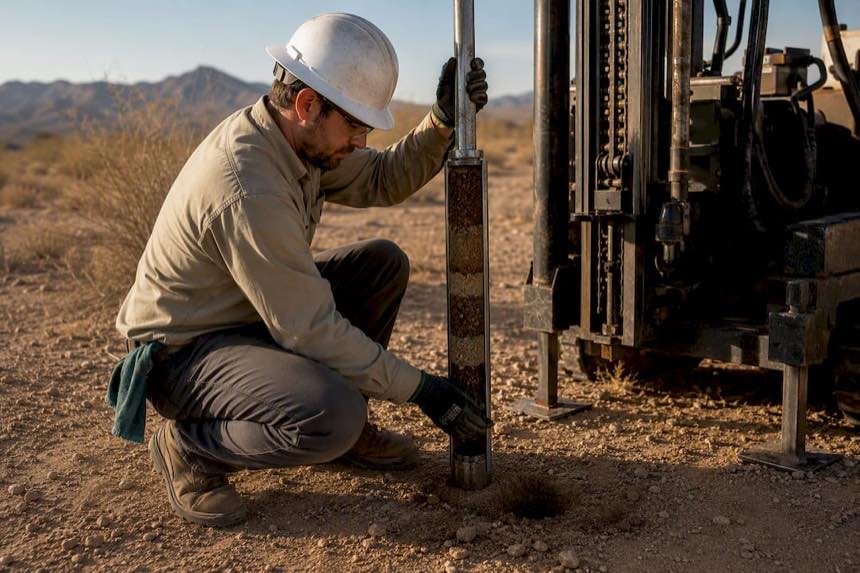
Arizona’s desert conditions affect more than comfort, they affect what a lender will approve. Expansive clay soils, common in parts of Maricopa and Pinal counties, shift with moisture changes and can crack foundations if a builder doesn’t account for them with proper engineering. Lenders often require a soil report before approving construction financing on undeveloped land, since foundation failure risk directly threatens their collateral.
Extreme heat also shapes construction timelines. Concrete curing, roofing work, and exterior finishing all slow down during peak summer months, which is part of why lenders favor the 8 to 12 month build windows discussed earlier. A construction schedule that ignores July and August heat is a schedule that’s likely to slip.
Flood zones matter too. Arizona’s monsoon season creates flash-flood risk in washes and low-lying parcels that look buildable most of the year. Lenders will flag land in a FEMA-designated flood zone, which can trigger flood insurance requirements that add to your monthly carrying costs. Before you fall in love with a lot, check its flood zone status and soil classification, both are underwriting factors, not just engineering details.
Water rights and well access add another layer specific to rural Arizona parcels. If your land isn’t on a municipal water system, lenders want documentation proving a legal, adequate water source before they’ll finance construction. That single requirement derails more rural land deals than any other factor.
State and Local Incentives for Land Purchase and Construction in Arizona
Arizona doesn’t offer a broad statewide grant program for buying raw land, but several avenues can reduce your total project cost depending on where you build and how you finance.
Government-backed loan programs function as the state’s biggest practical incentive. USDA one-time-close construction loans, available in eligible rural Arizona areas, can require little to no down payment for qualifying buyers. VA construction loans offer similar benefits for eligible veterans building on land they own or are purchasing. FHA one-time-close loans lower the down payment bar for buyers who don’t qualify for VA or USDA but still want a single-closing structure.
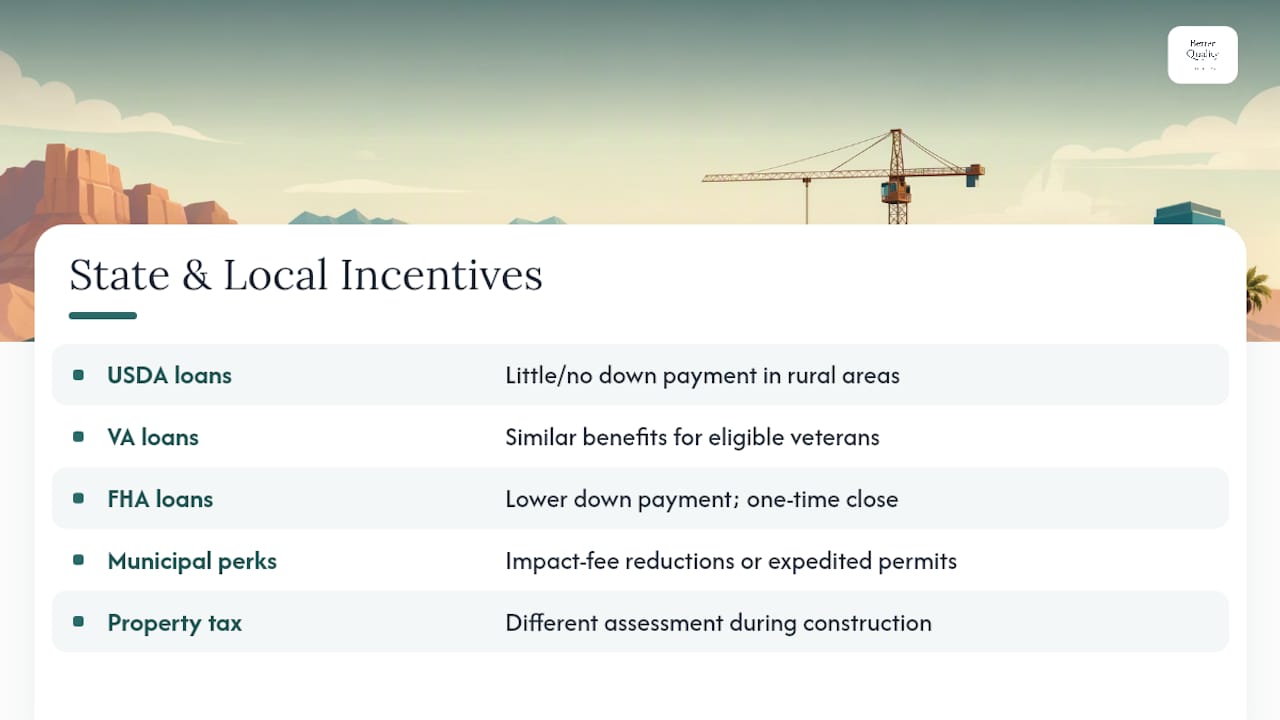
Some Arizona municipalities also offer impact fee reductions or expedited permitting for energy-efficient construction, though availability varies significantly by county and changes over time, so verify current programs directly with your local building department rather than relying on general guidance. Property tax treatment during construction is another detail worth checking with your county assessor, since vacant land and land under active construction can be assessed differently until the home is complete.
None of these programs replace the core decision of choosing the right loan structure, but stacking an eligible government-backed loan on top of a well-chosen lot can meaningfully lower your total cash-to-close.
A Builder-First Approach to Financing Your Arizona Build
Most people shop lenders before they’ve locked in a builder, and that’s backwards. Lock your builder and a realistic budget first. This week, get a written estimate and timeline from a licensed Arizona builder before you fill out a single loan application. Lenders move faster when your paperwork is already complete.
— David Kobierski
How Better Quality Builders Can Help You Get Started
Better Quality Builders is the alternative to piecing together your land purchase and builder search separately.
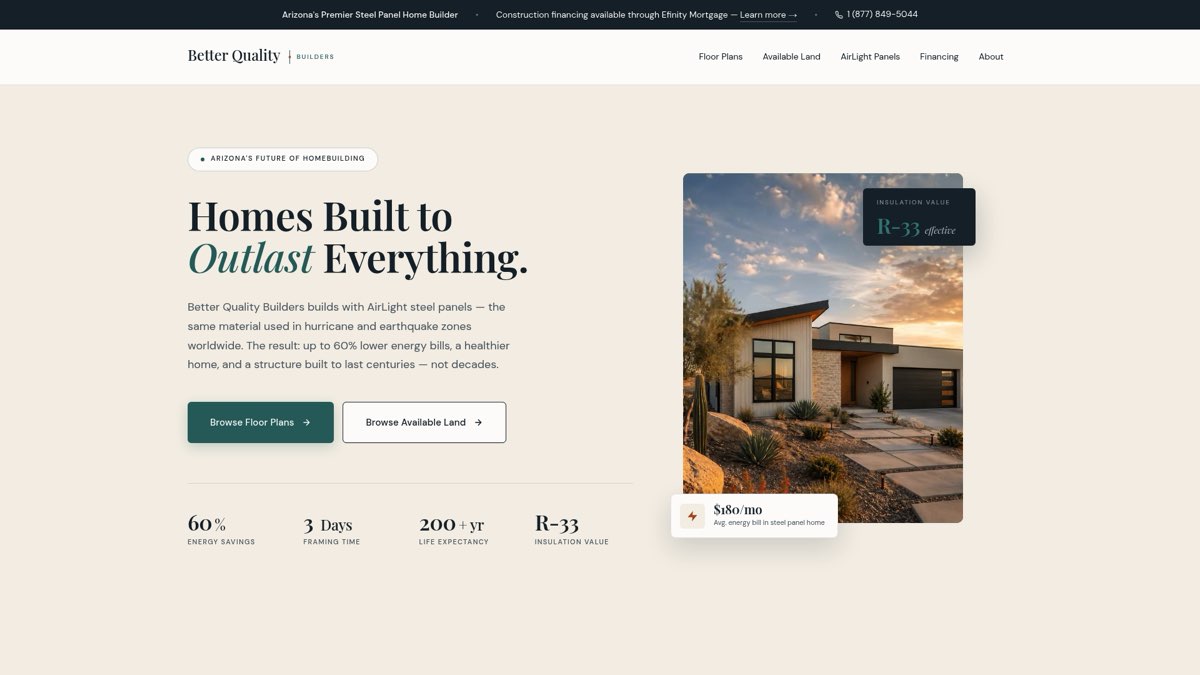
Start by browsing available land matched to buildable lots in Arizona, then look through the AIRLIGHT BUILD floor plan library to see what fits your budget and lot size. If you’re weighing local finish suppliers during planning, One Day Doors & Closets serves the Phoenix area for cabinetry and closet work. When you’re ready to talk numbers, the financing page walks through how Better Quality Builders coordinates your construction loan documentation and draw schedule from day one. Bring your target area, rough budget, and desired move-in timeline to that first call.
Sources
- Construction home loans (Arizona) — Capital Home Mortgage
- Construction and Lot Loans — OneAZ Credit Union
- Lot and Land Loans — Mountain America CU (MACU)
- Construction and lot loans — America First Credit Union
- Construction loans — Foothills Bank
FAQ
What Is the Monthly Payment on a $300,000 Construction Loan?
During construction, you typically pay interest only on the funds drawn, not the full $300,000, so early payments are low and rise as more of the loan is disbursed. Once the loan converts to a permanent mortgage, payments shift to full principal-and-interest amortization based on your final rate and term.
Can I Get a Construction Loan in Arizona?
Yes, Arizona has multiple local credit unions and banks offering construction and lot loans, including one-time-close construction-to-permanent options. Approval depends on your credit, a qualified builder, complete plans, and a buildable, properly permitted lot.
How Much Is a $200,000 Land Loan per Month?
Payment depends on your down payment, interest rate, term, and whether the loan amortizes immediately or carries an interest-only period. Lot loans often require a larger down payment than a typical home mortgage, which reduces the financed balance and your monthly payment accordingly.
Do I Have to Put 20% Down on a Construction Loan?
Not always. Down payments on land and construction loans commonly range from 10% to 30% depending on the lender and loan type, and government-backed programs like FHA or VA can lower that threshold for eligible borrowers.
What’s the Difference Between a One-Time-Close and Two-Close Construction Loan?
A one-time-close loan bundles land, construction, and your permanent mortgage into a single closing, letting you lock your rate upfront and avoid a second round of closing costs. A two-close loan requires refinancing into a separate permanent mortgage after construction finishes, giving more flexibility but doubling paperwork and fees.