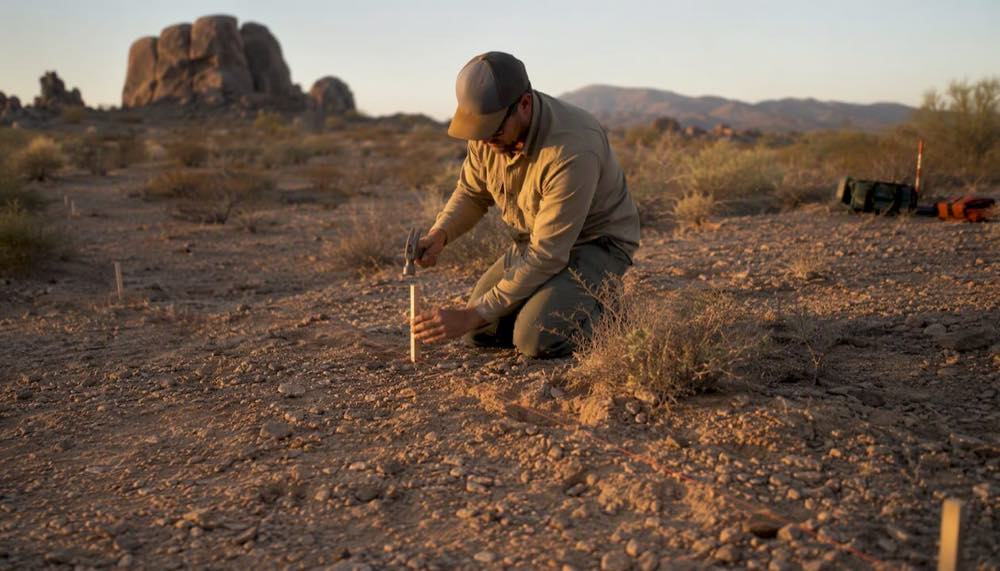
You can find buildable residential and vacant lots in Maricopa County right now using three primary channels: the county’s Available for Sale surplus listings, the PlanNet interactive zoning map, and major listing portals like ARMLS, LandWatch, and Zillow. The critical step most buyers skip is confirming buildability before writing an offer.
Before you contact a seller, run these four checks on every parcel:
- APN (Assessor Parcel Number): Pull it from the listing and look it up in the Maricopa County Assessor’s parcel viewer to confirm ownership and legal description.
- Zoning district: Use PlanNet to verify the zoning code and whether residential use is permitted by right.
- Legal access: Confirm the parcel touches a public road or has a recorded easement granting legal access.
- Flood status: Check the Flood Control District’s interactive parcel maps and FEMA layers for floodway or Zone AE designations.
Pro Tip: Set a 30–60 day due diligence contingency in your purchase contract. County agencies can take two to four weeks to respond to formal zoning or access inquiries, and you need that buffer before you’re committed.
Key Takeaways
Maricopa County buildable land requires verifying zoning, legal access, flood status, and utility feasibility before any offer is written, with PlanNet and the Assessor parcel viewer as your first two tools.
| Point | Details |
|---|---|
| Start with PlanNet and the Assessor | Confirm zoning district and APN ownership before any other step. |
| Flood and deed restrictions are deal-killers | Zone AE and Flood Control District deed restrictions can prohibit residential construction entirely. |
| Buildable area shrinks after setbacks | The zoning ordinance’s “buildable area” definition often reduces usable footprint significantly after easements and setbacks. |
| Combined financing speeds approval | A signed builder contract with a licensed contractor consistently improves construction loan approval odds. |
| Better Quality Builders packages lot and build | Real-time lot inventory, site evaluation, AirLight panel construction, and 10%-down financing in one process. |
Table of Contents
- Where can you find current buildable lots in Maricopa County?
- How do you confirm a parcel is legally and practically buildable?
- What parcel sizes and prices should you expect in Maricopa County?
- What red flags can prevent a lot from being buildable?
- What does the purchase timeline and cost look like?
- What financing options work for land and construction in Arizona?
- How Better Quality Builders helps you find and build on a Maricopa County lot
- What most buyers get wrong about Maricopa County buildable land
- Build your custom home on a lot you’ve already vetted
- Sources
Where can you find current buildable lots in Maricopa County?
Maricopa County buildable land shows up across several distinct channels, and each one has a different strength. Knowing which source to use first saves you from chasing parcels that are already under contract or legally unbuildable.
| Source | What It Lists | Update Cadence | Best Use Case |
|---|---|---|---|
| Maricopa County Available for Sale | Surplus/excess county parcels | Updated as parcels are added or sold | Government-owned lots, often with deed-restriction disclosures |
| ARMLS / Local MLS | Broker-listed residential lots and acreage | Near real-time | Widest selection of active, agent-represented parcels |
| LandWatch (Maricopa County) | Rural acreage and vacant lots | Daily syncs from brokers | Rural and semi-rural land, price-per-acre comparisons |
| Zillow (Maricopa County land) | Mixed residential lots and acreage | Frequent, but varies by listing source | Quick price scans; cross-check with county records |
| Maricopa County Assessor Parcel Viewer | All parcels, not just for-sale ones | Continuous county records | APN lookup, ownership, legal description |
Maricopa County Available for Sale is the only source that publishes parcel-specific disclosures, including zoning (you’ll often see designations like RU-43), floodplain determinations, and deed restriction notes for Flood Control District-acquired properties. Read those notes carefully. A parcel listed at an attractive price may carry a deed restriction that prohibits any habitable structure.
ARMLS and local MLS listings give you the broadest active inventory and the most accurate pricing data because licensed agents are legally accountable for what they post. If you’re working with a buyer’s agent, this is your primary search tool for buildable lots in Maricopa County.
LandWatch and Zillow are useful for initial price discovery and market feel, but neither replaces county records. Portal listings sometimes lag behind ownership changes or fail to flag zoning amendments. Always capture the APN from any portal listing and verify it independently through the Assessor before proceeding.
For county-surplus parcels specifically, the Available for Sale page is the authoritative source. Those listings include parcel size, zoning, and floodplain determination, which gives you a head start on the verification workflow below.
How do you confirm a parcel is legally and practically buildable?
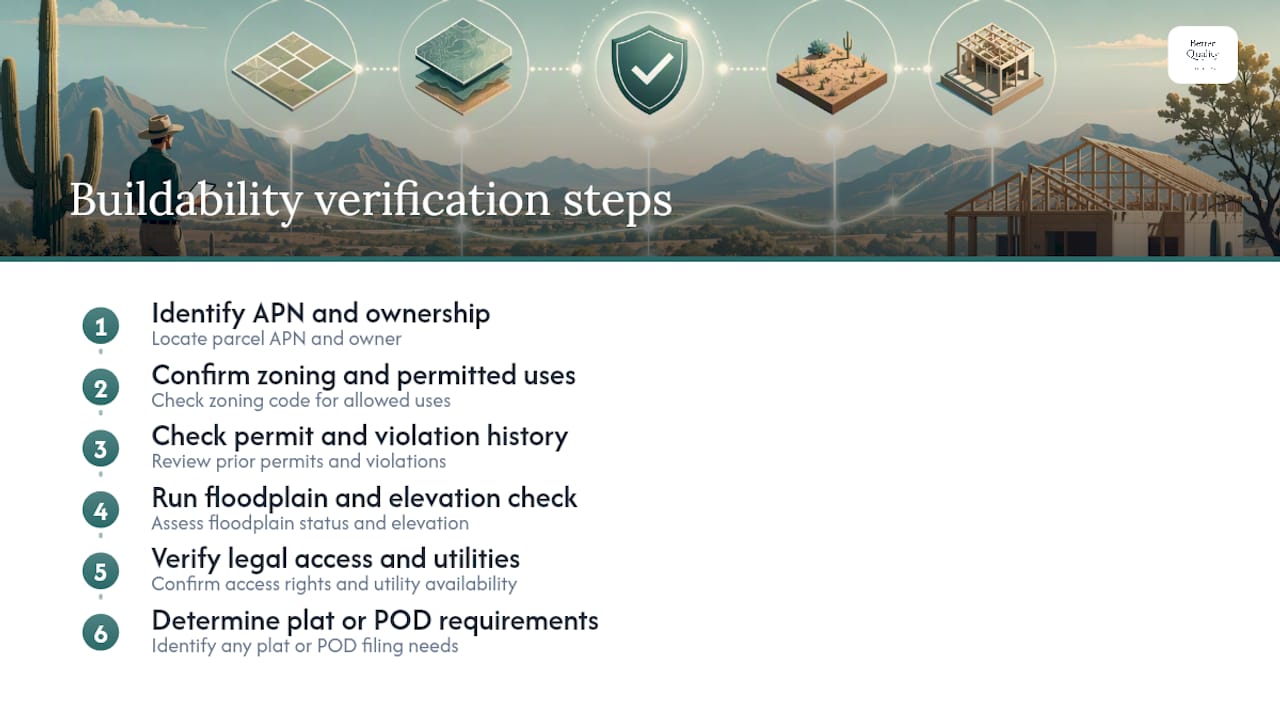
Confirming that a lot qualifies as Maricopa County buildable land takes more than checking the zoning code. Work through these six steps in order.
Step 1: Identify the APN and confirm ownership
Pull the APN from the listing and run it through the Maricopa County Assessor parcel viewer. Confirm the owner of record matches the seller, note the legal description exactly, and check whether the parcel is a lawfully created lot (recorded subdivision, recorded plat, or a legally recognized lot of record). A parcel that was never formally subdivided may not be buildable regardless of its size.
Step 2: Confirm zoning and permitted residential uses
Open PlanNet and enter the APN or address. PlanNet layers show the zoning district, any pending annexations, and floodplain delineations for unincorporated Maricopa County parcels. Cross-reference the zoning code against the Maricopa County Zoning Ordinance, which defines “buildable area” and the development standards that control setbacks, minimum lot area, lot width, building height, and lot coverage. A lot that looks large on a map can have a surprisingly constrained buildable envelope once setbacks and easements are subtracted.
If your intended use exceeds what the zoning district allows by right, a variance, use permit, rezoning, or Plan of Development (POD) may be required. Understanding that early avoids a costly surprise after you’ve closed.
Step 3: Check permit and violation history
The Flood Control District and Planning Department’s interactive parcel maps link directly to the Historical Permit Records Search and permit viewer tools, which cover records from 1999 through June 2024. Look for prior permits (which confirm past development activity), open code violations, or stop-work orders. An unresolved violation on a parcel can block your own permit application until it’s cleared.
Step 4: Run the floodplain and elevation check
PlanNet’s floodplain layer gives you a quick read, but also verify through the Flood Control District’s interactive maps and the FEMA Flood Map Service Center. Building in a Zone AE is possible but requires flood-elevation compliance, which adds cost. A floodway designation within Zone AE is more restrictive and can effectively prevent residential construction. Deed restrictions on Flood Control District-acquired surplus parcels often prohibit habitable structures entirely.
Step 5: Verify legal access and utility feasibility
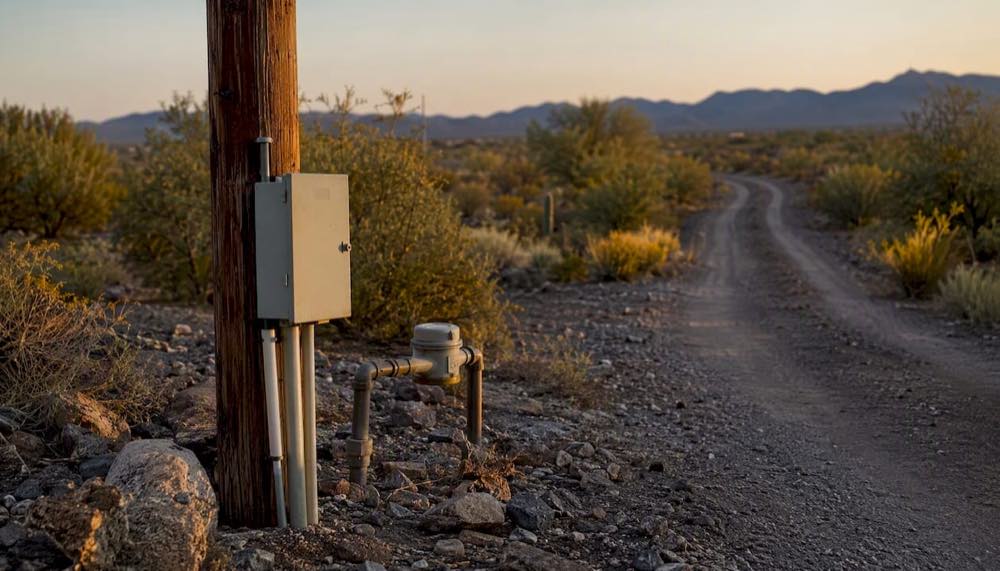
A parcel with no frontage on a public road and no recorded access easement is legally landlocked. Confirm access in the recorded instruments at the Maricopa County Recorder’s office. On the utility side, contact the relevant water provider for a will-serve letter, confirm sewer availability or septic feasibility with the county, and verify power access with the local utility. Rural parcels frequently require well permits and septic system approvals, both of which have their own lead times and costs.
Step 6: Determine if a plat or POD is required
If the parcel is in an unrecorded subdivision or if your project involves splitting or reconfiguring lots, a subdivision plat or POD approval through Maricopa County Planning & Development is required before permits can be issued. Contact county planning early to understand the scope and timeline.
Pro Tip: When you submit your due diligence questions to county agencies, send them in writing and request written responses. Those responses become part of your file and can support contingency removal or contract renegotiation if a material issue surfaces.
What parcel sizes and prices should you expect in Maricopa County?
Maricopa County land for sale spans a wide range, from urban infill lots under a quarter acre to rural acreage measured in the hundreds. Understanding the common categories helps you set realistic expectations.
Infill and urban lots in established Phoenix-area communities typically run from 6,000 square feet to about 15,000 square feet. These parcels usually have utilities already at the street, which reduces site-prep costs significantly. Zoning in these areas often falls under standard residential districts that permit single-family dwellings by right.
Suburban lots in newer or partially developed communities range from roughly a quarter acre to one acre. You’ll encounter a mix of zoning codes here, and HOA deed restrictions are common. Always request the CC&Rs before making an offer.
Rural acreage in unincorporated Maricopa County can range from one acre to several hundred acres. The RU-43 zoning designation (one dwelling per 43,560 square feet, or roughly one per acre) is one of the most common rural residential codes you’ll see on county surplus listings and portal searches. Larger rural parcels often require well drilling, septic systems, and road improvements, all of which add to your total development budget.
County-surplus parcels vary widely in size and condition. Some are small remnant parcels with limited buildability; others are full-sized lots that became available through tax forfeiture or agency disposition. The Available for Sale page is the place to review these, and the parcel-specific disclosures there are your first filter.
For pricing signals, use ARMLS and LandWatch to pull comparable sales in the same zoning district and general area. Zillow’s land listings give a rough market feel but tend to include stale listings. A low price per acre on a rural parcel often reflects the cost of utility extension, road access improvements, or flood mitigation, not a genuine bargain. Budget those costs before comparing parcels on price alone.
What red flags can prevent a lot from being buildable?
Some deal-killers are obvious in the listing; others only surface during due diligence. Watch for these on every parcel.
- No lawful lot of record: If the parcel was never formally subdivided or platted, it may not qualify for a building permit regardless of size or zoning.
- Landlocked parcel: No public road frontage and no recorded access easement means no legal access, and most lenders won’t finance it.
- Floodway or Zone AE designation: A floodway location within Zone AE typically prohibits new residential construction. Zone AE alone requires flood-elevation compliance and flood insurance.
- Deed restrictions from Flood Control District acquisitions: County-surplus parcels acquired for flood-control purposes often carry deed restrictions that prohibit habitable structures. The Available for Sale disclosures flag these, but read the actual deed restriction language, not just the summary.
- Significant easements: Utility, drainage, or pipeline easements can consume a large portion of a parcel’s buildable area. Cross-reference easement locations with the Maricopa County Zoning Ordinance setback requirements to see how much usable area remains.
- Open code violations or stop-work orders: These can block permit issuance until resolved. Check the permit history through the Flood Control District’s interactive parcel maps and permit viewer.
- Mineral claims or historic preservation overlays: Less common but worth checking through the Recorder and state land records, particularly on rural acreage.
- No POD or subdivision plat where one is required: If the parcel needs a Plan of Development before permits can issue, factor in the approval timeline (often several months) and cost.
For any red flag you identify, your options are to negotiate a contingency that allows you to exit if the issue can’t be resolved, commission an engineering feasibility study to quantify the cost of resolution, or simply decline the parcel. Not every problem is a deal-killer, but every problem has a price.
What does the purchase timeline and cost look like?
Buying a buildable lot in Maricopa County involves more steps than a standard home purchase. Here’s a realistic sequence.
Pre-offer due diligence (2–4 weeks minimum): Run the six-step verification workflow above before you write an offer. For complex rural parcels, budget 60–90 days for full due diligence once you’re under contract.
Offer and contract: Structure your purchase agreement with contingencies for zoning confirmation, title review, utility feasibility, and survey. For county-surplus parcels, review the specific terms on the Available for Sale page, as those transactions may have non-standard conditions.
Escrow and title (30–45 days typical): Order a preliminary title report immediately after going under contract. Confirm legal access appears in the recorded instruments, check for liens and encumbrances, and purchase an owner’s title insurance policy.
Survey and boundary confirmation: A boundary survey confirms the parcel corners match the legal description and identifies any encroachments. Budget $1,000–$3,000 for a standard residential lot survey; rural acreage surveys cost more.
Permitting and plan review: After closing, building permit lead times in Maricopa County vary by project complexity. Residential new construction typically requires plan review, which can take several weeks. Learning how to navigate custom home building permits in Arizona before you close helps you plan the construction timeline accurately.
Typical cost items to budget:
- Survey: $1,000–$3,000+ depending on parcel size and terrain
- Title insurance and escrow: varies by purchase price; typically 1–2% of the land price
- Geotechnical/soils report: $2,000–$5,000 for rural or sloped sites
- Well permit and drilling (rural parcels): $10,000–$25,000+
- Septic system design and installation: $8,000–$20,000+
- Road or driveway improvements: highly variable; budget separately after a site visit
- Impact fees and utility connection fees: set by the relevant municipality or utility district
- Flood-elevation mitigation (Zone AE parcels): varies by site conditions
Drive the access route in both normal and storm conditions before you close. A road that looks passable in dry weather may be impassable after a monsoon, and that affects both your build logistics and your long-term livability.
What financing options work for land and construction in Arizona?
Raw land financing is more restrictive than a standard mortgage, and the options narrow further when the parcel is rural or lacks confirmed utilities. Here are the main routes.
- Cash purchase: The most straightforward path for land acquisition, especially for rural acreage where lenders are cautious. Frees you to move quickly on county-surplus parcels.
- Lot loan (land loan): A standalone loan for the land purchase. Lenders typically require a larger down payment (often 20–35%) and confirmed buildable status, including verified legal access and acceptable zoning for a dwelling.
- Construction-to-permanent loan: Covers both the land and the build in a single loan that converts to a permanent mortgage at completion. Lenders generally require a licensed builder under contract, verified buildability, and flood-zone disclosures.
- Combined land and construction financing: Similar to construction-to-permanent but structured to close on the land and fund construction draws simultaneously. Better Quality Builders offers combined financing options with down payment paths starting at 10%, which can materially reduce the upfront cash requirement.
- Seller financing: Available on some private listings, particularly rural acreage. Terms vary widely; always have an attorney review the contract.
What lenders consistently want to see before approving a construction loan: confirmed zoning for residential use, evidence of legal access in recorded instruments, a flood-zone disclosure, and a signed contract with a licensed builder. That last point matters more than most buyers realize. A builder contract with a qualified contractor often shortens underwriting and improves approval odds.
Pro Tip: Prequalify with a construction lender before you make an offer on a specific lot. Ask them directly whether they will finance that parcel’s flood zone, whether they require recorded water and wastewater commitments, and whether they accept steel-panel construction methods. Getting those answers early prevents a financing surprise after you’ve spent money on due diligence.
For a detailed breakdown of construction financing structures, the financing guide for new home builds covers lender requirements and how a builder’s involvement affects the loan process. Better Quality Builders’ construction financing page outlines the combined lot and build options available directly through the company.
How Better Quality Builders helps you find and build on a Maricopa County lot
Finding Maricopa County buildable land is one challenge. Turning that lot into a finished home without delays, cost overruns, or permit surprises is another. Better Quality Builders addresses both sides of that process.
- Real-time lot inventory: Better Quality Builders maintains a current inventory of buildable lots in Arizona, so you’re not starting from scratch on the search.
- Site evaluation for buildability: The team assesses zoning, access, utilities, and physical constraints before you commit, reducing the risk of buying a parcel that can’t support your intended home.
- AirLight steel-insulated panel construction: Every home is built with AirLight steel panels, the same structural system used in hurricane and earthquake zones. The result is a home rated for up to 60% lower energy bills and a structure built to last well beyond the typical wood-frame lifespan.
- Combined land and construction financing: With down payment options starting at 10%, Better Quality Builders can package the lot purchase and the build into a single financing path, which simplifies the process and reduces the number of lenders you need to coordinate.
- Plan library and 3D previews: Browse a large library of customizable floor plans and see a 3D rendering of your chosen design on the actual lot before construction begins.
Working with a builder who handles both lot procurement and construction also strengthens your position with construction lenders. A signed builder contract with a licensed, experienced contractor is one of the factors that most consistently improves loan approval odds.
To learn more about the AirLight steel panel building system and how it performs in Arizona’s desert climate, or to explore the team’s Arizona building experience, those pages give you the specifics. For zoning questions related to smaller or accessory structures, this tiny home zoning laws checklist is a useful reference for understanding how local zoning rules apply to non-standard residential uses.
Key buyer checklist before you make an offer
Run every item on this list before removing your due diligence contingency on any Maricopa County lot:
- Confirm APN and ownership match via the Maricopa County Assessor parcel viewer
- Verify zoning district and permitted residential uses through PlanNet
- Check permit history and any open violations through the Flood Control District’s permit viewer
- Confirm flood zone status (Zone AE, floodway, or outside SFHA) via FCD maps and FEMA
- Verify legal access is recorded in county instruments
- Obtain a utility will-serve letter or confirm well and septic feasibility
- Order a preliminary title report and review for liens, easements, and encumbrances
- Confirm whether a POD, subdivision plat, or rezoning is required before permits can issue
Your single most important next step: run PlanNet for the zoning designation, then order a title report before you remove any contract contingencies.
What most buyers get wrong about Maricopa County buildable land
The standard advice for buying land in Maricopa County is to check the zoning and confirm the price. That’s a starting point, not a strategy.
The real risk isn’t buying land in the wrong zoning district. Most buyers catch that. The risk is buying a parcel that looks clean on paper but has a constrained buildable envelope after setbacks, easements, and floodplain overlays are applied. The Maricopa County Zoning Ordinance defines “buildable area” in a way that can reduce a seemingly spacious lot to a surprisingly tight footprint. A 43,000-square-foot rural parcel with a drainage easement running through the middle and a 30-foot front setback may support a much smaller home than the acreage suggests.
County-surplus parcels deserve special attention here. The Available for Sale page is an underused resource, and the deed-restriction disclosures on Flood Control District-acquired parcels are the most important thing on that page. Buyers who skim past those notes and focus on the price are the ones who end up owning land they can’t build on.
The other underrated step is the permit history check. A parcel with a prior stop-work order or an unresolved code violation won’t block a sale, but it will block your permit application. That’s a problem you want to find during due diligence, not after closing.
Finally, the financing piece: most buyers treat land financing and construction financing as two separate decisions made at two separate times. Combining them from the start, with a builder already under contract, is consistently the faster and lower-risk path. Lenders respond to a complete package, and a qualified builder’s involvement signals that the project is real and executable.
Build your custom home on a lot you’ve already vetted
Better Quality Builders gives Arizona homebuyers a direct path from lot selection to a finished custom home, without the coordination gap that typically exists between land purchase and construction.
Combined with a real-time lot inventory, in-house site evaluation, and construction financing starting at 10% down, Better Quality Builders packages the entire process into one accountable relationship. You’re not managing a land broker, a builder, and a lender separately. You’re working with one team that has done this in Arizona.
Browse the custom home floor plans to see what’s possible on your lot, or contact Better Quality Builders directly to request a site evaluation and a buildability assessment for a specific parcel you’re considering.
Sources
- Maricopa County Zoning Ordinance (PDF)
- Interactive Parcel Maps | Maricopa County, AZ
- Available for Sale | Maricopa County, AZ