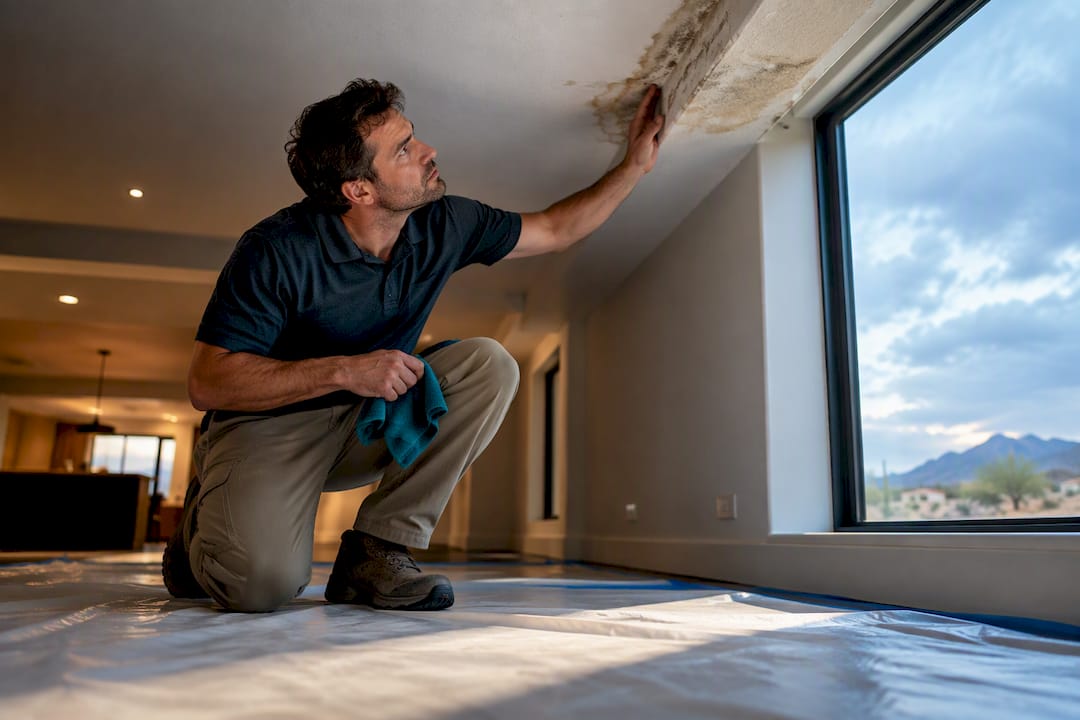
Mold resistant construction in Arizona comes down to one systems-based strategy: stop liquid water at the source, control vapor and air movement through the envelope, and design every assembly to dry out fast when it gets wet. That third piece matters most here, because monsoon downpours, slab leaks, and AC condensate lines create sudden, isolated wetting events in a climate that otherwise runs bone dry. Get those three controls right and the material choices that follow become far less critical.
TL;DR:
- Liquid water control at the site and early design decisions are the most cost-effective ways to prevent mold in Arizona homes.
- Rapid drying within 18 to 24 hours after wetting events is critical, especially during Phoenix’s hot, dry summers.
- Using non-organic materials like fiber cement and cement backer board reduces mold feed in exterior zones and high-moisture interior areas.
- Proper sealing, flashing, and assembly details are essential to prevent water pooling and hidden moisture behind cladding or in cavities.
- Steel panel construction with AirLight panels further minimizes mold risk by eliminating organic material from the building envelope.
Table of Contents
- What Makes Mold Resistant Construction in Arizona Different?
- Three Core Moisture-Control Principles Every Build Must Follow
- Mold-Resistant Materials and Where to Use Them
- Assembly Details That Stop Hidden Moisture
- Your Monitoring and Response Checklist
- Building a Year-Round Inspection Habit for Arizona Homes
- Grading and Landscaping Choices That Keep Water Away From the Foundation
- How to Choose a Contractor for Mold-Resistant Construction
- How Better Quality Builders Applies These Principles With AirLight Panels
- Ready to Build a Mold-Resistant Home? Here’s What to Prepare
- A Contractor’s Take on Where Arizona Homes Actually Fail
- Sources
- FAQ
What Makes Mold Resistant Construction in Arizona Different?
Arizona’s annual average relative humidity sits in the 27% to 41% range, low enough that most builders assume mold is someone else’s problem. That assumption breaks down every June 15 through September 30, when the monsoon window pushes dew points up and turns roofs, windows, and grading mistakes into active liability.
The failures that actually show up in Arizona homes follow a predictable pattern:
- Slab leaks that soak flooring and baseboards for months before anyone notices, often revealed only by warm floor spots or an unexplained spike in the water bill
- AC condensate overflow, especially where drain lines clog during peak summer runtime
- Evaporative coolers that dump humid air into living spaces right when monsoon storms are already raising indoor moisture
- Roof and window leaks during monsoon wind and rain events, particularly on parapet roofs common in Southwest architecture
- Attic and ceiling moisture in higher-elevation towns like Flagstaff or Prescott, where winter condensation behaves more like a Midwest climate than a desert one
The clock runs faster than most homeowners expect. The EPA’s 24 to 48 hour drying window for wet materials is already tight, and Phoenix-area heat can compress that colonization window to as little as 18 to 24 hours once conditions are right. Slab-on-grade floors and stucco cladding make it worse, since both retain moisture longer than framed construction with ventilated cavities.
Three Core Moisture-Control Principles Every Build Must Follow
Building science built for humid climates does not map cleanly onto Arizona’s boom-and-bust moisture pattern. The EPA’s own moisture control guidance narrows the job to three principles, and every material or assembly decision on an Arizona build should trace back to one of them.
- Control liquid water. Grade sites away from the foundation, flash every window and roof penetration correctly, and route roof drainage well clear of the slab perimeter.
- Control vapor and air movement. Seal ductwork, size HVAC equipment to the actual load rather than a rule of thumb, and install a continuous water-resistive barrier (WRB) so humid outdoor air cannot migrate into wall cavities.
- Enable rapid drying. Build assemblies with a drainage plane and ventilation path so any water that gets in has somewhere to go, instead of getting trapped between layers.
During design, sequence these in order: liquid water control is cheapest and most effective when it is a site-plan decision, not a retrofit. Vapor and air control depends on getting the HVAC contractor and the building envelope talking to each other before drywall goes up. Drying capacity is your insurance policy for the mistakes the first two principles do not catch.
Pro Tip: Design every assembly to dry, not to stay permanently waterproof. A wall that never lets water in but also never lets it out is one clogged flashing detail away from a hidden mold problem.
Mold-Resistant Materials and Where to Use Them
Material selection matters, but only after the systems above are in place. No board or panel on the market is mold-proof on its own. Manufacturer testing against ASTM D3273 (a chamber test that scores mold growth on treated surfaces) or ASTM C1396 (the standard specification for gypsum board) tells you a product resists surface growth under controlled conditions. It does not tell you what happens when that product sits in standing water for a week.
In wet or exterior-adjacent zones, favor non-organic materials that give mold nothing to feed on:
- Fiber cement siding and trim in place of wood
- Cement backer board under tile in bathrooms and laundry rooms
- Magnesium-oxide board in high-moisture utility spaces
- Tile and natural stone for flooring in bath and entry areas exposed to monsoon tracking
For interior wet areas where full masonry isn’t practical, mold-resistant (or “mold-guard”) gypsum board, treated with additives and a moisture-resistant facing, is a reasonable upgrade over standard drywall in bathrooms, laundry rooms, and kitchens. The limitation: these products slow surface colonization, they do not prevent water intrusion, and they still need to dry out on the EPA’s 24 to 48 hour clock like anything else.
Insulation deserves particular attention in Arizona because the wrong type invites condensation inside the wall rather than outside it. Closed-cell spray foam and mold-resistant batt products with a facing rated for the local vapor drive tend to outperform loose-fill in areas prone to slab or roof leaks, since wet cellulose holds moisture far longer than closed-cell foam.
For slab homes, choose flooring underlayment and subfloor materials rated for direct slab contact, and confirm the slab’s own vapor barrier is intact before finishes go down with advice from One Day Doors & Closets of Arizona.
Assembly Details That Stop Hidden Moisture
Materials only perform as well as the assembly around them. Most Arizona mold problems trace back to a handful of installation details that get rushed on tight schedules.
Wall assemblies need a continuous water-resistive barrier with no gaps at seams or penetrations, paired with a drainage plane that lets incidental water drain down and out rather than pooling behind cladding. Window flashing should follow shingle-style layering, meaning each piece overlaps the one below it, so water sheds downward and never gets channeled behind the WRB. Avoid designs that create trapped, unventilated cavities behind stucco or stone veneer. Those cavities are exactly where Arizona’s occasional wetting events turn into long-term hidden damage.
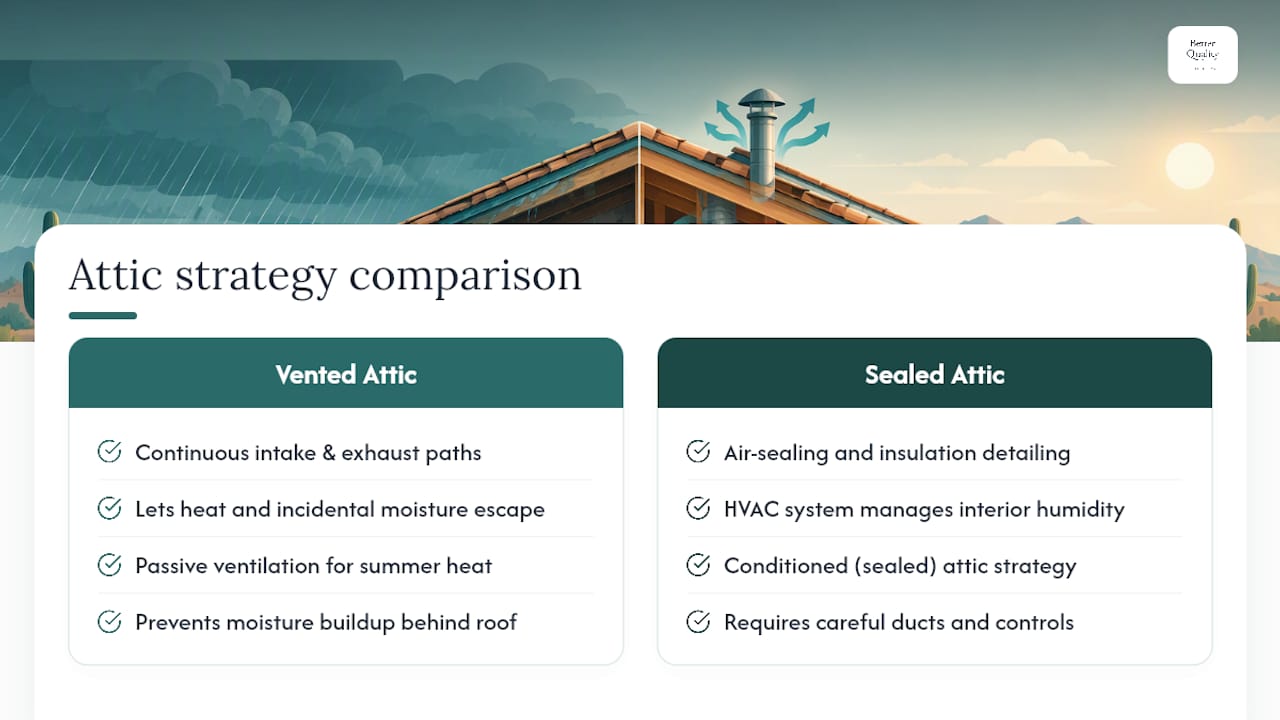
Roof and attic strategy depends on whether the attic is vented or sealed. Vented attics need continuous intake and exhaust paths so summer heat and any incidental moisture can escape. Sealed (conditioned) attics need careful air-sealing and insulation detailing so the HVAC system, not passive airflow, manages humidity. Either way, underlayment matters more in Arizona than the low annual rainfall suggests, since a single monsoon cell can drop more rain in an hour than a humid-climate roof sees in a month.
Foundation and slab work is where Arizona’s biggest blind spot lives. Slab-on-grade construction hides plumbing runs under the pour, and a slow slab leak can wet flooring for months before symptoms surface. Builders should confirm vapor barrier placement under the slab before the pour, and homeowners should ask for moisture testing at handover rather than assuming a dry-looking floor is a dry slab.
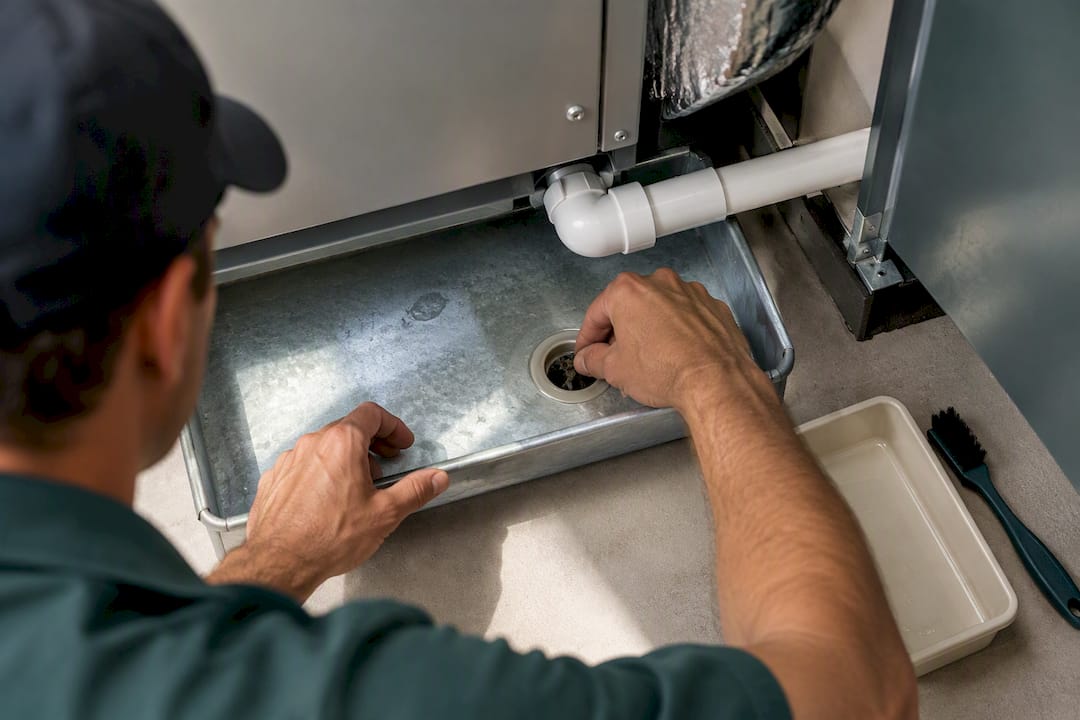
HVAC details carry outsized weight in a state where the AC runs nearly year-round. Condensate pans need a secondary drain or float switch so a clogged primary line doesn’t overflow into a ceiling cavity. Duct sealing keeps the system from pulling humid attic or crawlspace air into the conditioned space. ASHRAE’s position on indoor mold and dampness recommends keeping interior surfaces above the dew point, with a 60°F dew-point ceiling during unoccupied hours, as a practical target for preventing condensation on ducts and registers.
Pro Tip: Ask your builder where the secondary condensate drain routes. If the answer is “it doesn’t have one,” that’s a gap worth closing before the ceiling below the AC unit becomes a mold case study.
Your Monitoring and Response Checklist
A hygrometer costs less than a dinner out and tells you more about your home’s mold risk than any inspection you can schedule. Place one in the primary bathroom, one near the laundry area, and one in the attic or a slab-adjacent closet if the house has either concern. The EPA’s target range is 30% to 50% relative humidity, with 60% as the hard ceiling.
When a leak happens, speed determines the outcome:
- Stop the source. Shut off the supply line or the AC unit immediately, don’t wait for a plumber to confirm the obvious.
- Extract standing water. Wet-vac or pump out anything pooled before it soaks further into flooring or drywall.
- Dry within 24 to 48 hours. Bring in fans and a dehumidifier; this window is non-negotiable per EPA guidance, and shorter still during Phoenix summer heat.
- Remove saturated cellulose materials, including wet drywall and insulation, that pass the drying window still damp.
Seasonally, schedule a pre-monsoon roof and flashing inspection every May, service evaporative coolers before the humid season arrives (or switch to refrigerated AC during the monsoon window), and check condensate lines annually. If a leak is suspected but not visible, a moisture meter or thermal scan from a qualified inspector settles the question faster than guessing.
Building a Year-Round Inspection Habit for Arizona Homes
Arizona’s maintenance calendar doesn’t look like a humid-climate calendar, and treating it the same way leaves gaps. The riskiest months are also the hottest, which means inspections tend to get skipped exactly when they matter most.
Walk the attic and roofline every spring before monsoon season starts, checking for cracked flashing, gaps around vent boots, and any staining on the underside of the roof deck. Check bathroom and kitchen caulk lines twice a year. Silicone and grout degrade faster under Arizona’s UV exposure than most homeowners expect, and a failed seal around a tub or sink is a slow, invisible leak point.
Inspect AC condensate lines and pans at the start of summer, before the system runs continuously for months. A five-minute check of the drain line for algae buildup or a clogged trap can prevent an overflow that soaks a ceiling cavity for weeks unnoticed. If the home uses an evaporative cooler, either seasonally or full-time, service the pads and float valve before the pre-monsoon humidity spike, since a poorly maintained swamp cooler is one of the more common indoor humidity sources in older Arizona homes.
Basements are rare here, but crawlspaces and slab-adjacent utility closets deserve the same seasonal attention a Midwest homeowner gives a basement: a quick visual check for staining, efflorescence on masonry, or a musty smell after any storm event. Log what you find. A dated photo of a ceiling stain or a caulk line is far more useful to a contractor six months later than a vague memory that “something looked off.”
Grading and Landscaping Choices That Keep Water Away From the Foundation
Most Arizona foundation moisture problems start outside the house, not inside it. The grading around a slab should slope away from the foundation at a minimum of 6 inches of drop over the first 10 feet, directing roof runoff and irrigation overspray away from the perimeter rather than letting it pool against the stem wall.
Desert landscaping, xeriscaping in particular, actually works in the home’s favor here, since it relies on drip irrigation and gravel rather than sprinklers that regularly wet the soil near the foundation. If a lawn or garden bed sits close to the house, route irrigation lines and sprinkler heads to avoid direct contact with the foundation wall, and check that downspouts discharge at least several feet away rather than dumping straight onto the grade line.
Retaining walls and raised planters built against a house are a common mistake in Arizona landscaping. They trap water against the foundation instead of letting it drain away, turning a decorative feature into a slow-motion moisture source. If a planter has to sit close to the house, waterproof the side facing the foundation and ensure it has its own drainage outlet.
Gutters matter more in monsoon season than the state’s average rainfall suggests. A roof without gutters concentrates runoff at the drip line, right where the foundation is most vulnerable, during storms that can drop an inch of rain in under an hour.
How to Choose a Contractor for Mold-Resistant Construction
Not every builder treats moisture control as a design priority instead of a checklist item. When evaluating contractors for a mold-resistant build in Arizona, ask specifically how they handle each of the three core principles, liquid water, vapor and air movement, and drying capacity, rather than accepting a general “we build to code” answer.
A contractor experienced with Arizona’s climate should be able to describe their approach to slab vapor barriers, WRB installation and flashing sequencing, and HVAC condensate design without hesitation. Ask to see a wall section detail or a past project’s moisture-management plan. A builder who has genuinely thought through Arizona’s monsoon-driven risk will have documentation ready, not a vague assurance.
It’s also worth asking what happens if a slab leak or roof leak occurs during construction, before the house is even finished. A contractor who stores moisture-sensitive materials under weather protection and installs them close to enclosure completion, rather than leaving drywall or insulation exposed on site for weeks, is following EPA-recommended construction sequencing that reduces the odds of a mold problem before you ever move in.
Finally, ask about the building envelope itself. Builders working with non-traditional systems, like insulated steel panels instead of standard wood framing, often bring a different moisture profile to the table worth understanding before you commit to a design.
How Better Quality Builders Applies These Principles With AirLight Panels
Better Quality Builders builds with AirLight steel panels, a non-organic envelope material that gives mold no cellulose to feed on in the first place, while sealing the building tighter than typical wood-frame construction.
If you’re planning a build, come to the conversation ready to discuss site grading and slab conditions, your HVAC and humidity-control preferences, and which wet-area materials matter most to you. Those decisions shape the final moisture-resistant construction plan as much as any single material choice.
Ready to Build a Mold-Resistant Home? Here’s What to Prepare
If you’ve read this far, you already know that mold resistance in Arizona is a systems problem, not a shopping list. Better Quality Builders approaches it that way from the ground up, building custom homes with AirLight steel panels instead of the wood framing that gives mold something to grow on in the first place, paired with an envelope designed for Arizona’s monsoon-driven wetting events rather than a humid-climate rulebook that doesn’t apply here.

Before a consultation, gather a few basics: any lot you’re considering or interested in, your HVAC preferences (refrigerated AC versus evaporative cooling), and any moisture concerns specific to your site, like drainage, slope, or a history of flooding nearby. Better Quality Builders offers real-time lot inventory and 3D preview renderings so you can see how a design sits on your actual land before committing. Browse the floor plan library to find a layout that fits, and check the financing options, including combined construction and land financing with a 10% down payment, to see what a custom build looks like for your budget. When you’re ready to talk specifics, the about page walks through how the company’s custom home building process works from first conversation to move-in day.
A Contractor’s Take on Where Arizona Homes Actually Fail
Most of the mold conversation in Arizona construction focuses on the wrong variable. Homeowners ask about materials first, “which drywall resists mold best,” when the honest answer is that material choice barely moves the needle if the drying system around it fails. A house with standard gypsum board and a well-sealed HVAC system, correctly flashed windows, and a slab that was tested for moisture before the flooring went down will outperform a house full of premium mold-guard products sitting inside a leaky, poorly ventilated wall assembly.
The bigger blind spot, in my read of how these failures actually happen, is timing. Arizona’s low average humidity creates a false sense of security that shows up as deferred maintenance: skipped pre-monsoon roof checks, ignored condensate lines, evaporative coolers left running into July. The state’s mold risk isn’t chronic the way it is in the Gulf Coast or Pacific Northwest. It’s episodic, and episodic risk gets ignored precisely because nothing goes wrong most of the year. That is exactly the psychology that turns a fixable slab leak into a six-month hidden mold problem, because nobody was checking.
Steel panel construction changes that calculus in a way that’s underappreciated outside the industry. Removing organic material from the envelope doesn’t just resist mold. It buys homeowners a margin for the maintenance mistakes that inevitably happen, because there’s nothing behind the wall to feed on if a leak sits undetected for a few extra days. That’s a meaningfully different risk profile than a wood-framed house running the same climate.
— David Kobierski
Sources
The guidance in this article draws on the EPA’s mold and moisture control resources, ASHRAE’s position on limiting indoor dampness, Arizona’s habitability statute, and local drying science research specific to Phoenix’s climate.
- A Brief Guide to Mold, Moisture and Your Home | US EPA
- ASHRAE — Position document on limiting indoor mold and dampness
- Mold in Arizona: 2026 State Report + Humidity Rankings
FAQ
Is Mold a Big Problem in Arizona?
Mold is not a chronic problem in Arizona the way it is in humid states, since annual average humidity runs 27% to 41%. It becomes a real risk during specific events, monsoon storms, slab leaks, and AC condensate failures, which is why event-driven prevention matters more than year-round humidity control here.
What Is the Most Mold-Resistant Building Material?
No single material is fully mold-proof, but non-organic options like fiber cement, cement backer board, magnesium-oxide board, and tile give mold the least to feed on. Mold-resistant gypsum board, tested against standards like ASTM D3273, helps in interior wet areas but still depends on proper drying and installation.
What Are the Mold Laws in Arizona?
Arizona does not have a standalone statewide mold statute. Mold issues in rental properties are generally addressed through the state’s habitability requirements, which obligate landlords to keep HVAC and plumbing systems in working order.
How Fast Do I Need to Dry Out a Water Leak in Arizona?
Dry any water-damaged material within 24 to 48 hours to prevent mold growth. Phoenix’s summer heat can compress that window further, so treat any leak as an immediate priority rather than something to schedule for later in the week.
Does Steel Panel Construction Help With Mold Resistance?
Yes. Better Quality Builders uses AirLight steel panels, a non-organic envelope material that removes the cellulose food source mold needs to grow, while supporting a tighter building envelope for better vapor and air control.