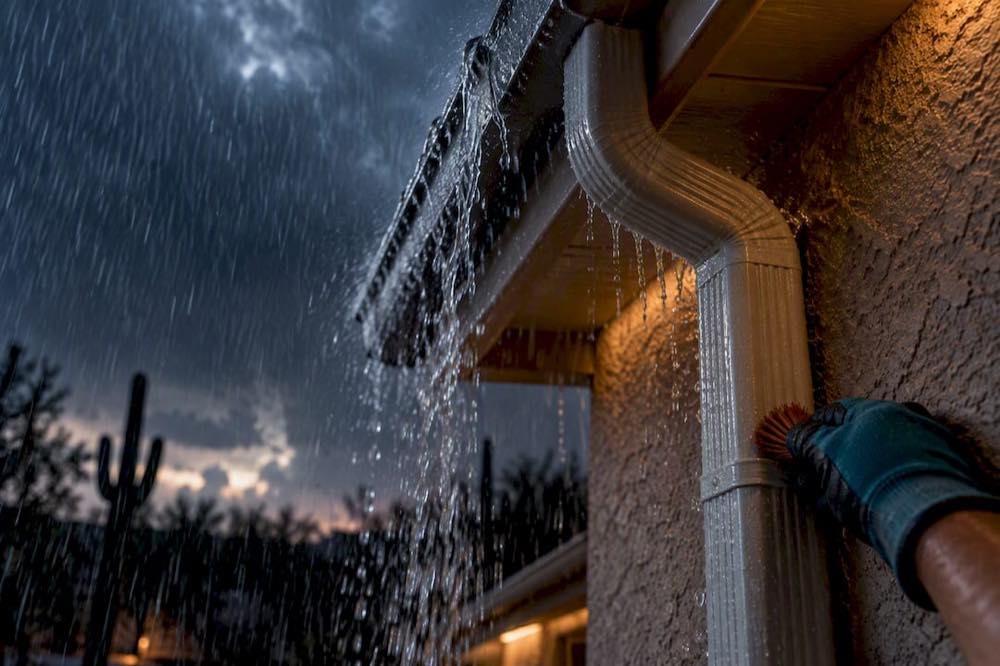
Before the next monsoon rolls in: confirm your flood coverage; clear every drain on your property, secure loose outdoor items, and fix the visible cracks and flashing gaps first. The National Weather Service and Arizona DIFI both flag insurance and drainage as the two things people wait too long to handle, and NFIP flood policies carry a 30-day waiting period, so acting this week matters more than acting perfectly.
TL;DR:
- Most homeowners discover their flood insurance excludes surface water flooding only after damage occurs, emphasizing the importance of early purchase well before storms forecasted.
- Proper yard grading, clearing drains, and inspecting exterior seals are crucial, as wind-driven rain can penetrate through small cracks and gaps during gusty monsoon storms.
- Regular maintenance of gutters and downspouts, along with sealing window and door vulnerabilities, significantly reduces indoor water intrusion risk during heavy Arizona rainfall.
- Patching recurring leaks suggests underlying construction flaws, making structural upgrades with moisture-resistant materials a more cost-effective long-term solution.
- Flood damage caused by wind-driven rain may be covered by standard homeowners policies, but rising surface water typically requires separate flood insurance with a 30-day wait period.
Table of Contents
- Monsoon Rain Protection Arizona: What to Do First
- Pre-Storm Checklist: What to Do 1 to 4 Weeks Out
- How Do You Inspect a Home for Wind-Driven Rain Risk?
- Fixing Drainage Before the Water Finds Your Foundation
- What Should You Never Do During an Arizona Monsoon Storm?
- Insurance Basics: What Actually Covers Monsoon Damage
- Materials That Actually Hold Up to Arizona Monsoons
- Sealing Windows and Doors Against Wind-Driven Rain
- Gutter and Downspout Maintenance for Monsoon Debris
- Emergency Kit Checklist for Monsoon Season
- Why Construction Choices Matter More Than Repeated Patching
- Consider a Long-Term Rebuild Before Next Monsoon Season
- Official Resources for Monsoon Alerts and Insurance
- Sources
- FAQ
Monsoon Rain Protection Arizona: What to Do First
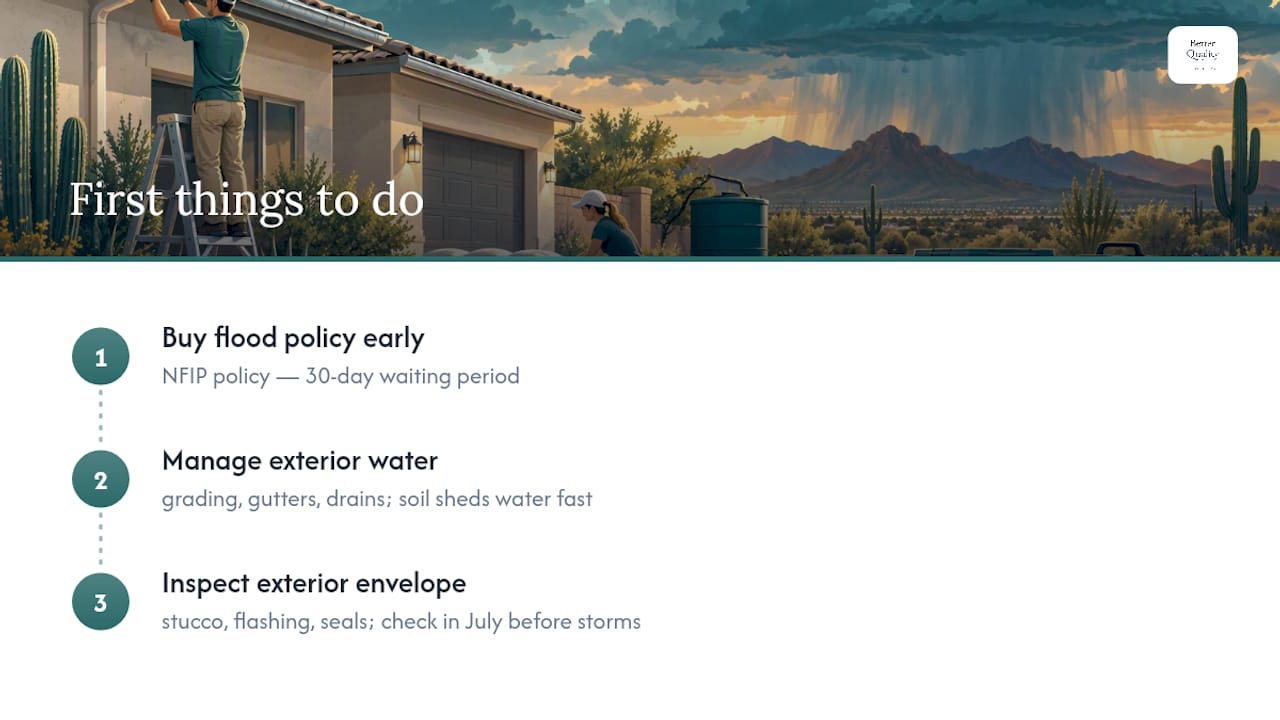
Arizona monsoon rain protection starts with a hard truth: most homeowners find out their policy excludes flooding the same week their garage takes on two inches of water. That’s not a knock on any one insurer. Standard homeowners and renters policies are built to exclude rising surface water, which is exactly what monsoon flash flooding produces. Flood coverage comes from a separate National Flood Insurance Program policy, and DIFI notes it typically carries a 30-day waiting period before coverage kicks in, so buying it the morning a storm is forecast does nothing for you.
The second priority is water management around the house itself, not inside it. Arizona’s baked, compacted soil doesn’t absorb rain the way garden soil does. It sheds water fast, which means grading, gutters, and drains do more work here than in almost any other climate. A yard that slopes toward the foundation, or a scupper clogged with mesquite pods, turns a fifteen-minute monsoon downpour into a standing-water problem at your back door.
Third: your exterior envelope, meaning stucco, flashing, window seals, and roof-to-wall transitions, is what actually keeps wind-driven rain out of your walls. Arizona storms rarely fall straight down. They come in sideways on 40 to 60 mph gusts, which pushes water into cracks that would never leak in a calm rain. Contractor guidance from TWDAZ recommends inspecting stucco and flashing in July, before peak storm season, because hardened soil and higher runoff make small gaps worse over a season, not better.
Pre-Storm Checklist: What to Do 1 to 4 Weeks Out
You don’t need a month of free weekends to get ready. You need about four focused tasks done in order before the sky turns green.
- Sign up for emergency alerts and check National Weather Service forecasts and county flood maps for your specific address, not just your zip code.
- Secure or store outdoor items. Patio furniture, umbrellas, potted plants, and trampolines become projectiles in monsoon wind gusts. What you can’t bring inside, anchor or weigh down.
- Clear gutters, scuppers, downspouts, and channel drains. Confirm the final water path actually carries runoff away from your foundation, not toward it.
- Move electronics and valuables off the floor if you live in a low-lying area or have flooded before. Renters should photograph any existing building issues and notify the landlord in writing now, not after water comes in.
- Schedule inspections and minor repairs in July, ahead of the heaviest August storms, so a contractor isn’t juggling forty other emergency calls when you call.
The University of Arizona’s monsoon guidance backs the alert-and-shelter approach as a baseline safety habit, not an optional extra, given how fast monsoon cells develop.
Pro Tip: Set your phone’s weather alerts to “severe” only, not “all,” during monsoon season. Getting a flash flood warning buried under twelve routine notifications defeats the point of having the alert at all.
How Do You Inspect a Home for Wind-Driven Rain Risk?
Wind-driven rain doesn’t need a hole to get in. It needs a hairline crack, a gap in flashing, or caulk that’s shrunk away from a window frame, and Arizona’s sun ages exterior materials faster than most homeowners expect.
Walk your exterior and check these specific spots:
- Stucco cracks, especially spider cracks radiating from window corners or foundation lines, where water tracks behind the surface instead of running off it.
- Window and door flashing, the metal or membrane strip that redirects water away from the frame. If it’s buckled, rusted, or was installed shallow, wind pressure can force water past it.
- Roof-to-wall transitions, where two different materials meet and sealant is the only thing standing between you and a leak.
- Weep screeds at the stucco’s base, which need to stay uncovered and unclogged so trapped moisture can drain out instead of climbing into the wall.
Inside, watch for interior stains, a musty smell in closets or crawl spaces, or paint that’s bubbling. Those are signs water is already getting in somewhere you haven’t found yet. A contractor using a moisture meter or infrared scan can locate a hidden leak source far faster than guesswork, and that matters because patching the visible symptom without finding the entry point means you’ll be back on the roof next August.
Hairline stucco cracks and a resealed window are DIY-friendly weekend jobs. Failed flashing, a compromised roof transition, or a buried weep screed call for a contractor, both because the fix requires removing material to do it right, and because a professional repair now is almost always cheaper than the drywall, insulation, and mold remediation a hidden leak causes over a full season. For homes with recurring wind damage, it’s worth reviewing wind-resistant design details built into the original construction, since some leak patterns trace back to how the house was framed, not just how it’s maintained.
Pro Tip: Run a garden hose over a suspect window seam for ten minutes while someone checks the inside frame. It’s the closest thing to a free water-intrusion test you’ll get.
Fixing Drainage Before the Water Finds Your Foundation
Grade check first: stand at your foundation line and confirm the ground slopes away from the house for at least six feet. If water pools against a wall or a slab edge after a normal rain, that’s your highest-priority fix, well before anything cosmetic.
- Clear scuppers, channel drains, and any low spot in the yard where debris collects. Mesquite pods, palm fronds, and dust silt clog these fast in Arizona.
- Use sandbags for temporary protection only. Maricopa County recommends filling them half to two thirds full and stacking them in a brick pattern, offset like bricks in a wall, so they hold against pressure instead of shifting apart.
- For a longer-term fix, a shallows wale or a rock-lined channel redirects runoff around the house instead of through it, and permeable hardscape in place of solid concrete lets water soak in rather than sheet toward your walls.
- Check that weep screeds and foundation vents aren’t buried under mulch or soil buildup. Both need airflow and drainage clearance to do their job.
Six inches of moving water is enough to knock down an adult, and that’s the same volume a poorly graded yard can push against a foundation wall during a heavy cell. Fixing the slope is cheaper than fixing the wall.
What Should You Never Do During an Arizona Monsoon Storm?
Flash flooding kills more people during monsoon season than lightning or wind combined, mostly because drivers underestimate moving water. Follow these rules without exception:
- Never drive through a flooded road. Moving water can be unexpectedly powerful and capable of knocking a person down or floating a vehicle, according to National Weather Service guidance that Maricopa County repeats every season.
- Stay out of washes, even dry-looking ones. A storm cell miles away can send a wall of water down a wash with almost no warning at your location.
- Avoid anything electrical that’s wet. Downed lines, flooded outlets, and submerged appliances are not worth the risk. Call the utility company, not a repair attempt.
- If water enters your home, shut off electricity or water only if you can reach the panel safely and it’s not standing in water. Photograph the damage before you touch anything you don’t have to.
Flow speed, not depth alone, is what makes floodwater dangerous. Water that looks ankle deep and calm can be moving fast enough underneath to sweep a person off their feet, which is why the safest move is always to avoid it entirely rather than judge it by eye.
Insurance Basics: What Actually Covers Monsoon Damage
Here’s the distinction that trips people up every year: wind-driven rain that gets in through a cracked wall or failed flashing is a building-envelope problem, and it’s often covered by a standard homeowners policy. Rising surface water, the kind that floods a garage from outside, generally isn’t. That’s flood insurance territory, and it requires a separate NFIP policy.
- NFIP coverage tops out at $250,000 for the dwelling and $100,000 for contents, figures worth knowing before you assume a claim will fully replace what you lost.
- The 30-day waiting period means buying flood coverage the week a storm is forecast is too late. Buy it in the spring, not in July.
- Renters can buy NFIP contents coverage even though the landlord carries the building policy, and separating those two conversations early avoids confusion after damage happens.
- Check your flood-zone status through FEMA mapping before assuming you’re low risk. A flood-zone lookup takes a few minutes and can change what coverage you decide to carry.
Document your property before storm season with dated, remotely stored photos of the roof, exterior walls, and drainage paths. If damage happens, photograph it before cleanup starts whenever it’s safe to do so. That before-and-after record is often the difference between a claim that pays and one that gets disputed.
Materials That Actually Hold Up to Arizona Monsoons
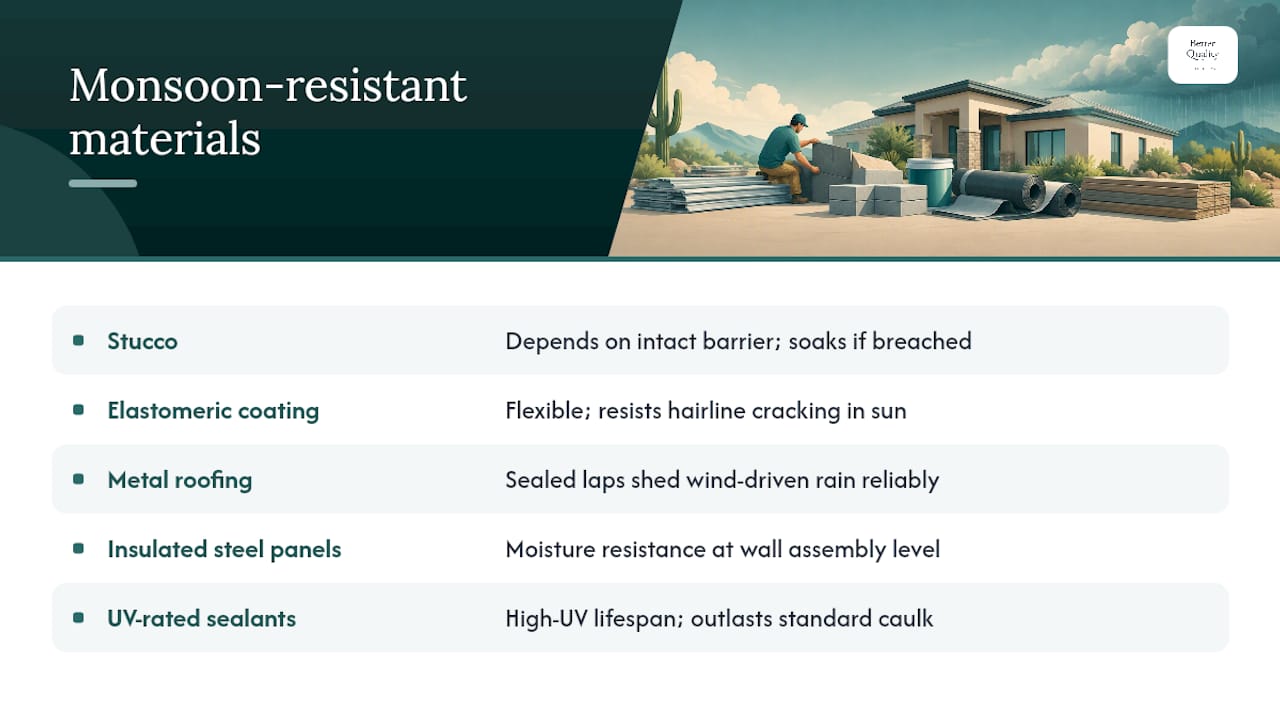
Not every “weatherproof” material performs the same way under Arizona’s specific combination of intense UV exposure, extreme heat cycling, and short, violent rain bursts. Traditional stucco, for instance, is durable but relies entirely on an intact weather barrier underneath it. Once that barrier fails from sun-cracking, the stucco itself becomes a water-holding sponge rather than a shield.
Elastomeric coatings, which flex slightly as the wall expands and contracts in heat, resist hairline cracking better than rigid paint finishes and are worth considering on south and west-facing walls that take the most sun and wind exposure. Metal roofing with properly lapped, sealed seams sheds wind-driven rain more reliably than tile in high-gust conditions, since tile relies on underlayment that degrades over time.
For structural systems, insulated steel panel construction, the kind used in hurricane and earthquake-prone regions, resists moisture intrusion at the wall assembly level rather than depending solely on a surface coating that needs reapplication every few years. That matters in a climate where a surface fix bought this spring can be sun-damaged by next monsoon season. Weatherstripping and sealants rated for high UV exposure also outlast standard hardware-store caulk, which chalks and shrinks within a season or two under direct Arizona sun.
The pattern across all of it: materials that fail here usually fail because heat degraded them first, and the rain just found the opening.
Sealing Windows and Doors Against Wind-Driven Rain
A window that’s never leaked in ten years of light rain can still leak in a monsoon gust, because wind pressure changes how water behaves at the seal. Rain doesn’t just fall onto a window during a monsoon storm, it gets pushed sideways into every gap the frame has.
Start with the weatherstripping around door thresholds. Compressed, cracked, or gapped stripping lets water in even when the door is fully closed, and it’s one of the cheapest fixes on this entire list. A local specialist like One Day Doors & Closets can assess whether your exterior doors need new thresholds or full replacement if the frame itself has warped from years of heat exposure.
For windows, check the caulk bead around the entire frame, not just the bottom sill. Gaps at the top and sides are just as vulnerable when wind is driving rain upward and sideways, not straight down. Silicone-based sealants rated for exterior UV exposure last longer than standard acrylic caulk in Arizona’s climate. If you’re replacing windows anyway, a lower solar heat gain coefficient pairs naturally with better-sealed, more modern frames, so it’s worth handling both upgrades at once rather than sealing old frames repeatedly.
Sliding doors deserve a second look too. Their track systems collect dust and debris year round, and that buildup can prevent the door from seating fully closed, leaving a gap wind-driven rain exploits.
Gutter and Downspout Maintenance for Monsoon Debris
Arizona gutters face a different enemy than gutters in rainier climates: dust, dry leaves, and desert debris that bake into a hardened crust between storms, then get hit all at once by an intense downpour that can’t drain through it.
Clean gutters at least twice before peak monsoon season, once in early June and again in mid-July, since a single spring cleaning won’t survive dust storms and dry heat baking debris into place. Check downspouts for the same crusted buildup, and confirm each one still discharges water at least several feet from the foundation rather than dumping it straight down at the base of the house.
Gutter guards help reduce the frequency of cleanings but don’t eliminate the need entirely, especially under palm trees or mesquite, which drop debris gutters guards weren’t designed to filter. After any major dust storm, a quick visual check of your gutter line takes less time than most people assume and catches a clog before the next storm cell arrives.
Emergency Kit Checklist for Monsoon Season
A monsoon-specific emergency kit looks different from a general disaster kit because Arizona’s risks are short, intense, and often paired with power outages from wind damage.
Keep these items stocked and accessible before storm season starts:
- Battery-powered or hand-crank weather radio, since cell towers can go down with power outages.
- Flashlights and extra batteries, stored somewhere other than a junk drawer you’ll forget in the dark.
- A three-day supply of water and non-perishable food per household member.
- A basic first aid kit, plus any prescription medications kept current, not expired.
- Copies of insurance policies and property photos stored digitally, not just in a filing cabinet that could get water damage.
- A car emergency kit including a flashlight, blanket, and phone charger, since flash flooding often strands drivers away from home.
- Cash on hand, since power outages can take down card readers at local stores.
Maricopa County’s monsoon prep guidance frames the family emergency plan and kit as a single package, not two separate tasks, and that pairing is worth keeping intact: a kit without a plan for where everyone meets is only half useful.
Why Construction Choices Matter More Than Repeated Patching
Most of the advice in this article treats your house as it already exists: patch the crack, clear the drain, seal the gap. That’s the right approach for this season. But if you’re patching the same stucco corner or the same window seam every August, the problem usually isn’t maintenance. It’s the original construction detail underneath.
Correct flashing at roof-to-wall transitions, drainage that’s graded right the first time, and an exterior material that doesn’t rely on a coating reapplied every few years all reduce how often you’re back on that ladder. Some builders use steel panel systems designed to resist moisture at the structural level, as these assemblies can outperform repeated surface patches over time. If you’re facing a third consecutive season of the same leak, or a repair estimate that rivals a partial rebuild, that’s the point to weigh a retrofit or new build against another round of patchwork.
— David Kobierski
Consider a Long-Term Rebuild Before Next Monsoon Season
If your home has taken on water damage more than once, patching the same spot every year isn’t protection, it’s a delay. For homeowners done chasing the same leak, options exist such as steel-insulated panels that resist moisture, mold, and pests at the structural level, not just the surface coating.

If a rebuild or major retrofit is on your radar, you can browse the AIRLIGHT BUILD floor plan library to see layouts already designed around this construction method, or look into available lots if you’re starting from land rather than an existing structure. Financing packages with 10% down, combining land and construction costs, make the jump from patch-and-repair to full rebuild more realistic than most homeowners assume. Reach out through the custom home building page to talk through whether your situation calls for repair or a fresh start.
Official Resources for Monsoon Alerts and Insurance
- Forecasts and safety: National Weather Service monsoon safety guidance and Maricopa County’s monsoon page.
- Insurance and flood risk: Arizona DIFI flood insurance information and disaster resources.
- Health and preparedness: University of Arizona monsoon safety guidance.
Sources
- Monsoon Safety | National Weather Service (Tucson/PHX pages consolidated)
- Flood insurance information | Arizona DIFI
- Arizona monsoon, lightning and your health | University of Arizona
- Monsoon | Maricopa County, AZ
- Is your Arizona home ready for the 2026 monsoon season? | TWDAZ
FAQ
Does NFIP Flood Insurance Start Right Away?
No. NFIP flood policies typically carry a 30-day waiting period before coverage takes effect, so buying a policy once a storm is already forecast won’t protect you for that event.
Are Sandbags Actually Effective for Monsoon Flooding?
Sandbags provide temporary protection when filled half to two thirds full and stacked in a brick pattern, but they’re a short-term barrier, not a permanent drainage fix. Grading and drain maintenance matter more for long-term protection.
Do Renters Need Their Own Flood Coverage?
Yes. Standard rental policies generally don’t cover flood damage, and renters can purchase NFIP contents coverage separately, since the landlord’s policy typically only covers the building itself.
When Should I Call a Contractor Instead of Fixing It Myself?
Hairline stucco cracks and resealing a window are reasonable DIY jobs, but failed flashing, a compromised roof-to-wall transition, or recurring leaks need a professional, ideally inspected in July before peak storm months hit.
What Does Better Quality Builders Offer for Long-Term Monsoon Protection?
Better Quality Builders builds custom homes using AirLight steel-insulated panels designed to resist moisture, mold, and pest intrusion at the structural level. Pricing details for the AIRLIGHT BUILD program are available directly on the site.