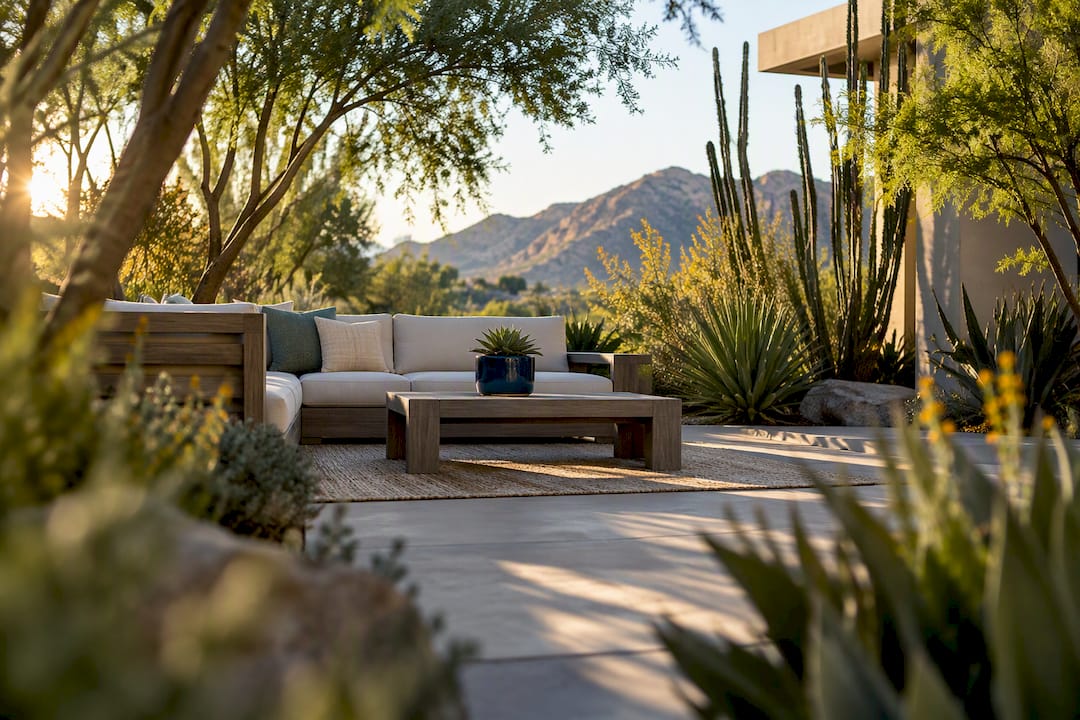
The best approach to privacy in an Arizona yard is never a single tall wall. It is a layered strategy: desert-adapted plants for softness and shade, vertical living walls where space is tight, heavy-gauge metal panels where you need a permanent screen, and hardscape moves like berms or pergolas that block sightlines without trapping heat. This combination costs less to maintain than a solid block wall, breathes with the desert instead of fighting it, and Arizona’s own statutes give homeowners more flexibility than most cities admit.
TL;DR:
- Desert-adapted plants like Arizona cypress and mesquite provide reliable, sustainable screening when matched to microclimates and properly irrigated from the start.
- Hardscape elements such as berms, retaining walls, and pergolas can offer immediate privacy without height restrictions, but require careful site mapping beforehand.
- Durable metal panels, especially heavy-gauge steel with quality powder-coating, serve as permanent privacy screens around utility areas and pool equipment, outlasting traditional fencing.
- Arizona’s legal framework limits municipalities from forcing strict fence or wall requirements, but HOA rules may still impose restrictions on screening materials and heights.
- Building privacy into the home design from the start, including lot orientation and structural placement, results in long-term effectiveness and reduces the need for retrofitting later.
Table of Contents
- Why Common Privacy Solutions Fail in Arizona
- Desert-Adapted Plants That Provide Reliable Screening
- Living Walls and Vertical Planting for Tight Spaces
- Durable Metal Panels for Low-Maintenance Screening
- Hardscape and Site Moves That Cut Sightlines Without Height
- Arizona Legal and Permitting Notes for Privacy Projects
- How a Custom-Home Builder Builds Privacy In From the Start
- What Arizona Homeowners Get Wrong About Privacy Design
- Build Privacy Into Your Home, Not Onto It
- Sources
- FAQ
Why Common Privacy Solutions Fail in Arizona
A six-foot cedar fence that looks great in a home improvement catalog often splits, warps, or bleaches within a few Arizona summers. UV exposure here is relentless, and the swing between 115 degree afternoons and cool monsoon nights puts real stress on thin wood and cheap vinyl. Materials expand, contract, and eventually crack.
Solid block or stucco walls create a different problem. They radiate stored heat back into the yard for hours after sunset, which can push patio temperatures noticeably higher on summer evenings. A wall also blocks the breezes that make Arizona evenings livable and can turn a backyard into a still, stagnant box.
Plants and wood carry their own risks when irrigation goes wrong. Overwatering invites root rot and pest pressure, including cypress bark beetle activity in stressed Arizona cypress. Underwatering in a heat wave can kill a screen planting outright.
Common failure points worth watching for:
- Untreated wood fencing that warps or splits within two to four monsoon seasons
- Solid masonry walls that trap radiant heat near seating areas
- Thin stamped metal panels that fade, dent, or rust at seams
- Screen plants stressed by inconsistent watering, inviting pest damage
None of this means a conventional fence is always wrong. A temporary rental property, a boundary dispute resolved by a private agreement, or a short-term budget constraint can still justify a basic fence. It just should not be the default for a home you plan to live in for decades.
Desert-Adapted Plants That Provide Reliable Screening
Plant privacy in Arizona works when you match species to microclimate and commit to the right watering rhythm from day one. The Arizona Cooperative Extension recommends selecting by elevation and hardiness rather than picking whatever looks lush at the nursery, since a plant suited to Tucson’s low desert can struggle at higher, cooler elevations near Flagstaff or Prescott.
- Arizona cypress grows into a dense, upright screen reaching roughly 40 feet tall and 25 feet wide at elevations between 3,000 and 6,000 feet, making it one of the fastest routes to a true living wall along a property line. It needs supplemental irrigation during dry stretches to avoid becoming vulnerable to bark beetles, and compact cultivars exist for smaller lots.
- Mesquite offers a more open, dappled screen better suited to filtering harsh western sun than blocking a direct sightline. Space trees 15 to 20 feet apart and expect three to five years before canopy coverage feels substantial.
- Palo verde works well near pool areas where you want shade without heavy leaf litter, though its canopy is thinner than cypress and less reliable as a standalone privacy screen.
- Hopseed bush is a dense, fast-growing shrub that handles narrow side yards well, often reaching six to twelve feet with regular pruning.
- Texas sage stays lower and rounder, useful as a mid-height layer in front of taller screening plants rather than as the primary barrier.
- Bottlebrush adds color and moderate density, and tolerates reflected heat off stucco walls better than many flowering shrubs.
- Oleander remains a classic dense screen where local rules allow it, though its toxicity makes it a poor choice near play areas or homes with pets that chew vegetation.
Pro Tip: Check root-zone moisture with a metal soil probe instead of trusting a timer alone. Push it into the ground near the drip line; if it slides in easily to 12 to 18 inches, the deep roots are getting water. If it stops short, your screen planting may look fine on the surface while slowly drying out underneath.
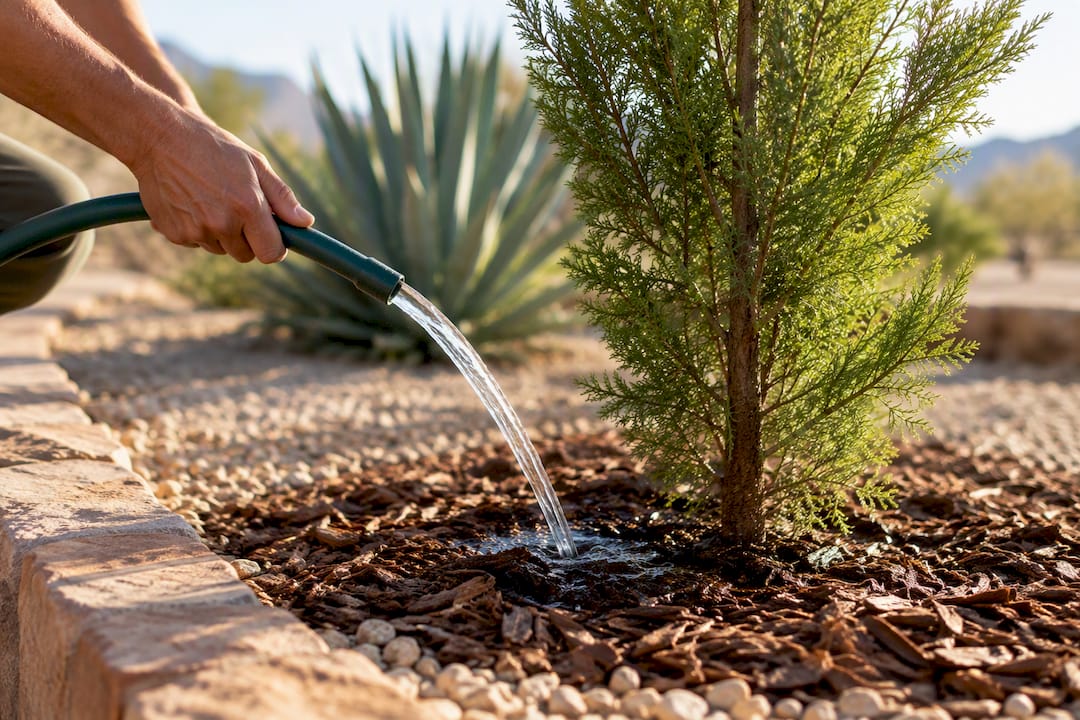
Deep, infrequent irrigation beats frequent shallow watering for establishing drought resilience in these species. Mulch heavily to reduce evaporation, and in higher-elevation yards, wrap young cypress and citrus-adjacent plantings before the first hard freeze.
Living Walls and Vertical Planting for Tight Spaces
A narrow side yard or a blank casita wall rarely has room for a mesquite grove, and that is exactly where vertical systems earn their place. Two approaches dominate: modular irrigated living walls and simpler trellis or climbing-plant systems.
Modular living walls use planted cells or pockets fed by a small reservoir and drip network, which lets you pack dense greenery into a few inches of depth. Trellis systems cost far less and rely on a climbing or trailing species trained up a frame, but they take longer to fill in and depend on choosing a plant that can actually handle full desert sun.
- Rosemary and trailing dichondra hold up well in modular cells with consistent drip irrigation
- Tradescantia adds fast-filling texture in partial shade against north or east-facing walls
- Autumn sage tolerates trellis training and brings color without heavy water demand
- Climbing species need pruning two to three times a year to stay flat against the structure
Winter protection matters more for vertical systems than ground plantings, since exposed roots in shallow cells cool faster than soil-buried roots. The best placements are casita walls facing a patio, courtyard backs where you want green without losing square footage, and blank exterior walls that face a neighbor’s second-story window.
Durable Metal Panels for Low-Maintenance Screening
Custom steel screening solves problems plants and trellises cannot: instant privacy, zero growing-in period, and a permanent barrier around pool equipment or utility pads. The material choice determines whether that panel lasts five years or fifty.
Heavy-gauge steel with professional powder-coating consistently outperforms the thin stamped panels sold at big-box retailers, which tend to fade, dent, and corrode at the seams within a few Arizona summers. AirLight steel panels, the same category of heavy-gauge, UV-stable material Better Quality Builders builds full homes with, illustrate why gauge and finish quality matter more than pattern or price when you’re screening something permanent.
- Choose perforated or laser-cut patterns that let air move through, avoiding the heat-trap effect of solid metal walls
- Powder-coating resists fading and chalking far longer than raw or painted finishes under intense UV
- Corten steel develops a stable rust patina that some homeowners prefer for a contemporary desert look, though it stains adjacent light-colored hardscape if not detailed with a drip edge
- Panels can double as a trellis backing, giving climbing plants structure while the metal handles the actual screening
The best-use cases are mechanical equipment enclosures, narrow access corridors between structures, and formal contemporary yards where a clean geometric screen fits the architecture better than a hedge.
Hardscape and Site Moves That Cut Sightlines Without Height
Before you plant a single screen tree or order a metal panel, walk your yard at the times of day you actually use it and map where the problem sightlines originate. A neighbor’s upstairs window, a street-facing patio corner, or a pool deck visible from a shared driveway each call for a different fix, and mapping them first prevents wasted budget on the wrong solution.
- Berms and raised planting beds change the eye line without adding height at the property line, which matters both for maintaining views and for staying clear of any HOA height restrictions on fences.
- Retaining walls paired with elevated planters give you two to three feet of effective screening height using landscaping rather than a formal wall, often at lower cost than equivalent linear feet of masonry.
- Pergolas with integrated planter boxes block overhead and angled sightlines from two-story neighboring homes while providing shade that a flat wall cannot.
- Water features mask road noise and conversation more effectively than most people expect, and pair naturally with the layered plant-and-panel approach discussed above.
Sequence matters. Hardscape and structures deliver privacy the day they’re installed; plant screens take years to mature. Install the berms, pergolas, and metal panels first for immediate coverage, then let the cypress and mesquite fill in behind them over time.
Arizona Legal and Permitting Notes for Privacy Projects
Arizona homeowners have more legal room than many assume. State statutes, including SB 1431 and related planning language, restrict how far municipalities can go in mandating screening, walls, fences, or specific exterior design elements on single-family homes. That preemption gives you real flexibility on material and design choices a city planning department might otherwise try to dictate.
HOAs are a separate matter entirely and are not bound by the same state limits, so a design review committee can still restrict fence height, panel finish, or plant placement within its own governing documents.
- Check your county planning office before finalizing any structure over typical fence height
- Submit HOA architectural review requests early since approval can take several weeks
- Historic districts often carry additional exterior-material restrictions worth confirming before ordering custom panels
- If your privacy project intersects with an off-grid or alternative wastewater system, know that kitchen wastewater is regulated separately from gray water in Arizona, meaning a composting toilet still requires a small septic system and sign-off from a licensed Soil & Site Evaluator
How a Custom-Home Builder Builds Privacy In From the Start
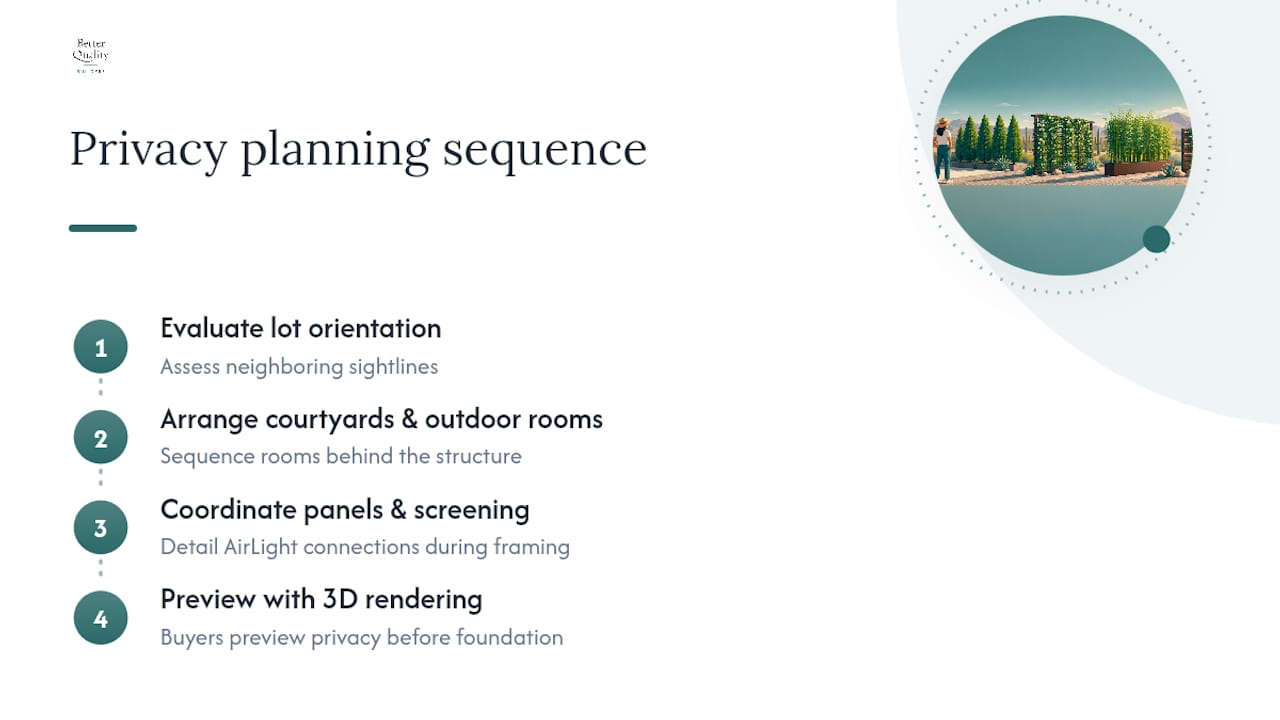
Privacy that works long-term starts at the lot-siting phase, not after move-in. Orienting a home so courtyards face away from neighboring sightlines, sequencing outdoor rooms behind the structure itself, and choosing panel placement during design rather than as an afterthought all reduce how much wall or fencing you need later.
Material decisions made at the framing stage carry forward for decades. A builder detailing AirLight panel connections alongside privacy screening can plan for thermal performance and airflow at the same time, instead of retrofitting a fix around finished construction. Better Quality Builders’ lot selection and 3D rendering process lets buyers preview how a specific lot’s orientation and neighboring structures affect privacy before a single foundation is poured, and the construction blog covers related site-planning topics for Arizona buyers weighing these tradeoffs.
What Arizona Homeowners Get Wrong About Privacy Design
Most privacy advice treats Arizona like it’s just another hot climate, and that’s the core mistake. The conventional playbook, a tall solid wall or a dense evergreen hedge, was written for places with mild summers and reliable rainfall. Here, that same wall becomes a radiant heater by 7 p.m., and that hedge becomes a water bill you will regret.
What the research actually supports is restraint paired with layering. Desert-adapted species like Arizona cypress and mesquite do the screening work plants are good at, without demanding the irrigation habits that kill them or the water costs that make xeriscape pointless in the first place. Metal panels and hardscape fill the gaps plants can’t, instantly and permanently, around pool equipment or narrow access zones where nothing grows fast enough.
The bigger miss is legal assumption. Homeowners routinely over-comply with imagined city rules on fence height or screening material, not realizing state preemption already limits what municipalities can demand. Check your actual constraints, whether they come from the county or your HOA, before designing around a rule that may not exist. Prioritize sightline mapping first. Everything else, plant species, panel finish, berm height, follows from knowing exactly what you’re blocking and why.
— David Kobierski
Build Privacy Into Your Home, Not Onto It
Retrofitting privacy onto an existing Arizona yard means working around a lot you didn’t choose and a structure that wasn’t oriented with sightlines in mind. Some builders take the approach that privacy should be designed into the lot selection, courtyard layout, and panel detailing before construction starts, using steel panels engineered for heat and UV exposure rather than retrofitted metal screening bolted on after the fact.
If you’re evaluating a builder for a privacy-focused project, ask four things: how they handle sightline review during site planning, what their irrigation plan looks like for any screening plants, how they detail living-wall or trellis attachments to the structure, and whether they support HOA or permit review directly. The AIRLIGHT BUILD floor plan library lets you see how privacy-oriented layouts work on paper, and the lot selection and 3D rendering process shows you exactly how a specific parcel’s orientation affects your sightlines before you commit. For entryway and gate detailing that ties into your privacy screening, One Day Doors & Closets of Arizona is a local resource worth a look. Start by reviewing available lots and requesting a 3D preview for the one you’re considering.
Sources
- SB1431: Arizona statutes on planning and home design (legislative text)
- Recommended Plants for Sierra Vista | UA Cooperative Extension
- Fact sheet for septic and composting systems (Cochise County Environmental Health)
FAQ
What Is the Best Privacy Tree for Arizona Yards?
Arizona cypress is the most reliable option for fast, dense screening, reaching roughly 40 feet tall at elevations between 3,000 and 6,000 feet. It needs supplemental irrigation during dry periods to avoid bark beetle stress, and mesquite is a strong alternative where you want filtered shade rather than a solid wall of green.
What Are the Privacy Laws in Arizona?
State statutes, including SB 1431, limit how much municipalities can mandate specific screening, wall, or fence designs on single-family homes. HOAs operate under separate rules and can still impose their own architectural requirements, so always check both before designing a privacy feature.
Can You Legally Live Off-Grid in Arizona?
Off-grid living is legal in Arizona, but wastewater systems still require permitting and oversight from a licensed Soil & Site Evaluator. Even a composting toilet setup needs a small septic system because kitchen wastewater is regulated separately and does not count as gray water.
Where Do High-End Homeowners Build Private Estates in Arizona?
Scottsdale, Paradise Valley, and parts of Sedona are known for large private lots with mature landscaping, elevation changes, and custom screening built into the site design rather than added later. Better Quality Builders works with buyers pursuing this kind of layout through its Scottsdale custom home building services.
How Much Does Privacy Landscaping Cost in an Arizona Yard?
Costs vary widely by material and scale, ranging from a modest plant-only screen to a full combination of metal panels, hardscape, and mature trees. Rather than publishing a single average, most builders and landscapers price based on square footage, plant maturity at installation, and panel fabrication complexity, so a site-specific quote is the only reliable number.