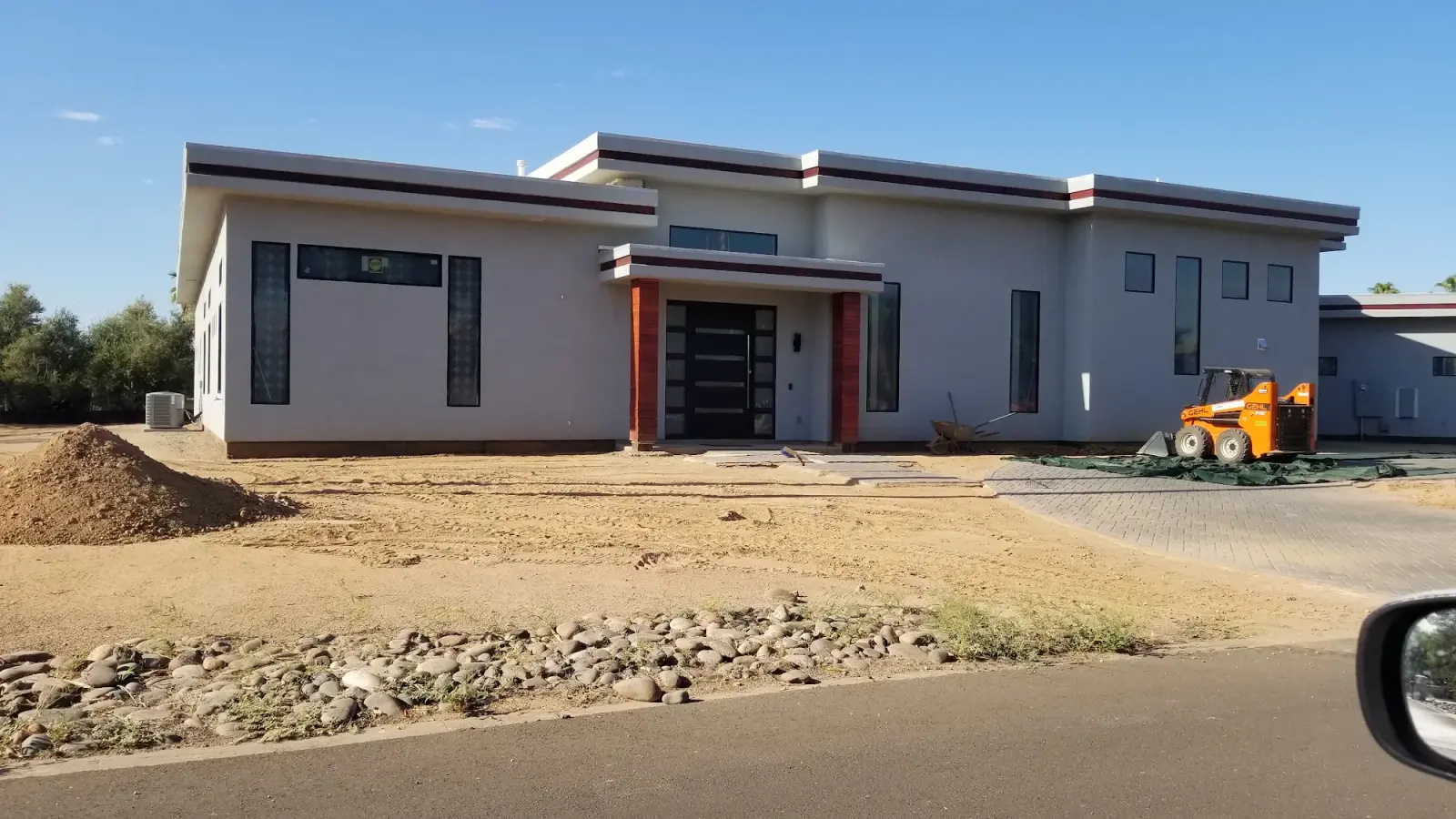
The most useful questions to ask a custom home builder are the ones that make vague promises concrete: prove your Arizona license, show me how you price a job, and put the schedule and warranty in writing before I sign. A builder who answers those clearly, with documents instead of reassurance, is the one worth hiring.
This is a buyer's interview script, not a process checklist. Print it, bring it to the first meeting, and for each question note what the builder actually said. Below every question you will find why it matters and what a good answer sounds like, so you can tell a confident answer from a dodge.
The short version
- Verify the license yourself. Ask for the exact Arizona Registrar of Contractors (ROC) license number and look it up free at roc.az.gov before anything else. Confirm the license is active, in the right classification, and bonded.
- Pin down the pricing model. Ask whether the contract is fixed price or cost-plus, how allowances are set, and exactly how change orders are priced and approved. This is where budgets quietly grow.
- Get the schedule and the site management in writing. Ask who runs the job day to day, how permits in your city or Maricopa County are handled, and what the realistic start-to-finish timeline is.
- Read the warranty before you sign, not after. Ask what is covered, for how long, and whether structural coverage is builder-backed or insured.
- Watch for the red flags: no written contract, cash-only or large up-front demands, no license number, pressure to sign fast, and no references you can call.
Why ask hard questions before you sign
A custom home is likely the largest project you will ever commission, and once a contract is signed your leverage drops sharply. The first meeting is when the builder is working to earn your business, so it is the moment they are most willing to answer plainly and put things in writing. Good builders expect these questions and welcome them. The one who gets defensive when you ask to verify a license or see a sample contract is telling you something important.
What should I ask about licensing, insurance, and bonding?
The questions:
- What is your exact Arizona ROC license number, and what classification is it?
- Are you bonded, and do you carry general liability and workers' compensation insurance?
- Can you provide a certificate of insurance naming the project?
Why it matters. In Arizona, most residential construction work above a small dollar threshold must be performed by a contractor licensed through the Arizona Registrar of Contractors. Hiring a licensed, bonded contractor is not just a formality: it is what gives you access to the ROC complaint process and the Residential Contractors' Recovery Fund if work is defective or left unfinished. An unlicensed builder leaves you with none of those protections.
What a good answer sounds like. The builder gives you the license number without hesitation and encourages you to verify it. You then go to roc.az.gov, search the license, and confirm it is active, in a residential classification, held by the business name on your contract, and shows a license bond. A good builder also carries general liability insurance and workers' compensation and will hand you a certificate on request. If anyone tells you a license "is being renewed," "isn't needed for this," or offers a discount for paying cash and skipping permits, stop there. For context on what that licensing buys you after move-in, see our guide to home builder warranties in Arizona.
What questions reveal how a builder prices a job?
The questions:
- Is this a fixed-price contract or cost-plus? If cost-plus, what is the builder's fee or percentage?
- Which items are covered by allowances, and are those allowances realistic for the finishes I actually want?
- How are change orders priced, documented, and approved, and can work proceed without my written sign-off?
- How are progress draws scheduled, and are they tied to completed and inspected milestones?
Why it matters. Pricing structure is where a "great price" turns into a much larger final number. A fixed-price contract puts the risk of cost overruns on the builder; a cost-plus contract means you pay actual costs plus a fee, so the headline number is really an estimate. Neither is automatically better, but you need to know which one you are signing. Allowances (a dollar figure budgeted for things like flooring, cabinets, or fixtures you have not chosen yet) are the other soft spot: lowball allowances make a bid look cheap, then the real selections blow past them. Change orders are the single most common source of budget surprises on a custom build.
What a good answer sounds like. The builder states the model plainly, shows you a sample contract, and walks through a real change-order form. Allowances are set against the finish level you described, not an invisible floor. Change orders are always written, priced before work starts, and never proceed without your signature. Progress draws line up with completed, inspected phases rather than arbitrary dates. For the full picture of what a build actually costs here, see what a custom home costs to build in Arizona, and for how to get a number you can trust, how to get an accurate custom home estimate. The mechanics of pricing mid-build are covered in change orders on an Arizona custom home.
What should I ask about schedule, permits, and who runs the site?
The questions:
- What is a realistic start-to-finish timeline for a home like mine, and what is the critical path?
- Who is my day-to-day point of contact, and who is physically on site managing trades?
- Who pulls the permits, and have you built in my jurisdiction (City of Scottsdale, another city, or unincorporated Maricopa County) before?
- How do you handle inspections and the certificate of occupancy?
Why it matters. Permitting and site management are where Arizona builds slow down. Plan review and permitting run through your local jurisdiction: the City of Scottsdale for homes inside the city, or Maricopa County Planning and Development for unincorporated land, each with its own review times and fees. A builder who has worked in your jurisdiction knows its quirks and plan-review turnaround. "Who is on site" matters just as much: on a custom build, the difference between a dedicated project manager and a builder juggling ten jobs from a truck shows up in your finish quality and your timeline.
What a good answer sounds like. The builder gives a phase-by-phase timeline (design, permitting, construction, final inspections) rather than a single rosy number, and explains what could extend it, such as monsoon-season weather, plan-review cycles, or change orders. They name your single point of contact and the person managing the site daily. They confirm they pull the permits and have cleared review in your specific jurisdiction. For a realistic phase map, see how long it takes to build a custom home in Arizona. If you are building in or near Scottsdale, ask specifically about the city's design review and hillside or native-plant rules, which add steps for many lots.
What should I ask about warranty and service after move-in?
The questions:
- What written warranty do you provide, and can I read it before I sign the construction contract?
- Is the structural coverage builder-backed or insured through a third party?
- What is the process and response time for a warranty request after I move in?
- What maintenance am I responsible for to keep coverage valid in this climate?
Why it matters. The warranty is one of the clearest signals of whether a builder plans to stand behind the home. Most new-home warranties follow the industry-standard 1-2-10 structure (one year on workmanship, two years on major systems, ten years on structural), and in Arizona you are additionally protected by the ROC workmanship standard, the implied warranty of workmanship and habitability, and an eight-year statute of repose. A builder who will not show you the written warranty up front is a problem.
What a good answer sounds like. The builder hands you the actual warranty document to read before you commit, explains in plain language what is and is not covered, and tells you whether structural coverage is backed by the company directly or by a third-party insurer. They describe a clear claim process with real response times.
Better Quality Builders' own warranty terms, including the exact workmanship period and whether structural coverage is builder-backed or insured, are [[OWNER-CONFIRM]]. We review our written warranty with every client in plain language before any contract is signed. The general framework and your Arizona legal protections are explained in our home builder warranty guide.
What answers are red flags?
Use this part of the script to catch trouble early. Any one of these is a reason to slow down; two or more is a reason to walk away.
- No license number, or a number that does not check out on roc.az.gov. This is the single biggest one.
- No written contract, or a refusal to let you read the contract and warranty before signing.
- Cash-only, or a large up-front deposit well beyond what is needed to start design and engineering.
- A bid far below everyone else's. It usually means low allowances, missing scope, or change orders waiting to happen.
- Pressure to sign today to "lock in" a price.
- No references and no addresses of completed homes you can drive past or owners you can call.
- Vague answers to specific questions, especially about who is on site and how change orders are priced.
How should I compare builders after the meetings?
Once you have run this script with two or three builders, line up their answers side by side rather than going on gut feel. Compare the pricing models on equal footing (a fixed price against a cost-plus estimate is not apples to apples), check that allowances match the finishes you actually want, and weigh the warranty terms and the references. The builder with the clearest contract and the most verifiable track record is usually a safer choice than the lowest bid. To make the estimates comparable, read how to get an accurate custom home estimate before you ask for numbers.
Frequently asked questions
What questions should I ask a home builder before hiring them?
Start with the essentials: the exact ROC license number (verify it at roc.az.gov), proof of bonding and insurance, whether the contract is fixed price or cost-plus, how allowances and change orders work, the realistic phase-by-phase timeline, who manages the site day to day, and what the written warranty covers. Ask to read the contract and warranty before you sign, and ask for references and addresses of completed Arizona homes.
How do I verify a custom home builder's license in Arizona?
Go to the Arizona Registrar of Contractors at roc.az.gov and search by the license number or business name the builder gives you. Confirm the license is active, held in a residential classification, matches the business name on your contract, and shows a license bond. The lookup also shows any complaint history. Verifying the license is what preserves your access to the ROC complaint process and the Residential Contractors' Recovery Fund.
What is the difference between a fixed-price and a cost-plus contract?
In a fixed-price contract you agree on one number and the builder carries the risk of cost overruns. In a cost-plus contract you pay the actual cost of labor and materials plus the builder's fee or percentage, so the quoted total is an estimate that can move. Fixed price gives more certainty; cost-plus can offer more transparency on actual costs. Know which one you are signing, and how change orders are priced under it.
What upgrades should I skip on a new build?
Skip upgrades that are hard to add later only when they are purely cosmetic and cheaply changed, such as trendy paint colors, light fixtures, and some surface finishes you can swap yourself. Prioritize spending on the things that are expensive or disruptive to change after the fact: the building envelope and insulation, window quality, electrical and plumbing rough-in locations, and anything structural. A good builder will tell you honestly which allowances are worth increasing and which you can trim.
Do I need a licensed builder for a custom home in Arizona?
Yes. Most residential construction work in Arizona above a small dollar threshold must be done by a contractor licensed through the Registrar of Contractors. Using a licensed, bonded builder is what gives you the ROC workmanship standard, the complaint process, and the Recovery Fund backstop. An unlicensed builder leaves you without those protections if something goes wrong.
How many builders should I interview before choosing one?
Interviewing two or three builders is usually enough to compare pricing models, timelines, warranties, and references on equal footing. More than that tends to add confusion rather than clarity. Use the same question script for each so the answers are directly comparable.
Sources
- Arizona Registrar of Contractors: license lookup, licensing requirements, bonding, complaint process, and the Residential Contractors' Recovery Fund (roc.az.gov)
- City of Scottsdale, Building and permitting (scottsdaleaz.gov/building)
- Maricopa County Planning and Development, permits for unincorporated areas (maricopa.gov)
- Industry-standard 1-2-10 new-home warranty framework and NAHB Residential Construction Performance Guidelines
Last updated: 2026-10-20. This article is general information for Arizona home buyers, not legal advice. Agency rules and license requirements change; verify current requirements with the Arizona Registrar of Contractors or your local building department for your specific situation.