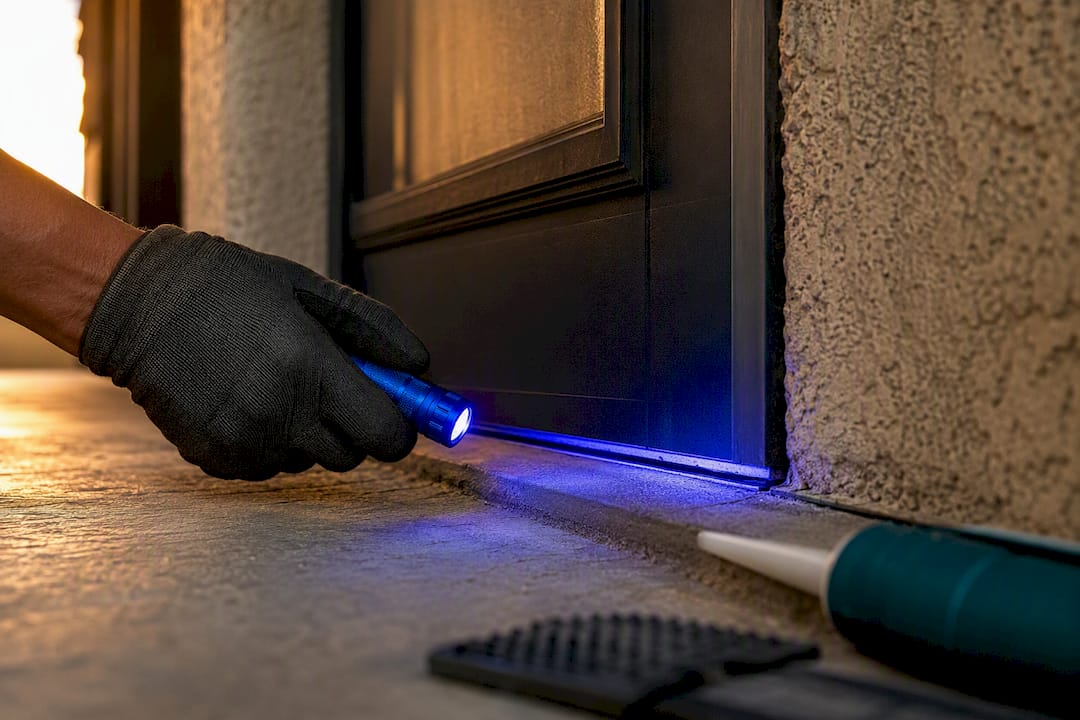
The most effective way to scorpion-proof an Arizona home is to seal every gap of 1/16 inch or wider, then pair that exclusion work with yard harborage reduction and targeted perimeter treatment. Sealing beats spraying because bark scorpions climb, squeeze, and hide inside walls where pesticides never reach. If sightings continue after you’ve closed the obvious gaps, a scorpion-aware pro can map the remaining routes with a blacklight and back the work with a warranty.
TL;DR:
- Sealing every gap of 1/16 inch or wider is crucial because bark scorpions can pass through openings as small as a dime in size.
- Focus on sealing exterior door thresholds, jambs, window screens, utility penetrations, and stucco cracks near grade to prevent entry routes.
- Pair sealing with yard modifications like removing debris, mulch, and vegetation within 12 inches of the foundation to eliminate scorpion shelter and prey sources.
- Use UV blacklight mapping to identify actual scorpion traffic paths before sealing, ensuring work targets high-traffic zones and avoids wasted effort.
- Schedule sealing and inspection efforts before peak activity season from late winter to early spring for best long-term results.
Table of Contents
- Top-Priority Scorpion Proofing Checklist for Arizona Homes
- How Do You Seal Doors, Windows, and Garages Against Scorpions?
- Sealing Stucco, Weep Screed, and Utility Penetrations Without Trapping Moisture
- Landscape Changes That Cut Off Scorpion Shelter and Food
- Cutting Off the Food Supply: Insects and Lighting
- How UV Blacklight Mapping Finds Scorpion Entry Routes
- When Should You Call a Professional Scorpion Sealer?
- When Should You Inspect and Reseal for Scorpions?
- How Home Construction Reduces Long-Term Scorpion Access
- What’s a Realistic Outcome When You Scorpion-Proof a Home?
- Building a Tighter Envelope With Better Quality Builders
- Sources
Top-Priority Scorpion Proofing Checklist for Arizona Homes
Start with the routes bark scorpions actually use, not the ones that feel intuitive. The University of Arizona Cooperative Extension ranks pest-proofing above pesticide use for exactly this reason: scorpions live in wall voids and under rock beds, places sprays rarely penetrate.
Work through these in order:
- Garage door bottom seal and jambs. This is the single largest gap in most Arizona homes and the first thing to fix.
- Exterior door thresholds and head gaps. Check the top of the doorframe, not just the bottom sweep.
- Weep screed along the stucco base. Screen it, never seal it shut.
- Window screens and sliding door tracks. Torn screens are an open invitation.
- Utility penetrations. AC lines, dryer vents, cable and irrigation conduits all need attention.
- Stucco cracks near grade. Even hairline cracks widen into scorpion highways over a few summers.
Pair sealing with a same-day yard pass: pull rock and mulch back at least 12 inches from the foundation, haul away any wood or stone piles stacked against the house, and prune branches so nothing touches the roofline or walls. Scorpions follow prey insects and shade, and a bare 12-inch buffer removes both.
For a fast read on your current exposure, run a night sweep with a UV flashlight before you seal anything. It tells you where the scorpions actually are, not where you assume they are. While you’re outside, move motion lights and porch fixtures away from the foundation, and secure trash cans and pet food bowls overnight. Both draw the roaches and crickets that bark scorpions hunt.
Most of this is realistic weekend work. Door sweeps, foam backer rod, and polyurethane sealant typically run under $100 for a full perimeter. Weep screed mesh and stucco patch material add another $30 to $60. Where the job gets harder, hollow block wall capping, full garage airlock retrofits, structural stucco cracks, handing it to a contractor usually pays for itself in avoided callbacks.
Pro Tip: Do the UV sweep and yard cleanup before you buy sealant. You’ll waste less material sealing gaps that turn out to be irrelevant once you see where the actual traffic is.
How Do You Seal Doors, Windows, and Garages Against Scorpions?
Exclusion work lives and dies on gap size. The Arizona bark scorpion, Centruroides sculpturatus, can flatten its body and pass through openings as small as 1/16 inch, roughly the thickness of a dime. That’s the number that should drive every decision in this section.
Run the daylight test first. Close each exterior door and window, then check for visible light around the frame from the outside at dusk or with a flashlight from inside at night. Any light leak means a scorpion-sized gap. Slide a business card around the perimeter of doors and windows; if it slips through without resistance, that’s your problem area.
Doors: thresholds, sweeps, and head gaps
Most homeowners fix the bottom of a door and ignore the top, but bark scorpions climb. A gap at the door head or along the jamb is just as exploitable as a worn threshold.
- Install an adjustable aluminum threshold with a vinyl or silicone insert rather than a fixed metal strip, since Arizona’s summer heat expands wood and metal framing enough to open seasonal gaps.
- Choose a door sweep rated for high heat, silicone or reinforced vinyl rather than basic foam, which degrades and cracks after a summer or two of 110°F exposure on a south-facing door.
- Check the head gap (the top of the frame) and the strike-side jamb, both common blind spots. Foam weatherstripping tape closes these cleanly.
- For French doors and double entries, add an astragal seal at the meeting point, another route bark scorpions use often.
Garage doors: building an airlock
The garage is usually the largest single entry point in the house, and it deserves the most attention of any section in this guide.
- Replace the bottom bulb seal if it’s cracked, flattened, or gapped at the corners, the most common garage failure point.
- Add jamb weatherstripping along both vertical tracks where the door meets the frame.
- Treat the service door into the garage (the one connecting garage to house) as a second perimeter. Sealing it turns the garage into an airlock, so anything that slips past the outer door still can’t reach living space.
- Check the garage door track brackets, which often leave small gaps into the wall cavity.
Windows and sliding doors
Window screens matter more than most homeowners assume, since a torn or bowed screen defeats a perfectly sealed frame around it.
- Replace torn screens rather than patching them; scorpions exploit even a small tear at a corner.
- Check sliding door tracks, which accumulate debris and warp slightly over time, creating a gap at the base rail.
- Add foam pile weatherstripping to double-hung and slider tracks where the sash meets the frame.
Pro Tip: Buy a pack of white chalk and mark every spot where the business card slipped through during your daylight test. That chalk trail becomes your sealing punch list, and it’s a lot more useful than trying to remember gaps a week later.
Sealing Stucco, Weep Screed, and Utility Penetrations Without Trapping Moisture
Weep screed, the metal strip along the base of stucco walls, exists to let moisture drain out of the wall assembly. It’s also a favorite scorpion entry point, which puts homeowners in a bind: seal it shut and you risk trapping moisture behind the stucco; leave it open and scorpions walk right in.
The fix is screening, not sealing. Cover weep screed with 1/8 inch mesh rather than caulk or foam. The mesh blocks scorpion access while preserving the airflow the wall assembly needs, and it avoids the mold and structural problems that come from sealing a drainage feature shut.
- Screen weep screed with fine mesh, never caulk, along the entire base perimeter.
- Cap open hollow block walls, since bark scorpions climb inside cinder block cavities and travel between floors and rooflines undetected.
- Seal around AC line sets, dryer vents, irrigation valve boxes, and solar conduit penetrations with expanding foam or backer rod and polyurethane sealant.
- Screen attic and soffit vents with the same 1/8 inch mesh used at weep screed, keeping ventilation intact while blocking entry.
- Inspect roofline penetrations, plumbing stacks, and vent boots, since these are often missed until a scorpion turns up on a ceiling.
Hollow block walls deserve special attention. Bark scorpions are climbers, and an uncapped block wall functions like a ladder straight into your structure. A quick cap check during any exterior walkaround is worth the five minutes it takes.
Landscape Changes That Cut Off Scorpion Shelter and Food
Sealing closes the front door. Landscaping removes the reason scorpions want to come inside in the first place, and the two work together far better than either does alone.
- Pull rock and mulch back at least 12 inches from the foundation. Decorative rock beds are prime bark scorpion habitat because they hold heat and hide prey insects underneath.
- Remove wood, brick, or stone piles stacked against exterior walls. These create the kind of dark, humid microhabitat scorpions favor most.
- Prune tree and shrub branches away from the roofline and walls. Any branch touching the structure is a bridge, and bark scorpions use vegetation contact points to bypass ground-level barriers entirely.
- Adjust irrigation heads and drip lines so they don’t create moist zones against the foundation. Consistently damp soil next to a wall draws both scorpions and the insects they hunt.
Xeriscaping and scorpion reduction aren’t in conflict. If you’re planning a rock and native-plant landscape, keep a clean gravel or decomposed granite buffer immediately against the foundation, then place larger rock features and dense plantings further out. That gives you the low-water look without stacking harborage right against the house. Foundation settling can also open small gaps over time as soil shifts, which is worth checking if your home is on expansive or poorly compacted soil.
Cutting Off the Food Supply: Insects and Lighting
Bark scorpions don’t wander toward your house at random. They follow the crickets, roaches, and other insects that show up wherever food, water, and light collect, which means insect control and smart lighting choices do real work here.
- Manage trash cans, pet food bowls, and outdoor clutter, all of which attract the roaches and crickets scorpions hunt.
- Swap white porch and security lights for yellow bug bulbs, which draw far fewer flying insects than standard white or blue-white LEDs.
- Move floodlights and motion lights away from the foundation and toward the yard perimeter instead, pulling the insect swarm away from your walls.
- Consider targeted granular pyrethroid treatment along the foundation perimeter as a complementary tactic, not a replacement for sealing.
- Skip ultrasonic repellent devices and essential oil sprays. Field testing has found no meaningful evidence that either does anything against Arizona bark scorpions, and money spent there is money not spent on sealant and mesh.
How UV Blacklight Mapping Finds Scorpion Entry Routes
Bark scorpions fluoresce a vivid blue green under ultraviolet light, which turns a dark backyard into a genuinely useful diagnostic tool. Pest professionals rely on blacklight mapping precisely because it shows the actual routes scorpions use instead of forcing a guess at where to seal.
- Time it right. Search 30 to 60 minutes after full dark, since bark scorpions are most active in the first few hours of night, especially on warm evenings.
- Gear up simply. A dedicated UV flashlight, long tongs or forceps, a smooth-sided bucket, and closed-toe boots cover the basics for a homeowner sweep.
- Walk the perimeter slowly. Check foundation lines, block wall bases, rock beds, and door thresholds first, the highest-traffic zones.
- Log what you find. Note locations rather than just counting scorpions; clusters near a specific wall section point straight at a sealing gap.
Mapping before sealing keeps you from wasting sealant on low-traffic areas while ignoring the one weep screed section scorpions actually use.
When Should You Call a Professional Scorpion Sealer?
DIY sealing handles most homes, but a few situations call for professional evidence-mapped work. Ongoing indoor sightings after you’ve sealed the obvious gaps, infants or young children in the home, and adjacent uncapped block walls on neighboring properties all tip the scale toward hiring a pro.
- Evidence-mapped sealing typically includes a nighttime blacklight survey, full-height door and window seal systems, and garage airlock construction rather than spot patching.
- Partial-scope jobs (a single problem area like a garage or one wing of the house) run toward the lower end of the $600 to $2,500 range common in the Phoenix area.
- Whole-home sealing with blacklight mapping as an add-on lands at the upper end of that range, and warranties commonly run one year on the sealing work itself.
- Ask any contractor for their specific gap threshold (it should be 1/16 inch, not a vaguer standard), whether mesh or sealant is used at weep screed, and what the post-job verification looks like.
- Confirm the warranty covers re-seal visits, not just a one-time treatment, since seasonal expansion and contraction can reopen small gaps within a year.
A local door specialty retrofitter, such as One Day Doors & Closets of Arizona, can also handle aftermarket threshold and sweep upgrades if your existing doors are the weak point rather than the stucco or block walls.
When Should You Inspect and Reseal for Scorpions?
Timing your sealing work around Arizona’s seasons makes it noticeably more effective. Poison center data shows scorpion exposure calls peak from June through September, which makes late winter and early spring the ideal sealing window, well before the summer surge and before temperatures make outdoor work miserable.
- February through April: Complete major sealing projects, garage work, threshold replacement, weep screed mesh, before scorpion activity ramps up.
- September and October: Inspect and repatch anything the monsoon season loosened. Heavy rain and shifting soil can open small gaps that weren’t there in spring.
- Every 2 to 3 months: Run a quick visual walk of doors, garage seals, and visible stucco cracks.
- Twice yearly: Do a full inspection, daylight card test at doors and windows, night UV sweep in the yard, and check block wall caps.
- After any storm or contractor work: Reseal checks are especially important following monsoon storms or after any exterior repair that disturbs stucco or trim.
A recurring seasonal checklist, whether you run it yourself or hand it to a pest-control service, keeps small gaps from becoming an August surprise.
How Home Construction Reduces Long-Term Scorpion Access
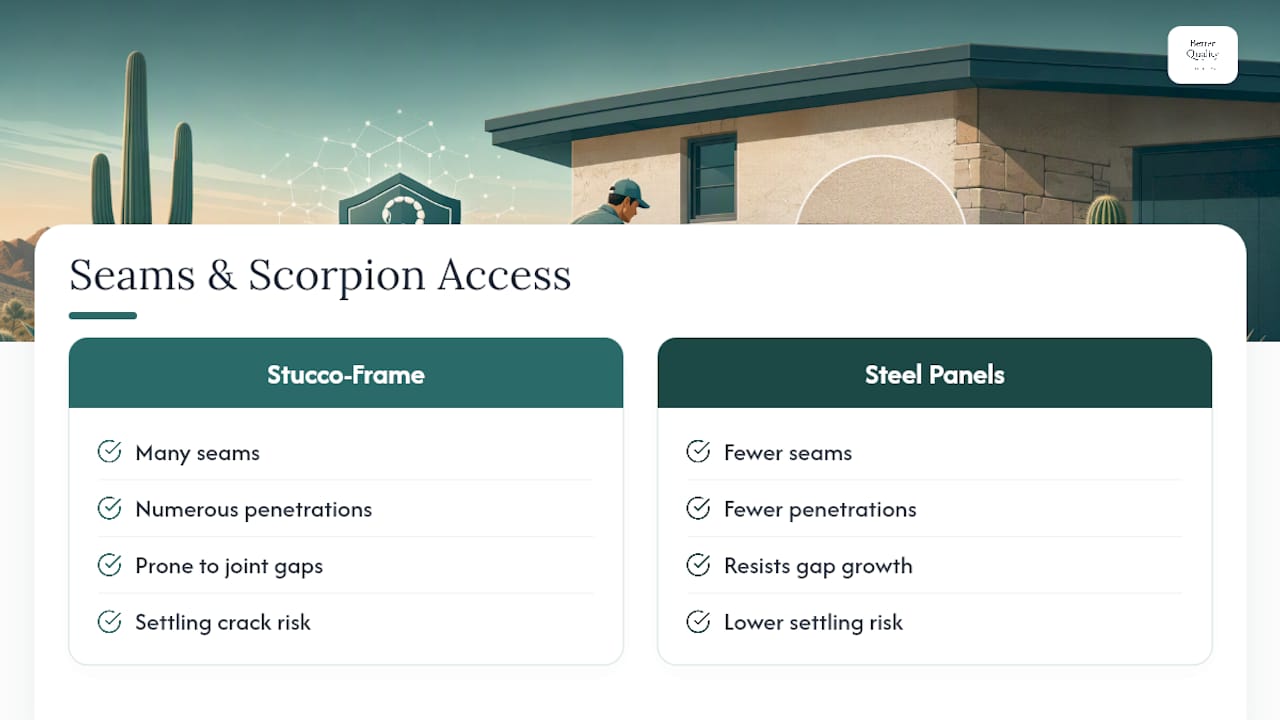
The homes with the fewest scorpion problems tend to share one trait: a tight, continuous exterior envelope with few seams for anything to exploit. Traditional stucco-over-frame construction accumulates joints at every stud bay, utility penetration, and trim detail, and each joint is a potential gap that opens a little more every summer as materials expand and contract.
Some builders use continuous panel construction with steel panels because it has far fewer seams than conventional framing, which means fewer places for scorpions, and for the kind of gaps that let dust and heat through too, to develop over time. Choosing exterior materials and detailing at the design stage, rather than retrofitting them later, is almost always the more durable path. If your current home already has extensive settling cracks, deteriorating stucco, or a maze of additions and remodels, a full retrofit can get expensive fast, and at that point building new with a tighter envelope is often the better long-term investment. For homeowners weighing that decision, our guide to choosing exterior materials breaks down which details matter most for a durable, scorpion-resistant exterior.
What’s a Realistic Outcome When You Scorpion-Proof a Home?
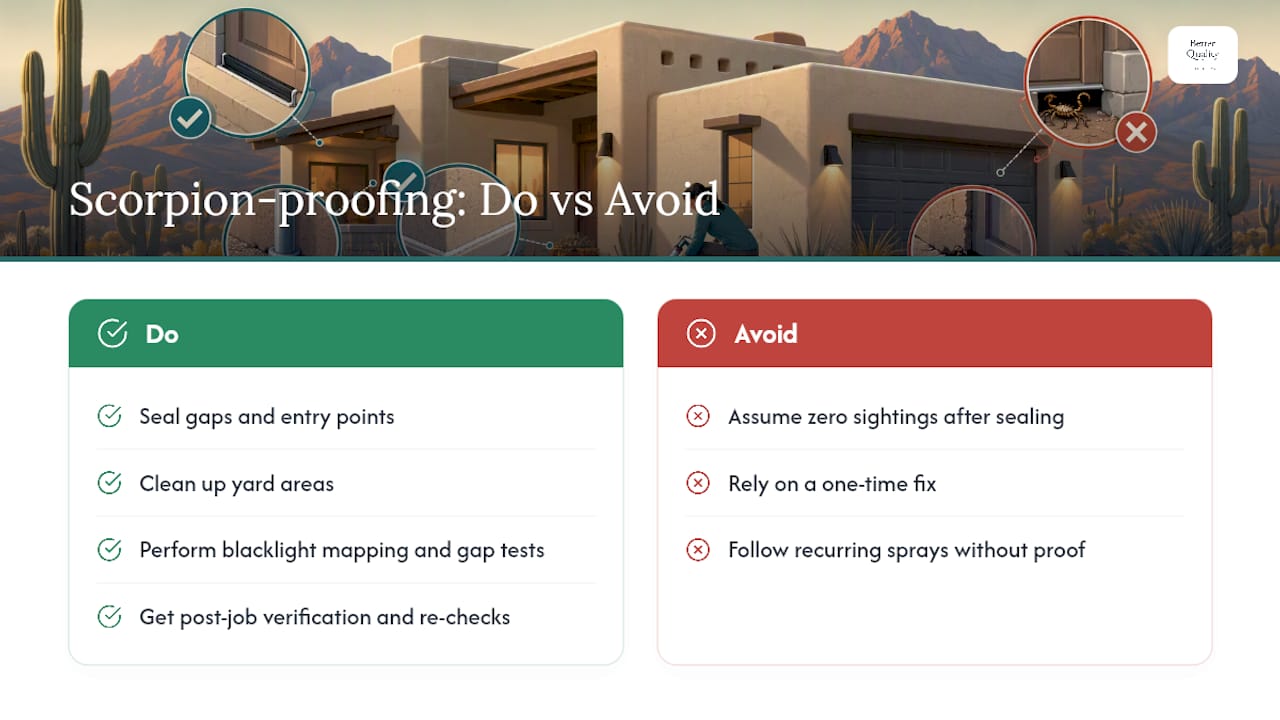
Sealing dramatically cuts indoor sightings, but treat that as harm reduction, not a guarantee of zero. Complete elimination usually takes sealing plus yard cleanup plus ongoing checks working together, not a one-time fix.
If young children or anyone especially vulnerable to a sting lives in the home, prioritize the highest-traffic entry points first and get a post-job verification, not just a treatment date on a calendar. Evidence-based decisions, blacklight mapping, gap testing, documented re-checks, beat a recurring spray schedule with no way to confirm it’s working.
— David Kobierski
Building a Tighter Envelope With Better Quality Builders
If you’re weighing a full retrofit against building new, the math often favors a tighter envelope from the start rather than chasing gaps in an aging stucco home year after year. Better Quality Builders constructs custom Arizona homes with AirLight steel-insulated panels, which create a continuous exterior shell with far fewer seams than traditional stud-and-stucco framing, fewer joints for scorpions, dust, and heat to exploit over decades instead of years.

This approach fits three kinds of homeowners best: those building new who want scorpion-resistant details designed in from day one, those facing a retrofit bill steep enough that a rebuild starts to pencil out, and anyone who wants a home built once and sealed right rather than resealed every spring. Combined construction and land financing with a 10% down payment option makes that path accessible even if you haven’t purchased a lot yet. Start by browsing current buildable lots and floor plans to see what a tight, steel-panel envelope could look like on your land.
Sources
- Sealing for Scorpions in Arizona: A Homeowner Guide
- Scorpion Deterrent for Arizona Homes | Firehouse Pest Control
- Scorpion Sealing in Phoenix, AZ — Russell Pest Control Phoenix, AZ