
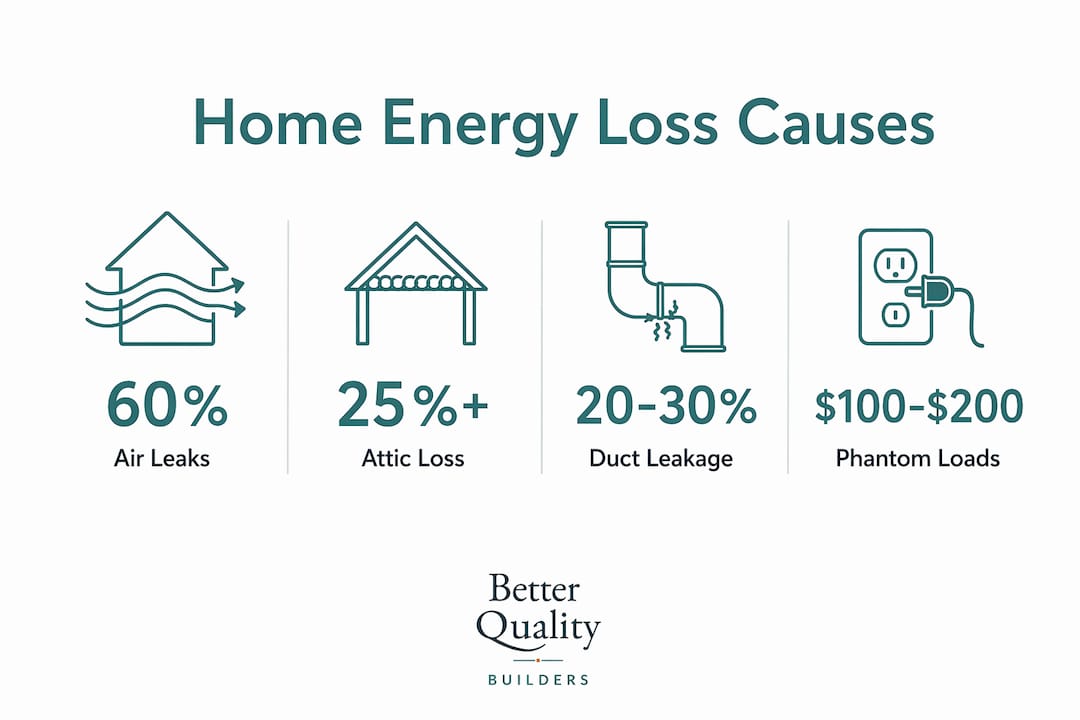
Home energy loss is defined as the uncontrolled escape of heated or cooled air from your home’s building envelope through leaks, poor insulation, and inefficient systems. Air infiltration alone accounts for nearly 60% of heating and cooling loss in most homes. Poor attic insulation contributes over 25% of heat loss during cold months. HVAC systems consume 40–55% of all household electricity. Together, these three factors explain why your energy bills stay high no matter how carefully you manage the thermostat. Understanding what causes home energy loss is the first step toward fixing it.
What causes home energy loss in most homes?
Air infiltration through the building envelope is the single largest cause of residential energy loss. The building envelope includes every surface that separates conditioned indoor air from the outside: walls, the roof, the foundation, windows, and doors. When that envelope has gaps, your heating and cooling system works overtime to replace the air that escapes.
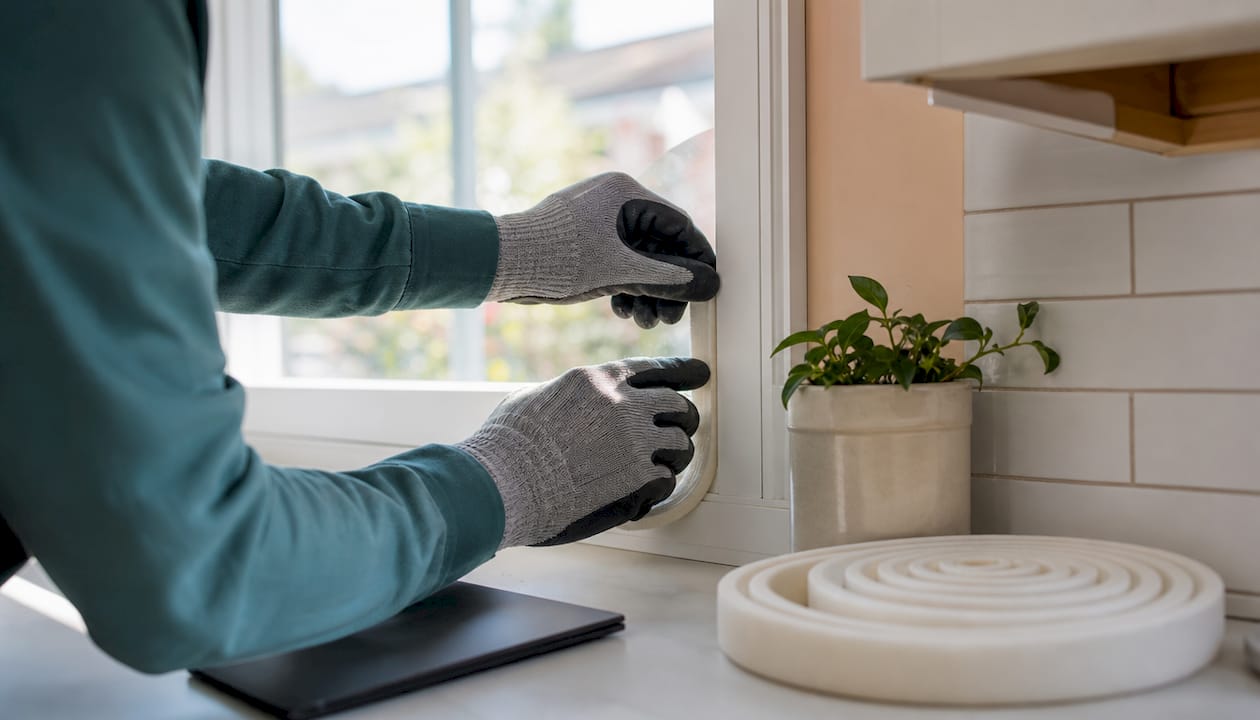
Air sealing improvements can reduce household electricity use by 15–25%, which translates to $300–$540 in annual savings on an average $180 monthly bill. That figure puts air leakage ahead of appliance upgrades and window replacements as a return on investment. Sealing leaks costs far less than replacing windows, yet delivers faster results.
The industry term for this problem is “thermal envelope performance.” Energy auditors measure it using a blower door test, which depressurizes the home and reveals exactly where air escapes. Homeowners who skip this test often spend money on the wrong fixes first.
How do air leaks drive energy waste in houses?
Air leaks occur wherever the building envelope has a gap, crack, or penetration. The most common locations are wall-to-floor joints, window and door frames, attic hatches, rim joists, and cantilevered floors. Less obvious sources include recessed light fixtures, electrical outlets on exterior walls, and plumbing penetrations through the ceiling.
The stack effect explains why leaks matter so much. Warm air rises and escapes through gaps at the top of the house, pulling cold outside air in through gaps at the bottom. This cycle runs constantly in winter, forcing your furnace to run longer than it should.
Attic hatches, recessed lights, rim joists, and cantilevered floors are the biggest hidden air leakage points in most homes. Sealing these areas over a weekend produces faster energy savings than expensive window replacements. That surprises most homeowners, who assume windows are the main culprit.
You can detect leaks yourself with a stick of incense held near suspected gaps on a windy day. A thermal imaging camera gives a more complete picture and is available for rent at most tool rental shops.
- Attic hatch: Often unsealed and uninsulated, it acts like an open window to the attic.
- Recessed lights: Older can lights have large gaps where they penetrate the ceiling.
- Rim joists: The framing at the top of your foundation wall is a major cold-air entry point.
- Electrical outlets: Exterior wall outlets let cold air flow directly into the living space.
- Cantilevered floors: Floors that extend beyond the foundation below are exposed to outside air on three sides.
Pro Tip: Seal attic bypasses before adding insulation. Insulation slows heat transfer but does not stop airflow. Foam and caulk first, then insulate on top.
Does insulation quality really affect energy loss that much?
Insulation slows heat transfer through three mechanisms: conduction, convection, and radiation. Conduction moves heat through solid materials. Convection moves it through air currents. Radiation transfers it as infrared energy across open spaces. Good insulation addresses all three, but gaps and compression reduce its effectiveness significantly.
More than 25% of heat loss in homes happens through inadequately insulated attics, driven by the stack effect. Homes built before 2005 are especially likely to have insufficient attic insulation by current standards. Upgrading attic insulation delivers one of the highest returns on investment of any home improvement.
Thermal bridging compounds the problem in walls. Thermal bridging occurs when conductive materials like metal studs or window frames bypass the insulation layer entirely, creating cold spots and reducing the wall’s effective R-value. In steel-framed construction, thermal bridging can cut wall insulation performance by a significant margin if the design does not account for it.
| Area | Heat loss contribution | Priority |
|---|---|---|
| Attic | Over 25% | High |
| Walls | Moderate, worsened by thermal bridging | Medium |
| Floors and foundation | Lower but meaningful | Medium |
| Windows and doors | Significant in older homes | High |
Pro Tip: Check your attic insulation depth. Most older homes need R-38 to R-60 in the attic. If you can see the floor joists, you need more insulation.
How do HVAC systems and ductwork increase energy loss?
HVAC systems are the largest electricity consumers in any home, accounting for 40–55% of usage, with water heaters adding another 15–25%. A system that runs inefficiently multiplies every other energy loss problem in the house. Four specific issues drive most HVAC-related waste.
- Leaky ductwork. Duct leakage wastes 20–30% of conditioned air by releasing it into attics, crawl spaces, and wall cavities before it reaches living areas. The system runs longer to compensate, burning more electricity for the same result.
- Oversized systems. Oversized HVAC units short-cycle frequently, meaning they reach the set temperature too quickly and shut off before removing enough humidity. Short-cycling increases wear and leaves the home feeling clammy even at the correct temperature.
- Dirty filters. A clogged filter restricts airflow, forcing the blower motor to work harder. Replacing filters every 60–90 days is one of the lowest-cost maintenance steps with a direct impact on efficiency.
- Incorrect thermostat settings. Leaving the thermostat at a fixed temperature around the clock wastes energy during hours when no one is home. A programmable or smart thermostat corrects this automatically.
Duct sealing is underappreciated as a fix. Most homeowners never inspect their ductwork, yet sealing ducts improves comfort and reduces costs more than many visible upgrades. Mastic sealant or metal-backed tape applied at joints and connections stops conditioned air from escaping into unconditioned spaces.
What role do windows, doors, and structural elements play?
Windows and doors are the most visible sources of energy loss, but they are rarely the largest. Single-pane windows transfer heat rapidly because glass conducts heat far better than insulated wall assemblies. Double-pane windows with a low-emissivity coating reduce that transfer significantly. The gap between the panes, filled with argon or krypton gas, adds another layer of resistance.
Door frames and window seals fail over time. Weatherstripping compresses and cracks, leaving gaps that let conditioned air escape year-round. Caulking around window and door frames shrinks and separates, especially in climates with large temperature swings.
- Weatherstripping: Check the seal by closing a door on a dollar bill. If it slides out easily, the seal needs replacement.
- Caulking: Inspect exterior caulk lines each spring. Gaps wider than a credit card need immediate attention.
- Garage doors: Uninsulated garage doors and gaps at the bottom seal are a major source of energy loss in attached garages.
- Foundation cracks: Small cracks in the foundation let cold air into the basement and crawl space, raising heating loads throughout the house.
Energy-efficient homes appraise higher precisely because buyers recognize the long-term cost of poor windows, doors, and envelope performance. Fixing these elements pays off both in monthly savings and in resale value.
Hidden causes of energy loss homeowners often miss
Phantom loads are the most overlooked source of energy waste in modern homes. Devices in standby mode add $100–$200 to annual electricity costs. Televisions, gaming consoles, cable boxes, and phone chargers all draw power continuously even when you are not using them. Smart power strips cut this waste by shutting off power to devices that are not actively in use.
Thermal bridging in walls creates cold spots that homeowners often mistake for drafts. Thermal bridging through metal studs and window frames reduces insulation effectiveness and can cause condensation and mold if surface temperatures drop below the dew point. Continuous exterior insulation boards break the thermal bridge by covering the studs entirely.
- Attic hatches: An uninsulated attic hatch loses as much heat as a small window left open all winter.
- Recessed lights: Older fixtures create direct pathways between the living space and the attic.
- Rim joists: These are often the coldest surfaces in a basement and the easiest to fix with cut-and-cobble rigid foam.
- Phantom loads: A plug-in energy meter identifies which devices waste the most power on standby.
Pro Tip: Plug-in energy meters like Kill A Watt let you measure exactly how much power each device draws on standby. Identify your three biggest phantom loads and put them on smart strips first.
Building a net zero energy home addresses all of these hidden losses from the start, because the design accounts for air sealing, thermal bridging, and phantom load management before construction begins.
Key Takeaways
Air leaks, poor insulation, inefficient HVAC systems, and phantom loads are the four primary causes of home energy loss, and each one has a clear, cost-effective fix.
| Point | Details |
|---|---|
| Air leaks dominate energy loss | Air infiltration causes nearly 60% of heating and cooling loss; sealing leaks first delivers the fastest return. |
| Attic insulation is critical | Over 25% of heat loss occurs through the attic; upgrading insulation in older homes is a high-priority fix. |
| HVAC and ducts waste the most electricity | HVAC uses 40–55% of home electricity; leaky ducts waste 20–30% of conditioned air before it reaches living areas. |
| Thermal bridging reduces wall performance | Metal studs and window frames bypass insulation, creating cold spots and potential moisture problems. |
| Phantom loads add up quietly | Standby electronics cost $100–$200 per year; smart power strips eliminate this waste with no lifestyle change. |
Why I tell every homeowner to start in the attic
Most homeowners I work with assume their windows are the main problem. They want new windows. Windows are visible, they feel cold in winter, and replacing them feels like a meaningful upgrade. The data tells a different story.
Attic sealing and insulation consistently outperform window replacements in energy savings per dollar spent. The attic is where the stack effect does its worst damage, and it is also where the fixes are most straightforward. Foam, caulk, and insulation batts cost a fraction of a window replacement project.
The second surprise is always duct leakage. Homeowners rarely think about their ductwork until the system fails. But older homes lose energy disproportionately through attic bypasses and leaky ducts, while newer homes tend to lose more through thermostat habits and phantom loads. Knowing your home’s age and construction type tells you where to look first.
My honest recommendation: get a professional energy audit before spending money on any upgrade. A blower door test and duct pressurization test cost a few hundred dollars and tell you exactly where your home loses energy. That knowledge is worth far more than guessing. The green building certification process often includes this audit as a baseline, which is another reason to consider certified construction when building new.
— David Kobierski
Building a home that does not lose energy from day one
Better Quality Builders constructs homes with AirLight steel panels, the same structural material used in hurricane and earthquake zones worldwide. These panels create an airtight, continuously insulated building envelope that eliminates the air leaks, thermal bridging, and duct losses that plague conventional wood-frame construction.

The result is up to 60% lower energy bills compared to standard construction. That is not a thermostat adjustment or a weatherstripping fix. It is a structural advantage built into every wall, roof, and floor panel. Homeowners who want to stop patching problems and start with a home that performs correctly from the first day can learn more about AirLight panel homes or explore custom home builds designed around energy performance from the ground up.
FAQ
What is the single biggest cause of home energy loss?
Air infiltration through gaps in the building envelope causes nearly 60% of heating and cooling loss. Sealing these leaks delivers the highest return on investment of any energy improvement.
Why is my home losing energy even with new insulation?
Insulation slows heat transfer but does not stop airflow. If air leaks are not sealed first, new insulation will underperform. Attic bypasses, rim joists, and recessed lights are the most common unsealed gaps.
How much energy does leaky ductwork waste?
Duct leakage wastes 20–30% of conditioned air by releasing it into attics and crawl spaces before it reaches living areas. Sealing ducts with mastic sealant or metal-backed tape corrects this directly.
What are phantom loads and how much do they cost?
Phantom loads are the electricity devices draw while in standby mode. They add $100–$200 to annual electricity bills. Smart power strips eliminate standby draw without requiring any change in daily habits.
Does thermal bridging really matter in a well-insulated home?
Thermal bridging through metal studs and window frames bypasses insulation entirely, reducing the wall’s effective R-value and creating cold spots that can lead to condensation and mold. Continuous exterior insulation boards are the most reliable fix.